Search
Graphic Design BA (Hons)
Study level: Undergraduate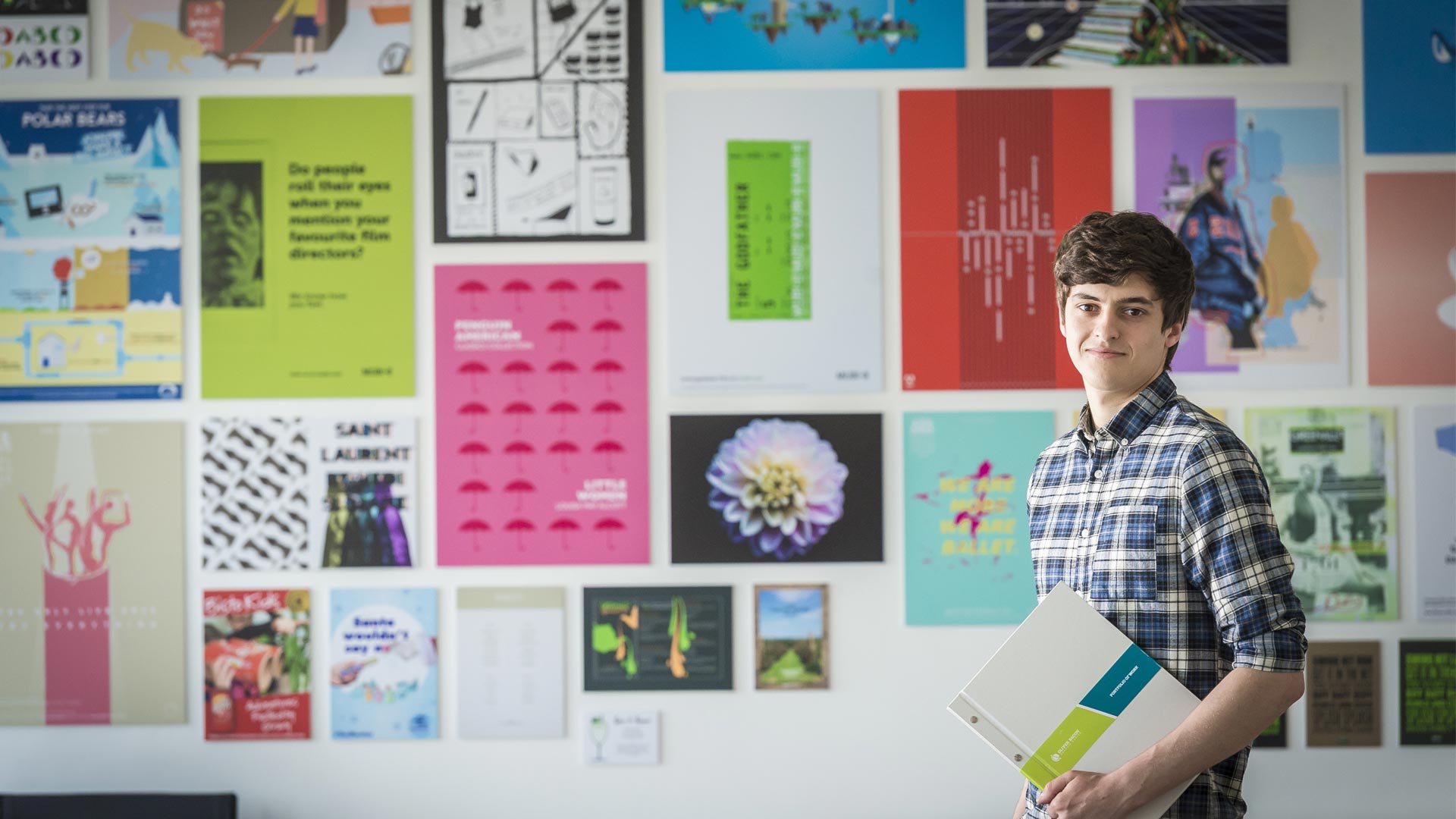
The future graphic designer needs to be visionary, informed, responsible and technically adaptable. This course is designed to support your development in these areas through critical thinking, practical skills and creative exploration.
Course features
Year of entry
Location
Coventry University (Coventry)
Study mode
Full-time
Sandwich
Duration
3 years full-time
4 years sandwich
Course code
W211
Start date
September 2027
November 2027
January 2028
March 2028
May 2028
July 2028
Course overview
Designed for ambitious creatives, this course helps you develop a diverse set of graphic design skills and build a distinctive portfolio. You’ll have the opportunity to grow your confidence and professional understanding to pursue roles in established studios or explore your own design ventures.
- Comprehensive design foundation: gain practical experience with essential design principles across multiple areas, including branding, advertising, information design, editorial and web design, typography, motion graphics and UI/UX.
- Creative ownership: take charge of your learning by selecting projects that align with your passions, honing your skills and shaping your own perspective on design.
- Portfolio development: build a standout portfolio that showcases your skills and creativity, helping you clearly define and pursue your individual career goals.

Rated Gold Overall
Teaching Excellence Framework (TEF) 2023
5 QS Stars for Teaching and Facilities
QS Stars University Ratings
4th Student City in England (Coventry)
QS Best Student Cities Index 2027Why you should study this course
Graphic designers use visual communication to shape how people see and understand the world. Graphic design isn’t just about making things look good – it’s about communicating ideas, solving problems and connecting with people. This course will help you develop your creative voice while building the skills and confidence to work in today’s fast-changing design industry.
- Explore and experiment
You’ll be encouraged to explore ideas through experimentation with both digital and hands-on design methods. The course creates a supportive environment where you can test ideas, take creative risks and discover new ways of working while developing your own style as a designer. - Develop industry awareness
You’ll gain insight into the creative industries through project-based learning, guest speakers, studio visits and opportunities to develop your portfolio. These experiences help you understand how graphic design works in professional environments and prepare you for future careers or further study. - Build strong design skills
You’ll develop practical design skills using industry-standard tools and techniques. Through practice, feedback and iteration, you’ll learn how to craft thoughtful, well-designed outcomes across digital and physical media. - Think critically about design
Graphic designers need to understand the world around them. You’ll learn how to research ideas, ask questions and analyse information so you can make informed design decisions and respond to real-world challenges. - Communicate through storytelling
Design has the power to inform, inspire and influence people. You’ll learn how to use visual storytelling and design thinking to communicate ideas clearly and create meaningful connections with audiences.
29th
for Graphic Design
Guardian University Guide 2026
About the School of Arts and Creative Industries
- Our hands-on, practitioner-led approach is rooted in project-based learning. This creates opportunities for cross-disciplinary working and engagement with external collaborators. Where appropriate, you may work with peers from other courses, bringing specialist skills to interdisciplinary projects in ways that reflect the collaborative nature of creative studios and agencies in the creative industries.
- Our learning and teaching mirror the needs of the creative industries, so our graduates have the opportunity to develop the skills and attributes needed to become industry specialists, leaders and innovators.
- Our studio culture seeks to ensure you are socially responsible in our creative community and develop critical thinking in research and making processes.
- Our global initiatives aim to give you skills to become a collaborative communicator and make you culturally competent.
- Our industry links typically enable us to host an exciting programme of guest speakers2 covering topics such as:
— type design: previous speaker Jonathan Barnbrook
— design culture: previous speaker Craig Oldham
— branding: previous speaker SEA Design London. - Past students have worked on projects such as wayfinding design for the Coventry Biennial 2025 and branding for Innovatoire CIC.
What can you do with an Art and Design degree?
An art and design degree can open the door to a range of careers across the creative industries. Wherever your interests lie, university is a chance to build your creative practice, develop a portfolio that reflects your strengths and discover where your ideas could take you.
Learn more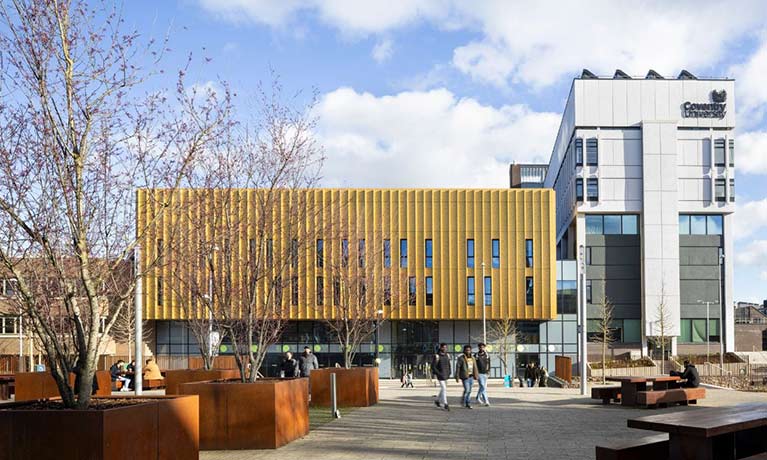
British Art Show 10 at Coventry University
See work by leading contemporary artists, including 2024 Turner Prize winner Jasleen Kaur, as British Art Show 10 comes to Coventry University.
Dates: 2 October 2026 - 10 January 2027
Discover British Art Show 10What you'll study
We regularly review our course content to keep it relevant and current for our students. Consequently, we may update modules to reflect the latest industry standards.
How you'll learn
Teaching and learning methods may include:
- lectures
- seminars
- tutorials
- presentations
- group projects
- workshops
- practical studio sessions
- practical workshop sessions.
Teaching contact hours
As a full-time undergraduate student, you will study modules totalling 120 credits each academic year. A typical 30-credit module requires 300 hours of study. Study hours are made up of teaching contact hours and guided and independent study.
Teaching hours
Teaching hours may vary, depending on where you are in your studies, but on average, you will have between 12 and 15 teaching and learning hours each week. You will also have the option to attend additional sessions, including time with a progress coach or to meet with staff for advice and feedback. As you progress through your studies, teaching hours may reduce.
Guided and independent study
Throughout your studies, you will be expected to spend time in guided and independent study to make up the required study hours per module. You will be digging deeper into topics, reviewing what you’ve learnt and completing assignments. This can be completed around your personal commitments. As you progress to the end of your studies, you’ll spend more time on independent learning.
Online learning
As an innovative university, we use different teaching methods, including online tools and emerging technologies. So, some of your teaching hours and assessments may be delivered online.
Assessment
This course is assessed using methods that vary by module. These approaches are intended to prepare you for the complex and evolving contexts of professional practice. Assessment methods may include:
- artefacts
- practical coursework
- digital coursework
- individual work
- group work
- live/video presentations
- video/academic essays.
The Coventry University assessment strategy aims to ensure that our courses are fairly assessed and allows us to monitor student progression towards achieving the intended learning outcomes.
Community is what makes this course special. Whether we’re preparing students to join professional networks, going above and beyond to nurture creative mindsets in the studio or forging cross-disciplinary relationships, community is at the heart of what we do. We don’t just simply say so, our students have said so by voting us Course of the Year at the Student Voice Awards 2024.
Paula Murarescu, Course Director, 2024
Entry requirements
Typical entry requirements:
Fees and funding
| Student | Full-time | Part-time |
|---|---|---|
| UK, Ireland*, Channel Islands or Isle of Man | 2027/28 fees TBC 2026/27 fees: £9,790 per year |
Not available |
| EU | 2027/28 fees TBC 2026/27 fees: £9,790 per year with EU Support Bursary** 2027/28 fees TBC 2026/27 fees: £20,800 per year without EU Support Bursary** |
Not available |
| International | 2027/28 fees TBC 2026/27 fees: £20,800 per year |
Not available |
If you choose to study this course with a professional placement2 or study abroad year, you will need to pay a tuition fee3 to cover your academic support throughout your placement year. Students commencing their professional placement in the academic year 2028/29 will pay £1,575 if they are paying UK fees, or £1,900 if they are paying international fees.
For advice and guidance on tuition fees and student loans visit our Undergraduate Finance page and see The University’s Tuition Fee and Refund Terms and Conditions.
The University will charge the tuition fees that are stated in the table above for the first Academic Year of study. The University will review tuition fees each year. For UK (home) students, if Parliament permits an increase in tuition fees, the university may increase fees for each subsequent year of study in line with any such changes. Note that any increase is expected to be in line with the Retail Price Index (RPI), a UK measure of inflation that tracks changes in the cost of living.
If you choose to study this course with a professional placement or study abroad year, the University will charge the tuition fees stated above for those on a placement during Academic Year 2028/29. The University will review professional placement tuition fees each year. For UK (home) students, the University may increase fees for each subsequent year of study, but such that it will be no more than 5% above RPI.
For international students, we may increase fees each year, but such increases will be no more than 5% above inflation. If you defer your course start date or have to extend your studies beyond the normal duration of the course (e.g. to repeat a year or resit examinations) you may be charged the tuition fees in force at the time you take that additional period of study, and/or in line with any legislative changes that apply at that time.
We offer a range of International scholarships to students all over the world. For more information, visit our International Scholarships page.
Tuition fees cover the cost of your teaching, assessments, facilities and support services. There may be additional costs not covered by this fee such as accommodation and living costs, recommended reading books, stationery, printing and re-assessments should you need them. Find out what's included in your tuition costs.
The following are additional costs not included in the tuition fees:
- Any optional overseas field trips or visits: £400+ per trip.
- Any costs associated with securing, attending or completing a placement (whether in the UK or abroad) which may include costs of travel, accommodation, equipment or uniform required for the placement and any visa-related costs.
*Irish student fees
The rights of Irish residents to study in the UK are preserved under the Common Travel Area arrangement. If you are an Irish student and meet the residency criteria, you can study in England, pay the same level of tuition fees as English students and utilise the Tuition Fee Loan.
**EU Support Bursary
Following the UK's exit from the European Union, we are offering financial support to all eligible EU students who wish to study an undergraduate or a postgraduate degree with us full-time. This bursary will be used to offset the cost of your tuition fees to bring them in line with that of UK students. Students studying a degree with a foundation year with us are not eligible for the bursary.
How do you know if you need to pay UK or international tuition fees?
Facilities
The Delia Derbyshire building provides you with a range of facilities you can use to enhance your skills through practical applications. You will have the opportunity to work both independently and collaboratively while using a hyper studio designed for cross-disciplinary projects; immersive studios with cutting-edge virtual reality and mixed-reality technologies4.
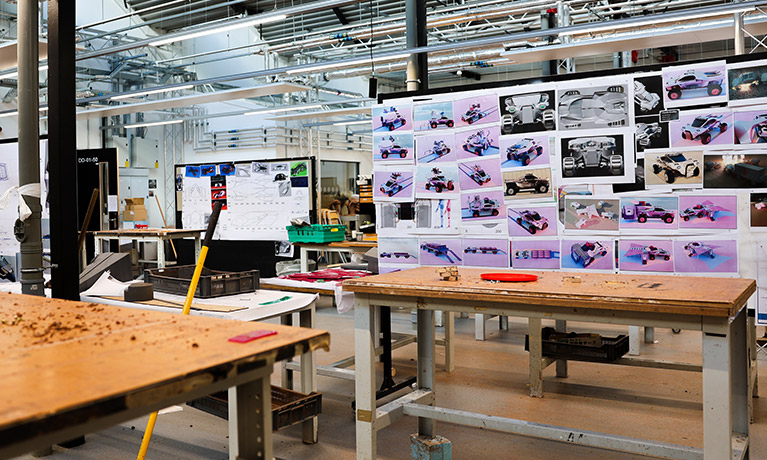
Our current digital and industrial workshops are of industry-standard quality and house 3D rapid prototyping, laser cutters and milling machines. These facilities are available to all students on our courses at no extra cost. These are subject to availability.
We also have a ceramic and small-metal-working workshop, a large digital print bureau, and clay modelling studios where you can realise your creative artistic and design solutions.
The fashion workshops have digital embroidery machines, digital printers and a printmaking workshop that includes etching, screen printing and a rare, one of only three in existence in the UK, letterpress studio.
In our Mac and PC CAD labs, you can become digitally literate in presentation and design skills using the Adobe suite of software. You can also learn other software packages including Alias, Toom Boom, Revit, and Maya that maybe relevant to your studies.
Take a virtual tour
You’ll use facilities through timetabled teaching, practical activities and relevant independent study. Access may vary by module, activity, capacity, supervision or safety requirements. Access may change or be limited where the University needs to follow public authority guidance, decisions or orders.
Careers and opportunities
The structure of the course, the experiences and support made available to you are all designed with a view to developing the skills, competencies and imaginative thinking necessary for a creative career in a demanding, competitive and rapidly changing work environment.
Whether you choose to enter employment in a design agency or studio upon graduation, or have dreams of becoming self-employed, the course aims to produce graduates that are flexible, responsive and resilient. Whatever your career trajectory, we work together to make you industry ready.
The university's careers team is on hand to offer tailored career and enterprise support if you wish to gain employment or take advantage of professional practice opportunities within course specific industries. It aims to provide specialist careers information, advice and guidance to all our students from their first year through to final year and beyond graduation, helping them receive the opportunities to reach their desired career outcome.
Our Graphic Design students have previously won reputable design competitions such as D&AD and the Penguin Cover Design Award, and they received many YCN commendations. Our graduates have gone on to create award winning advertising campaigns for Silver Spoon and moving imagine work for The Mill, user interfaces for IBM, marketing work for premier UK football teams, and campaign touchpoints for Vintage Books’ release of Kamala Harris’ New York Times bestselling book 'The Truths We Hold'.
Where our graduates work
- Arsenal
- BOND Agency
- Exient
- FutureDeluxe
- Havas Lynx Group
- IBM
- Kaizen
- New Genre
- Rebel Creatives
- Scholastic
- Simon & Schuster
- Sky TV
- Springetts
- Tata Motors
- The Football Association
- THG
- Tottenham Hotspur Football Club
- Whiteroom Agency
Our graduates have also produced freelance work for organisations including MTV, Natwest, Xbox, Nike, HEAD, BBC, Channel 4, Sports Relief and Children in Need.
The graduate destinations listed above illustrate potential career paths. You may need to gain additional qualifications or practical experience, pass professional examinations, complete training, cover associated costs and meet specific visa or immigration requirements to secure employment in these fields.
Further study
- Advertising and Brand Management MA
- Design Management MA
- Digital Marketing Management MSc
- Graphic Design MA
- Illustration and Animation MA
- International Marketing Management MSc
You may be entitled to an alumni discount on your fees if you decide to extend your time with us by progressing from undergraduate to postgraduate study.

Discover Phoenix+
Phoenix+ brings you together with other students to learn, experience and develop essential knowledge and skills. Whatever destination you choose, it's about preparing you for life after university.
Learn more about Phoenix+How to apply
UK students
International students
Disclaimers
You may also like
Coventry University (Coventry)
Illustration BA (Hons)
Coventry University (Coventry)

Fine Art BA (Hons)
Coventry University (Coventry)