Search
Engineering Project Management MSc
Study level: Postgraduate
Learn how to start, plan, monitor, control and complete engineering projects. Master project management tools and gain valuable insights into team dynamics including leadership, communication and teamwork.
Course features
Year of entry
Location
Coventry University (Coventry)
Study mode
Full-time
With Professional Placement
Duration
1 year full-time
Up to 2 years full-time with professional placement
Course code
EEST006
Start date
September 2026
November 2026
January 2027
March 2027
May 2027
July 2027
Course overview
Explore a strategic, high-level approach to engineering project management, with industry-informed modules. Designed for engineering graduates and professionals seeking to enhance their project management skills, this programme aims to support your development for leadership roles in engineering project management and allied fields.
Course content includes the following:
-
Leadership and decision-making: focuses on leadership skills, strategic planning, and risk management with practical applications.
-
Innovation and engineering design: emphasises modern design methodologies, prototyping, and critical thinking in engineering solutions.
-
Project management tools and methods: covers key project management frameworks like PRINCE2 and Agile, with certification opportunities.2
-
Project planning and execution: integrates agile and traditional methods to design, de-risk, and successfully manage engineering projects.

5 QS Stars for Teaching and Facilities
QS Stars University Ratings
Ranked 1st for Engagement
Postgraduate Taught Experience Survey (PTES) 2026
Ranked 5th for Overall Satisfaction in PTES
Postgraduate Taught Experience Survey (PTES) 2026Why you should study this course
Prepare to lead organisational change and navigate the technical complexities of modern engineering. We take a critical, high-level view of the sector, equipping you with the expertise to deliver successful projects through the following:
- Industry-appropriate curriculum: course content covers a blend of project management expertise so you can learn to handle complex projects in various advanced engineering fields
- Global perspective: take part in training on managing international projects and leading diverse teams, both of which are crucial in the global engineering industry
- Hands-on experience: gain practical experience through industry-inspired case studies, problem statements and real-world project exemplars, allowing you to apply theoretical knowledge to real circumstances
- Technological edge: get contextual exposure to modern technology and engineering domain concepts, which prepares you for project handling in various engineering fields
- Career advancement: course content prepares you for senior project management roles, teaching you skills highly sought-after in the engineering sector.
- Gain practical experience and boost your CV with an additional professional placement2. See the modules for more details.
Ranked 3rd
for overall satisfaction in Engineering and Technology
Postgraduate Taught Experience Survey (PTES) 2026 (ranked out of 44 HEIs)
Accreditation and professional recognition

Chartered Management Institute (CMI)
The module Leadership and Commercial Management meets the criteria set by the Chartered Management Institute (CMI) for the CMI Level 7 Certificate in Strategic Management and Leadership Practice. Students who successfully pass this module will be eligible to gain the award as an additional qualification at no additional cost.
What you'll study
This course integrates technical project management with the leadership skills required to manage multidisciplinary teams. Explore how project teams operate in practice and master industry-standard software to plan and execute complex engineering projects.
We regularly review our course content, to make it relevant and current for the benefit of our students. For these reasons, course modules may be updated.
How you'll learn
Teaching and learning methods may include:
- lectures: gain a strong foundation in project management theory, tools and industry standards, helping you understand how complex engineering projects are planned, delivered and controlled.
- seminars: explore real project challenges in more depth, discuss ideas with others and learn how theory is applied to real engineering and business contexts.
- tutorials: smaller, focused sessions where you can ask questions, get personalised feedback and strengthen your understanding of key concepts and assessments.
- presentations: build confidence in explaining ideas clearly and professionally, a vital skill for communicating with stakeholders, clients and senior management.
- group projects: mirror how engineering projects work in industry, allowing you to develop teamwork, leadership, problem-solving and project coordination skills.
- workshops: hands-on and practical, giving you the chance to apply project management tools, techniques and software in realistic scenarios.
- practical laboratory sessions: understand how projects connect to real engineering systems and environments, strengthening your ability to manage technical risks, resources and delivery constraints.
Teaching contact hours
As a full-time postgraduate student, you will study modules totalling 180 credits each academic year. A typical 30-credit module requires a total of 300 hours of study. Study hours are made up of teaching contact hours, and guided and independent study.
Teaching hours
Teaching hours may vary, depending on where you are in your studies, but on average you will have between 8 and 12 teaching and learning hours each week. You will also have the opportunity to attend optional sessions including time with a Success Coach or to meet with staff for advice and feedback.
Guided and independent study
Throughout your studies, you will be expected to spend time in guided and independent study to make up the required study hours per module. You will be digging deeper into topics, reviewing what you’ve learnt and completing assignments. This can be completed around your personal commitments. As you progress to the end of your studies, you’ll spend more time on independent learning.
Online learning
As an innovative university, we use different teaching methods, including online tools and emerging technologies. So, some of your teaching hours and assessments may be delivered online.
Assessment
This course will be assessed using a variety of methods which could vary depending on the module. Assessment methods may include:
- reports
- tests
- essays
- exams
- practical coursework
- assignments
- viva
- presentations.
The Coventry University assessment strategy aims to ensure that our courses are fairly assessed and allows us to monitor student progression towards achieving the intended learning outcomes.

Focus with block learning
Most courses use block learning. You study one module for six weeks, then move on to the next. It's a simple, structured way to stay organised and build confidence in your studies.
Explore block learningEntry requirements
Typical entry requirements:
Fees and funding
| Student | Full-time | Part-time |
|---|---|---|
| UK, Ireland*, Channel Islands or Isle of Man | £11,700 £1,575 professional placement fee (if placement secured) |
Not available |
| EU | £11,700 per year with EU Support Bursary** £1,575 professional placement fee (if placement secured) per year with EU Support Bursary** £19,500 per year without EU Support Bursary** £1,900 professional placement fee (if placement secured) per year without EU Support Bursary** |
Not available |
| International | £19,500 £1,900 professional placement fee (if placement secured) |
Not available |
For advice and guidance on tuition fees3 and student loans visit our Postgraduate Finance page and see the University's Tuition Fee and Refund Terms and Conditions.
We offer a range of International scholarships to students all over the world. For more information, visit our international scholarships page.
Tuition fees cover the cost of your teaching, assessments, facilities and support services. There may be additional costs not covered by this fee, such as accommodation and living costs, recommended reading books, stationery, printing and re-assessments should you need them.
The following are additional costs not included in the tuition fees:
- Any optional overseas field trips or visits: £400+ per trip.
- Any costs associated with securing, attending or completing a placement (whether in the UK or abroad).
*Irish student fees
The rights of Irish residents to study in the UK are preserved under the Common Travel Area arrangement. If you are an Irish student and meet the residency criteria, you can study in England, pay the same level of tuition fees as English students and utilise the Postgraduate Master's Loan.
**EU Support Bursary
Following the UK's exit from the European Union, we are offering financial support to all eligible EU students who wish to study an undergraduate or a postgraduate degree with us full-time. This bursary will be used to offset the cost of your tuition fees to bring them in line with that of UK students. Students studying a degree with a foundation year with us are not eligible for the bursary.
How do you know if you need to pay UK or international tuition fees?
Facilities
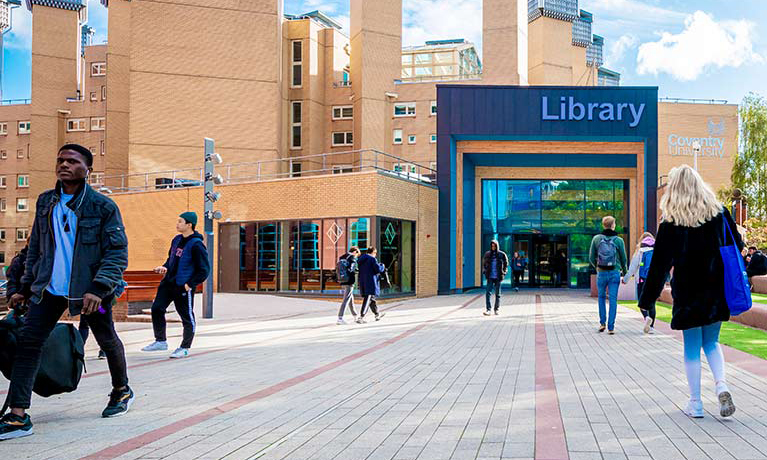
Lanchester Library
The library is usually open 364 days a year. It’s where you can access your course’s specialist Academic Liaison Librarian. It’s also home to specialist teams which can support you with your academic writing and maths and statistics questions.
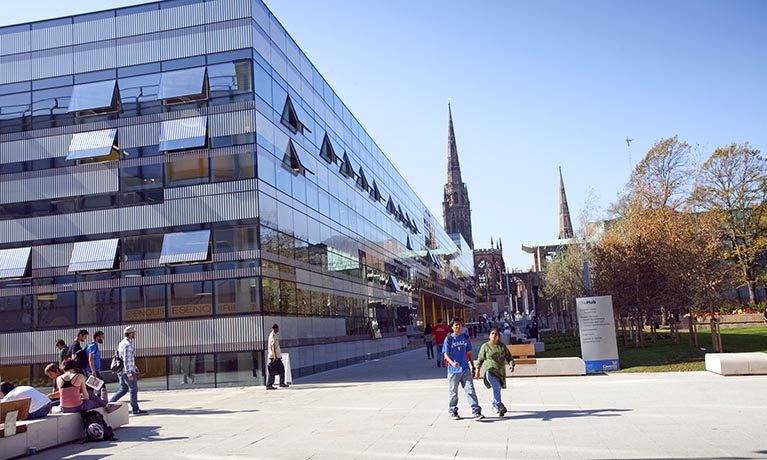
The Hub
The Hub is the centre of student life on campus. Facilities include a food court, convenience store, multi-faith centre, medical centre, hairdresser, coffee shops and the Your SU offices. It has fully licensed function spaces and a bar.

Careers and employability
Get one-on-one guidance lasting up to 18 months from the end of your course. We’ll help you find placements and graduate roles, offer CV and application checks, mentoring, skills workshops, employer events and more.
You’ll use facilities through timetabled teaching, practical activities and relevant independent study. Access may vary by module, activity, capacity, supervision or safety requirements. Access may change or be limited where the University needs to follow public authority guidance, decisions or orders.
Careers and opportunities
Successful graduates may seek positions in the following job roles:
- Engineering project manager / project manager
How this course helps you:
Develop end-to-end project management capability, covering planning, scheduling, risk, cost control and delivery. Group projects, project planning tools and presentation work closely mirror how engineering projects are run in industry, helping you graduate ready to manage real projects and teams. - Project engineer
How this course helps you:
Bridge technical engineering knowledge with project leadership skills. Practical sessions and workshops help you understand how engineering decisions affect time, cost, quality and risk, essential for coordinating technical delivery within complex projects. - Program manager
How this course helps you:
Gain experience managing interconnected projects, understanding dependencies, resources and strategic objectives. The focus on leadership, stakeholder management and decision-making supports progression into programme-level roles. - Operations manager
How this course helps you:
Learn how to improve efficiency, manage workflows and reduce risk across engineering operations. Project-based learning and analytical tools help you understand how projects drive operational performance. - Risk or planning manager
How this course helps you:
Risk assessment, scheduling and control tools are embedded throughout the course. Learn how to identify, analyse and mitigate technical and commercial risks. a key requirement for planning and assurance roles. - Construction or infrastructure project manager
How this course helps you:
Skills in leadership, procurement awareness and project controls are directly transferable to construction and infrastructure sectors.
The graduate destinations listed above illustrate potential career paths. You may need to gain additional qualifications or practical experience, pass professional examinations, complete training, cover associated costs and meet specific visa or immigration requirements to secure employment in these fields.
Where our graduates work
Successful graduates of this course have gone on to work for companies including Balfour Beatty Vinci (BBV) HS2 projects, Bosch and JLR.
How to apply
UK students
International students
Disclaimers
You may also like
Coventry University (Coventry)

Civil Engineering Project Management MSc
Coventry University (Coventry)
Advanced Mechanical Engineering MSc
Coventry University (Coventry)