Search
English Literature and Creative Writing BA (Hons)
Study level: Undergraduate
Explore your creativity in a supportive and inclusive environment where your ideas shape your learning and guide you towards your career goals.
Course features
Year of entry
Location
Coventry University (Coventry)
Study mode
Full-time
Sandwich
Duration
3 years full-time
4 years sandwich
Course code
QW38
Start date
September 2027
November 2027
January 2028
March 2028
May 2028
July 2028
Course overview
This course offers a modern approach to a timeless subject. With us, you’ll be part of a community of writers and literary scholars, potentially shaping the future of literature and entertainment.
- Contemporary curriculum: explore new and emerging writing forms such as video games, graphic novels, manga and social media writing.
- Innovative approach: experiment with exciting forms, bringing your interests and ideas into your creative work. Explore escape room writing, point-and-click branching narratives, vlog-style documentaries and technology-led storytelling.
- Creative freedom: our course gives you the space to share your ideas and bring out your unique writer’s voice. The course is 100 per cent coursework with no exams, and you can choose between traditional writing forms, new media, essays or portfolio-based projects.

Rated Gold Overall
Teaching Excellence Framework (TEF) 2023
5 QS Stars for Teaching and Facilities
QS Stars University Ratings
4th Student City in England (Coventry)
QS Best Student Cities Index 2027Why you should study this course
- Innovative curriculum: whether you’re passionate about poetry, video games, or screenwriting, you’ll join a lively learning community to explore topics such as: how to write interesting and compelling characters; how technology has changed the way we approach writing stories; ways that filmmakers have constructed characters and places; and how writing can be more than words on a page, manifesting in escape room experiences, branching point and click narratives, and tabletop roleplaying.
- Project-based learning: actively engage in real-world, meaningful projects. Work on complex problems, create tangible solutions and develop essential skills such as critical thinking, collaboration and communication. Assessment is designed to reflect the type of work and tasks carried out by English literature and creative writing graduates, such as the production of industry-ready portfolios, video presentations, podcasts and creative work samples that showcase your expertise and real-world readiness.
- Take control: experiment with all kinds of approaches, from physical masks for poetry to live action roleplaying experiences, visual novels and playable video games. Your ideas are valued, and our course will help you push yourself to think and be different.
- Supportive learning environment: find the freedom to share your ideas in a welcoming and supportive environment. This helps you to achieve your very best so you can graduate with key transferable skills that prepare you for work within creative and other industries.
- Exciting opportunities: you'll have the chance to work on optional projects. These could include building escape rooms, engaging in discussions with key figures in the creative industries, or getting involved with issues and events in your local community.2
Joint 18th
for Creative Writing
The Times and Sunday Times Good University Guide 2026
What you'll study
Your first year is shared with students from closely related courses. This approach allows you to learn alongside other disciplines, broaden your perspective and develop strong collaboration skills from the very start.
The common first year also offers flexibility. If you discover a stronger interest in another subject area, you may have the opportunity to transfer to a related course at the end of the year, subject to meeting progression requirements.
Common first year courses:
- English Literature BA (Hons)
- English Literature and Creative Writing BA (Hons)
- Philosophy BA (Hons)
We regularly review our course content to keep it relevant and current for our students. Consequently, we may update modules to reflect the latest industry standards.
How you'll learn
Learn through hands-on activities and real-world examples, using the same approaches professionals use in the field. It’s all about helping you build the skills you need to feel confident and prepared for your future career.
Teaching methods may include:
- seminars and workshops with real-time feedback and support from lecturers and peers
- project work that can include script development, short film and podcasts
- immersive and interactive games that students solve with critical thinking
- visits to local historical and cultural sites2
- experiences and knowledge in more than one discipline with shared creative writing and literature modules
- opportunities for one-to-one tutorials.
These are only a few of the teaching activities you can participate in. We also work with you to identify your interests and passions and find ways to integrate those into classes and assessments.
Teaching contact hours
As a full-time undergraduate student, you will study modules totalling 120 credits each academic year. A typical 30-credit module requires 300 hours of study. Study hours are made up of teaching contact hours and guided and independent study.
Teaching hours
Teaching hours may vary, depending on where you are in your studies, but on average, you will have between 12 and 15 teaching and learning hours each week. You will also have the option to attend additional sessions, including time with a progress coach or to meet with staff for advice and feedback. As you progress through your studies, teaching hours may reduce.
Guided and independent study
Throughout your studies, you will be expected to spend time in guided and independent study to make up the required study hours per module. You will be digging deeper into topics, reviewing what you’ve learnt and completing assignments. This can be completed around your personal commitments. As you progress to the end of your studies, you’ll spend more time on independent learning.
Online learning
As an innovative university, we use different teaching methods, including online tools and emerging technologies. So, some of your teaching hours and assessments may be delivered online.
Assessment
This course incorporates new and innovative assessment methods aligned with current industry standards, providing you with practical, real-world skills designed to advance your professional readiness and career prospects.
Assessment methods may include:
- essays: both critical and creative
- podcasts
- movie and theatre scripts
- short documentaries and films
- presentations
- game narratives and live-action interactive experiences
- media articles like reviews, guides and personal experience.
The Coventry University Group assessment strategy ensures that our courses are fairly assessed and allows us to monitor student progression towards achieving the intended learning outcomes.
International experience opportunities
This course has a multicultural and international outlook, and we use a range of international texts and authors. You may also obtain international professional experience if you decide to undertake an optional placement year.2
Please note that all international experience opportunities may be subject to additional costs, competitive application, availability and meeting applicable visa and travel requirements are therefore not guaranteed.2
The English and Creative Writing BA (Hons) course has been designed to allow you to experiment with your creativity in an environment that is friendly, relaxed and supports you in reaching your full potential.
The course explores traditional forms of writing like screenwriting, short story and poetry, alongside modern forms like video games, graphic novels and tabletop role-playing games. Assessment gives you the freedom and choice to tailor your coursework to your strengths and interests; it focuses on industry-standard outputs that are suitable for portfolios and showcasing your work to employers, in various creative industries.
I want my students to discover their unique writer’s voice in a setting that promotes their individuality, and provides the guidance and support necessary to build their confidence.
Lyle Weir, Course Director, English and Creative Writing, October 2024
Entry requirements
Typical entry requirements:
Fees and funding
| Student | Full-time | Part-time |
|---|---|---|
| UK, Ireland*, Channel Islands or Isle of Man | 2027/28 fees TBC 2026/27 fees: £9,790 per year |
Not available |
| EU | 2027/28 fees TBC 2026/27 fees: £9,790 per year with EU Support Bursary** 2027/28 fees TBC 2026/27 fees: £17,600 per year without EU Support Bursary** |
Not available |
| International | 2027/28 fees TBC 2026/27 fees: £17,600 per year |
Not available |
If you choose to study this course with a professional placement2 or study abroad year, you will need to pay a tuition fee3 to cover your academic support throughout your placement year. Students commencing their professional placement in the academic year 2028/29 will pay £1,575 if they are paying UK fees, or £1,900 if they are paying international fees.
For advice and guidance on tuition fees and student loans visit our Undergraduate Finance page and see The University’s Tuition Fee and Refund Terms and Conditions.
The University will charge the tuition fees that are stated in the table above for the first Academic Year of study. The University will review tuition fees each year. For UK (home) students, if Parliament permits an increase in tuition fees, the university may increase fees for each subsequent year of study in line with any such changes. Note that any increase is expected to be in line with the Retail Price Index (RPI), a UK measure of inflation that tracks changes in the cost of living.
If you choose to study this course with a professional placement or study abroad year, the University will charge the tuition fees stated above for those on a placement during Academic Year 2028/29. The University will review professional placement tuition fees each year. For UK (home) students, the University may increase fees for each subsequent year of study, but such that it will be no more than 5% above RPI.
For international students, we may increase fees each year, but such increases will be no more than 5% above inflation. If you defer your course start date or have to extend your studies beyond the normal duration of the course (e.g. to repeat a year or resit examinations) you may be charged the tuition fees in force at the time you take that additional period of study, and/or in line with any legislative changes that apply at that time.
We offer a range of International scholarships to students all over the world. For more information, visit our International Scholarships page.
Tuition fees cover the cost of your teaching, assessments, facilities and support services. There may be additional costs not covered by this fee such as accommodation and living costs, recommended reading books, stationery, printing and re-assessments should you need them. Find out what's included in your tuition costs.
The following are additional costs not included in the tuition fees:
- Any optional overseas field trips or visits: £400+ per trip.
- Any costs associated with securing, attending or completing a placement (whether in the UK or abroad) which may include costs of travel, accommodation, equipment or uniform required for the placement and any visa-related costs.
*Irish student fees
The rights of Irish residents to study in the UK are preserved under the Common Travel Area arrangement. If you are an Irish student and meet the residency criteria, you can study in England, pay the same level of tuition fees as English students and utilise the Tuition Fee Loan.
**EU Support Bursary
Following the UK's exit from the European Union, we are offering financial support to all eligible EU students who wish to study an undergraduate or a postgraduate degree with us full-time. This bursary will be used to offset the cost of your tuition fees to bring them in line with that of UK students. Students studying a degree with a foundation year with us are not eligible for the bursary.
How do you know if you need to pay UK or international tuition fees?
Facilities
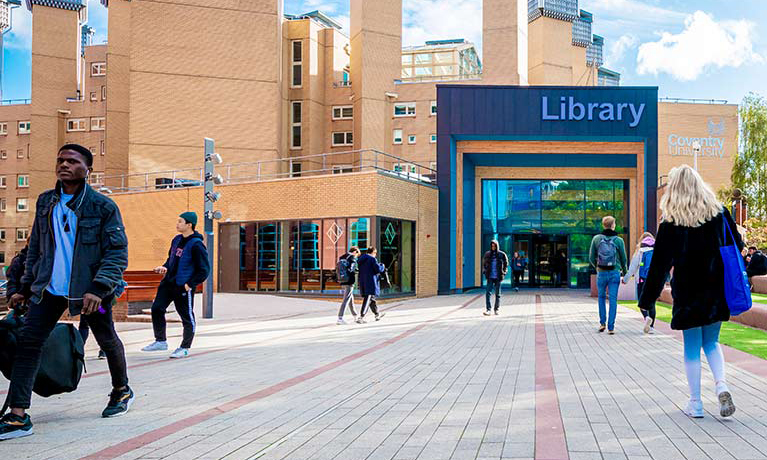
Students will benefit from studying on our well-equipped, modern campus4.
Lanchester Library
The library is open 364 days a year. It’s where you can access your course’s specialist Academic Liaison Librarian. It’s also home to specialist teams which can support you with your academic writing and maths and statistics questions.

The Hub
The Hub is the centre of student life on campus. Facilities include a food court, convenience store, multi-faith centre, medical centre, hairdresser, coffee shops and the Your SU offices. It has fully licensed function spaces and a bar.

Careers and employability
Get one-on-one career and employability guidance lasting up to 18 months from the end of your course. We’ll help you find placements and graduate roles, offer CV and application checks, mentoring, skills workshops, employer events and more.
You’ll use facilities through timetabled teaching, practical activities and relevant independent study. Access may vary by module, activity, capacity, supervision or safety requirements. Access may change or be limited where the University needs to follow public authority guidance, decisions or orders.
Careers and opportunities
Throughout the course, your academic study will be combined with skills development in a range of areas highly valued by many types of employers. Learn about and refine your critical thinking and analysis in both written and spoken formats, improving your reading and listening ability to communicate and present ideas at exceptional levels.
On successful completion of the course, you should be a graduate with a firm sense of global cultural diversity, ready to make a dynamic difference anywhere in the world. You could find yourself working in the following roles:
- Game narrative designer
- Broadcasting
- Screen, theatre and radio writer
- Author/novelist
- Graphic novelist
- Campaign manager and marketer
- Educator
- Social media creator, manager and editor.
The graduate destinations listed above illustrate potential career paths. You may need to gain additional qualifications or practical experience, pass professional examinations, complete training, cover associated costs and meet specific visa or immigration requirements to secure employment in these fields.
Where our graduates work
Previous graduates of the course have gone on to work in teaching or publishing for companies such as Granta Magazine.
As the course also develops other abilities, such as thinking critically and analytically, research, collating and organising data, a number of previous students have also embarked upon careers as financial specialists, HR managers or press officers in companies such as Air Products, Tesco and Deutsche Bank.
Further study
You can choose to continue your studies at Coventry University with the English Literature MA. You may be entitled to an alumni discount on your fees if you decide to extend your time with us by progressing from undergraduate to postgraduate study.

Discover Phoenix+
Phoenix+ brings you together with other students to learn, experience and develop essential knowledge and skills. Whatever destination you choose, it's about preparing you for life after university.
Learn more about Phoenix+How to apply
UK students
International students
Disclaimers
You may also like

Coventry University (Coventry)

English Literature BA (Hons)
Coventry University (Coventry)