Search
Sustainable Transport Systems MSc
Study level: Postgraduate
Equip yourself with the expertise to design, manage and optimise sustainable and integrated transport systems that align with the United Nations (UN’s) Sustainable Development Goals (SDGs).
Course features
Year of entry
2026-27
Location
Coventry University (Coventry)
Study mode
Full-time
With Professional Placement
Duration
1 year full-time
Up to 2 years full-time with professional placement
Course code
EEST002
Start date
September 2026
November 2026
January 2027
March 2027
May 2027
July 2027
Course overview
This course aims to teach you the skills and knowledge needed to address key challenges in sustainable transport, such as decarbonisation, smart mobility and transport systems integration, through a multi-disciplinary approach.
- Sustainable and innovative transport solutions: explore eco-friendly technologies, including zero-emission transportation methods and next-generation mobility solutions such as uncrewed aerial systems and autonomous vehicles.
- Multimodal transportation: understand the principles of integrating various transport modes for a cohesive system.
- Global connectivity: examine how integrated transport systems connect cities, regions and countries globally, promoting sustainable development.
- Strategic transport policy development: focus on developing and leading policies that drive sustainable transport innovation.

5 QS Stars for Teaching and Facilities
QS Stars University Ratings
Ranked 1st for Engagement
Postgraduate Taught Experience Survey (PTES) 2026
Ranked 5th for Overall Satisfaction in PTES
Postgraduate Taught Experience Survey (PTES) 2026Why you should study this course
- Multidisciplinary approach - this programme adopts a multidisciplinary approach, combining insights from engineering, computing, management science, and sustainable planning and design.
- Transport innovation focus - explore innovations that enhance transportation efficiency and integrate various transport modes.
- Leadership career preparation - course content aims to equip you with the skills necessary for leadership roles in next-generation transport management, transport consultancy, sustainable transport planning and policy advising.
- Professional placement opportunity - gain practical experience and boost your CV with an additional professional placement. See the modules for more details.2
Ranked 17th
for overall satisfaction in Engineering and Technology
Postgraduate Taught Experience Survey (PTES) 2025 (ranked out of 42 HEIs)
Accreditation and professional recognition

Chartered Management Institute (CMI)
The module Strategic Transport Management and Leadership meets the criteria set by the Chartered Management Institute (CMI) for the CMI Level 7 Certificate in Strategic Management and Leadership Practice. Students who successfully pass this module will be eligible to gain the award as an additional qualification at no additional cost.
What you'll study
We regularly review our course content, to make it relevant and current for the benefit of our students. For these reasons, course modules may be updated.
How you'll learn
Teaching and learning methods may include:
- lectures - builds a strong understanding of sustainable transport principles, policy, systems design and emerging mobility technologies.
- seminars - encourages critical discussion of real-world transport challenges, sustainability issues and global case studies.
- tutorials - provides focused support to deepen your understanding of complex modelling, planning and analytical concepts.
- presentations - develops confidence in communicating transport strategies and policy recommendations to professional audiences.
- group projects - reflects multidisciplinary industry practice, strengthening collaboration and transport planning problem-solving skills.
- workshops - offers hands-on experience with transport modelling tools, data analysis techniques and system design approaches.
- practical laboratory sessions - enables you to apply analytical and simulation methods to real transport data, building technical confidence and practical expertise.
Teaching contact hours
As a full-time postgraduate student, you will study modules totalling 180 credits each academic year. A typical 30-credit module requires a total of 300 hours of study. Study hours are made up of teaching contact hours, and guided and independent study.
Teaching hours
Teaching hours may vary, depending on where you are in your studies, but on average you will have between 8 and 12 teaching and learning hours each week. You will also have the opportunity to attend optional sessions including time with a Success Coach or to meet with staff for advice and feedback.
Guided and independent study
Throughout your studies, you will be expected to spend time in guided and independent study to make up the required study hours per module. You will be digging deeper into topics, reviewing what you’ve learnt and completing assignments. This can be completed around your personal commitments. As you progress to the end of your studies, you’ll spend more time on independent learning.
Online learning
As an innovative university, we use different teaching methods, including online tools and emerging technologies. So, some of your teaching hours and assessments may be delivered online.
Assessment
This course will be assessed using a variety of methods which could vary depending on the module. Assessment methods may include:
- reports
- tests
- essays
- exams
- practical coursework
- assignments
- viva voce
- presentations.
The Coventry University assessment strategy aims to ensure that our courses are fairly assessed and allows us to monitor student progression towards achieving the intended learning outcomes.

Focus with block learning
Most courses use block learning. You study one module for six weeks, then move on to the next. It's a simple, structured way to stay organised and build confidence in your studies.
Explore block learningEntry requirements
Typical entry requirements:
Fees and funding
| Student | Full-time | Part-time |
|---|---|---|
| UK, Ireland*, Channel Islands or Isle of Man | £11,700 £1,575 professional placement fee (if placement secured) |
Not available |
| EU | £11,700 per year with EU Support Bursary** £1,575 professional placement fee (if placement secured) per year with EU Support Bursary** £19,500 per year without EU Support Bursary** £1,900 professional placement fee (if placement secured) per year without EU Support Bursary** |
Not available |
| International | £19,500 £1,900 professional placement fee (if placement secured) |
Not available |
For advice and guidance on tuition fees3 and student loans visit our Postgraduate Finance page and see the University's Tuition Fee and Refund Terms and Conditions.
We offer a range of International scholarships to students all over the world. For more information, visit our international scholarships page.
Tuition fees cover the cost of your teaching, assessments, facilities and support services. There may be additional costs not covered by this fee, such as accommodation and living costs, recommended reading books, stationery, printing and re-assessments should you need them.
The following are additional costs not included in the tuition fees:
- Any optional overseas field trips or visits: £400+ per trip.
- Any costs associated with securing, attending or completing a placement (whether in the UK or abroad).
*Irish student fees
The rights of Irish residents to study in the UK are preserved under the Common Travel Area arrangement. If you are an Irish student and meet the residency criteria, you can study in England, pay the same level of tuition fees as English students and utilise the Postgraduate Master's Loan.
**EU Support Bursary
Following the UK's exit from the European Union, we are offering financial support to all eligible EU students who wish to study an undergraduate or a postgraduate degree with us full-time. This bursary will be used to offset the cost of your tuition fees to bring them in line with that of UK students. Students studying a degree with a foundation year with us are not eligible for the bursary.
How do you know if you need to pay UK or international tuition fees?
Facilities
This course is studied in two buildings: the Frank Whittle Building and Beatrice Shilling Building, both of which are equipped with specialist equipment to support your studies. This includes access to a full-size Harrier jet, flight simulators and other equipment which you may have access to depending on the learning needs of modules.
You will also have access to leading aviation intelligence and transport process design simulation software.
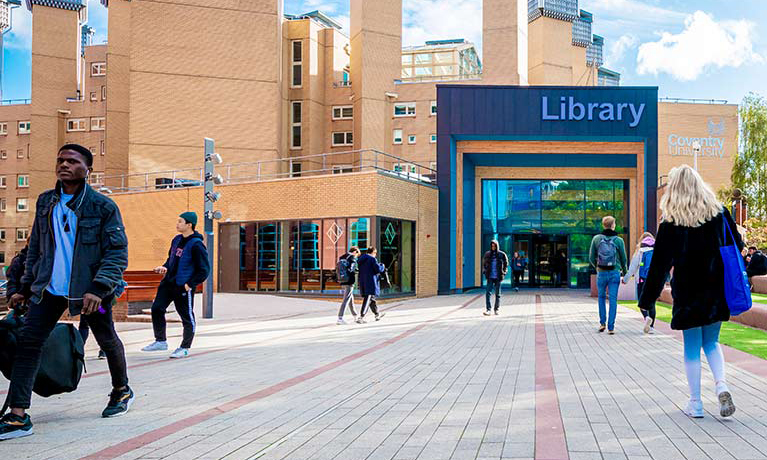
Lanchester Library
The library is usually open 364 days a year. It’s where you can access your course’s specialist Academic Liaison Librarian. It’s also home to specialist teams which can support you with your academic writing and maths and statistics questions.
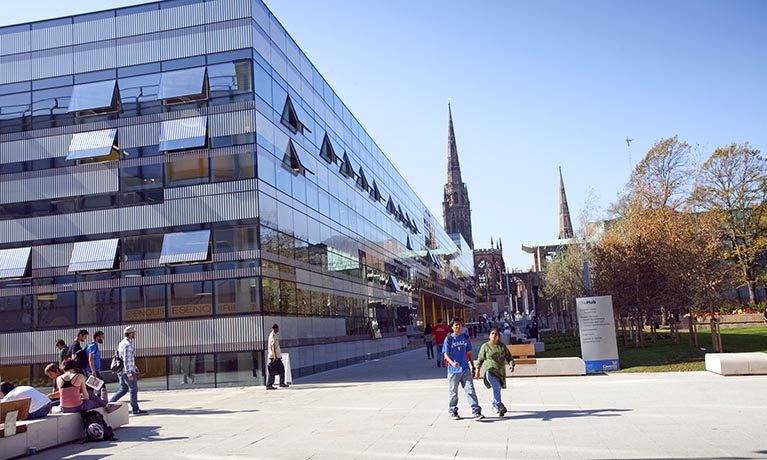
The Hub
The Hub is the centre of student life on campus. Facilities include a food court, convenience store, multi-faith centre, medical centre, hairdresser, coffee shops and the Your SU offices. It has fully licensed function spaces and a bar.

Careers and employability
Get one-on-one guidance lasting up to 18 months from the end of your course. We’ll help you find placements and graduate roles, offer CV and application checks, mentoring, skills workshops, employer events and more.
You’ll use facilities through timetabled teaching, practical activities and relevant independent study. Access may vary by module, activity, capacity, supervision or safety requirements. Access may change or be limited where the University needs to follow public authority guidance, decisions or orders.
Careers and opportunities
Graduates of this course could find employment globally in a variety of transportation management, consultancy and academic roles.
Graduates may be considered for employment in the following positions:
- Transport Planner
How the course helps:
Develop skills in transport modelling, system design and sustainable mobility planning, preparing you to design efficient, low-carbon transport networks for cities and regions. - Sustainable Transport Consultant
How the course helps:
Through case studies, group projects and policy analysis, you learn how to evaluate transport systems and provide evidence-based recommendations to public and private sector clients. - Transport Policy Advisor
How the course helps:
Build your understanding of regulatory frameworks, sustainability strategies and data-driven decision-making, equipping you to support local or national transport policy development. - Mobility or Smart Transport Analyst
How the course helps:
Training in data analysis, simulation and integrated transport systems prepares you to assess new mobility technologies and optimise multi-modal transport solutions. - Infrastructure or Transport Project Manager
How the course helps:
Gain leadership, planning and systems-thinking skills through collaborative projects and applied learning, preparing you to manage complex transport initiatives from design to delivery.
How to apply
UK students
International students
Disclaimers
You may also like

Coventry University (Coventry)

Intelligent Transport Systems MSc
Coventry University (Coventry)