Search
Data Science and Computational Intelligence MSc
Study level: Postgraduate
This course uses a blend of theory and hands-on practical elements to explore advanced models and techniques for addressing large-scale, complex and dynamic data challenges.
Course features
Year of entry
Location
Coventry University (Coventry)
Study mode
Full-time
With Professional Placement
Duration
1 year full-time
Up to 2 years full-time with professional placement
Course code
EEST038
Start date
September 2026
November 2026
January 2027
March 2027
May 2027
July 2027
Course overview
There is a demand for data scientists with the skills to develop innovative computational intelligence applications, capable of analysing large amounts of complex data to inform businesses decisions and market strategies.
- Study topics in big data management, data protection and data ethics, statistical modelling, machine learning, deep learning, computer vision, natural language processing, generative AI and reinforcement learning.
- Explore how data science can be used to extract meaningful insights from both structured and unstructured data, leveraging concepts and tools from mathematics, statistics, computer science, machine learning and related disciplines.
- Learn about computational intelligence and how it plays a pivotal role in solving complex problems and simulating human-like intelligence in computational systems.

5 QS Stars for Teaching and Facilities
QS Stars University Ratings
Ranked 1st for Engagement
Postgraduate Taught Experience Survey (PTES) 2026
Ranked 5th for Overall Satisfaction in PTES
Postgraduate Taught Experience Survey (PTES) 2026Why you should study this course
- Comprehensive technical knowledge - get an in-depth understanding of a broad range of concepts, algorithms, models, applications, and issues in data science and computational intelligence.
- Advanced AI applications - engage deeply with complex challenges in natural language processing, reinforcement learning, computer vision, big data management and statistical modelling.
- Ethics and responsibility - learn about critical legal, ethical, social and professional aspects, including responsible AI use, bias mitigation, data protection, transparency and sustainability.
- Research-informed teaching - study a course that has been designed in collaboration with Coventry University’s Centre for Computational Science and Mathematical Modelling. Our current research staff are involved in teaching some modules, supervising student projects and using current research to inform curriculum content.
- Professional placement opportunity - gain practical experience and boost your CV with an additional professional placement. See the modules for more details.2
Ranked 3rd
for overall satisfaction in Engineering and Technology
Postgraduate Taught Experience Survey (PTES) 2026 (ranked out of 44 HEIs)
Accreditation and professional recognition

Chartered Management Institute
The module The Data Science Professional meets the criteria set by the Chartered Management Institute (CMI) for the CMI Level 7 Certificate in Strategic Management and Leadership Practice. Students who successfully pass this module will be eligible to gain the award as an additional qualification at no additional cost.
I’m really enjoying the Data Science and Computational Intelligence MSc programme, especially learning from the experienced professors at Coventry University’s Centre for Computational Science and Mathematical Modelling whose expertise and passion make the experience both very rigorous and inspiring. The programme not only offers classes on classical ML but also has a strong focus on cutting edge areas like Generative AI. All in all a full stack AI programme.
Mohammed Khan - Postgraduate student (2026)

What you'll study
You will have the opportunity to specialise in a range of topics. This includes how you can use machine learning and statistical modelling to extract insights from data (structured and unstructured), the use of generative AI and its applications, the exploration into the latest advancement in deep learning and more.
We regularly review our course content, to make it relevant and current for the benefit of our students. For these reasons, course modules may be updated.
How you'll learn
Teaching methods may include:
- lectures - provide a strong foundation in core theories, algorithms and computational models underpinning data science and AI, helping you understand both the mathematics and real-world applications behind intelligent systems.
- seminars - encourage critical discussion of emerging topics such as machine learning advances, ethical AI and big data challenges, helping you evaluate research and industry developments in depth.
- tutorials - offer focused support to strengthen your understanding of complex concepts such as statistical modelling or optimisation techniques, with opportunities for personalised feedback.
- presentations - develop your ability to communicate technical findings clearly to both technical and non-technical audiences - an essential skill in data-driven organisations.
- group projects - simulate real-world data science teams, enabling you to collaborate on problem-solving, model development and data analysis while building teamwork and project management skills.
- workshops - provide hands-on experience with programming tools, machine learning frameworks and data processing techniques, allowing you to apply theory to practical challenges.
- practical laboratory sessions - enable you to design, implement and test algorithms using real datasets, building technical confidence in coding, experimentation and model evaluation.
Teaching contact hours
As a full-time postgraduate student, you will study modules totalling 180 credits each academic year. A typical 30-credit module requires a total of 300 hours of study. Study hours are made up of teaching contact hours, and guided and independent study.
Teaching hours
Teaching hours may vary, depending on where you are in your studies, but on average you will have between 8 and 12 teaching and learning hours each week. You will also have the opportunity to attend optional sessions including time with a Success Coach or to meet with staff for advice and feedback.
Guided and independent study
Throughout your studies, you will be expected to spend time in guided and independent study to make up the required study hours per module. You will be digging deeper into topics, reviewing what you’ve learnt and completing assignments. This can be completed around your personal commitments. As you progress to the end of your studies, you’ll spend more time on independent learning.
Online learning
As an innovative university, we use different teaching methods, including online tools and emerging technologies. So, some of your teaching hours and assessments may be delivered online.
Assessment
This course will be assessed using a variety of methods which could vary depending upon the module. Assessment methods may include:
- reports
- tests
- essays
- practical coursework
- assignments
- vivas
- presentations.
The Coventry University assessment strategy aims to ensure that our courses are fairly assessed and allows us to monitor student progression towards achieving the intended learning outcomes.

Focus with block learning
Most courses use block learning. You study one module for six weeks, then move on to the next. It's a simple, structured way to stay organised and build confidence in your studies.
Explore block learningEntry requirements
Typical entry requirements:
Fees and funding
| Student | Full-time | Part-time |
|---|---|---|
| UK, Ireland*, Channel Islands or Isle of Man | £11,700 £1,575 professional placement fee (if placement secured) |
Not available |
| EU | £11,700 per year with EU Support Bursary** £1,575 professional placement fee (if placement secured) per year with EU Support Bursary** £19,500 per year without EU Support Bursary** £1,900 professional placement fee (if placement secured) per year without EU Support Bursary** |
Not available |
| International | £19,500 £1,900 professional placement fee (if placement secured) |
Not available |
For advice and guidance on tuition fees3 and student loans visit our Postgraduate Finance page and see the University's Tuition Fee and Refund Terms and Conditions.
We offer a range of International scholarships to students all over the world. For more information, visit our international scholarships page.
Tuition fees cover the cost of your teaching, assessments, facilities and support services. There may be additional costs not covered by this fee, such as accommodation and living costs, recommended reading books, stationery, printing and re-assessments should you need them.
The following are additional costs not included in the tuition fees:
- Any optional overseas field trips or visits: £400+ per trip.
- Any costs associated with securing, attending or completing a placement (whether in the UK or abroad).
*Irish student fees
The rights of Irish residents to study in the UK are preserved under the Common Travel Area arrangement. If you are an Irish student and meet the residency criteria, you can study in England, pay the same level of tuition fees as English students and utilise the Postgraduate Master's Loan.
**EU Support Bursary
Following the UK's exit from the European Union, we are offering financial support to all eligible EU students who wish to study an undergraduate or a postgraduate degree with us full-time. This bursary will be used to offset the cost of your tuition fees to bring them in line with that of UK students. Students studying a degree with a foundation year with us are not eligible for the bursary.
How do you know if you need to pay UK or international tuition fees?
Facilities
Sir Frank Whittle Building
Our Engineering, Environment and Science facilities boast modern, multifunctional teaching and research buildings that support hands-on learning. Laboratories and workshops are equipped to commercial and industrial standards and are available to students both in and out of class time (subject to availability).
Beatrice Shilling Building
The four-storey building is home to a host of facilities, including a gaming and virtual reality studio, a specialist area for 3D printing and rapid prototyping, a laser facility and physics and electronics laboratories. All learning spaces are designed around a full height central atrium to promote student and staff collaboration.
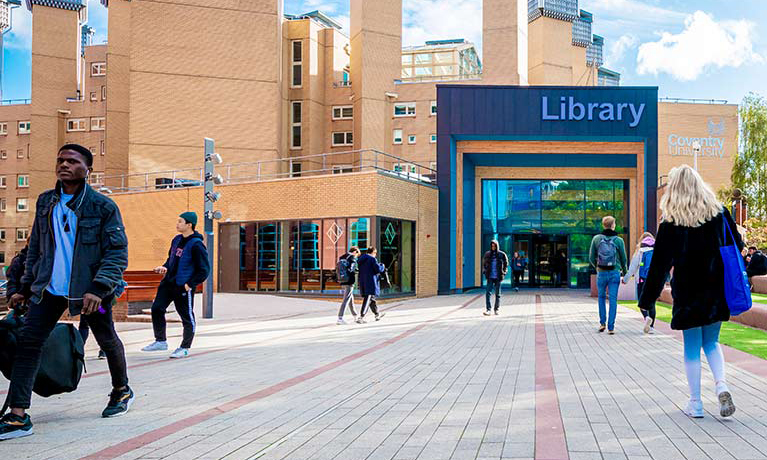
Lanchester Library
The library is usually open 364 days a year. It’s where you can access your course’s specialist Academic Liaison Librarian. It’s also home to specialist teams which can support you with your academic writing and maths and statistics questions.
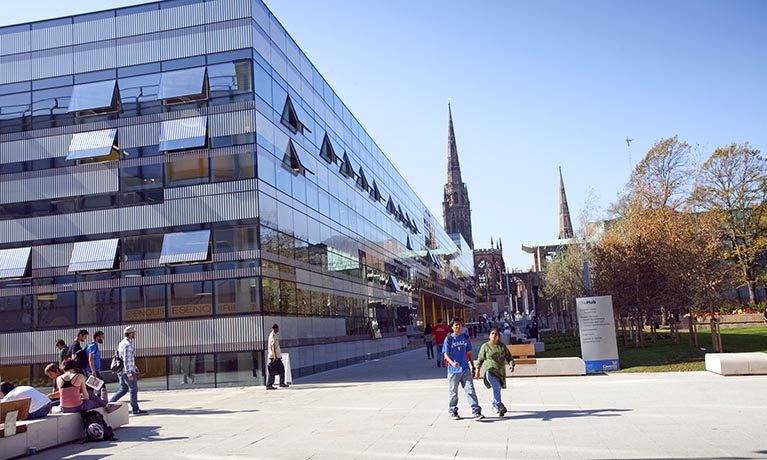
The Hub
The Hub is the centre of student life on campus. Facilities include a food court, convenience store, multi-faith centre, medical centre, hairdresser, coffee shops and the Your SU offices. It has fully licensed function spaces and a bar.

Careers and employability
Get one-on-one guidance lasting up to 18 months from the end of your course. We’ll help you find placements and graduate roles, offer CV and application checks, mentoring, skills workshops, employer events and more.
You’ll use facilities through timetabled teaching, practical activities and relevant independent study. Access may vary by module, activity, capacity, supervision or safety requirements. Access may change or be limited where the University needs to follow public authority guidance, decisions or orders.
Careers and opportunities
On successful completion of this course, you should be well qualified to apply your technical, research, programming, problem-solving and analytical skills across various sectors including technology, industry, business and government.
There could be career opportunities in AI research and development, machine learning, data management and data analysis. Potential employers include AI research institutions, major technology companies, tech startups, data science teams within businesses and government agencies, and professional consultancy firms.
On successful completion of this course, you may be able to seek positions as:
- Data scientist - develop advanced skills in statistical modelling, machine learning and big data management. Practical laboratory sessions and group projects give you experience working with real datasets, building predictive models and communicating insights, all key requirements for data science roles.
- Machine learning/AI engineer - through modules in computational intelligence, reinforcement learning and algorithm design, you should gain both theoretical understanding and hands-on implementation skills needed to build, test and optimise intelligent systems.
- Data analyst/business intelligence analyst - training in data analytics, visualisation and interpretation prepares you to extract actionable insights from complex datasets. Presentations and applied projects help you develop the ability to explain findings clearly to decision-makers.
- Computer vision or NLP specialist - engage with advanced topics such as natural language processing and computer vision, supported by practical experimentation in labs. This prepares you for specialist AI roles in areas like automation, robotics or language technologies.
- AI ethics and governance specialist - the course explores legal, ethical and professional issues including responsible AI use, bias mitigation and transparency. This supports emerging roles focused on AI regulation, compliance and responsible innovation.
The graduate destinations listed above illustrate potential career paths. You may need to gain additional qualifications or practical experience, pass professional examinations, complete training, cover associated costs and meet specific visa or immigration requirements to secure employment in these fields.
Where our graduates work
Successful graduates of this course have gone on to work for companies managing cutting-edge projects in data science, artificial intelligence and computational intelligence.
How to apply
UK students
International students
Disclaimers
You may also like

Coventry University (Coventry)

Data Science MSc
Coventry University (Coventry)

Computer Science MSc
Coventry University (Coventry)