Search
Pharmacology BSc (Hons)
Study level: Undergraduate
Explore how drugs work and are developed through an approach combining human physiology, biochemistry, genetics and molecular biology. Gain hands-on laboratory experience and prepare for roles in the pharmaceutical industry.
Course features
Course option
Year of entry
Location
Coventry University (Coventry)
Study mode
Full-time
Sandwich
Duration
3 years full-time
4 years sandwich
UCAS codes
BB92
Start date
September 2026
November 2026
January 2027
March 2027
May 2027
July 2027
Course overview
Explore how drugs affect the body and how they’re used to treat disease. Learn how new medicines are discovered, developed and tested, and how science helps improve health.
- Discover the power of pharmacology: explore how drugs interact with the human body, from molecular mechanisms to novel therapeutics and how they can make a real difference in human health.
- Hands-on learning: master advanced techniques like cell culture and flow cytometry in our Super-Lab and prepare for a career in pharmacology.4
- Launch your career: gain the skills and knowledge valued by employers and prepare for a range of career paths within the pharmaceutical industry in research, development, clinical trials, regulatory affairs and more.

Rated Gold Overall
Teaching Excellence Framework (TEF) 2023
5 QS Stars for Teaching and Facilities
QS Stars University Ratings
Top 5 Student City in England (Coventry)
QS Best Student Cities Index 2026Why you should study this course
- Contemporary facilities4: learn techniques from mammalian cell culture and flow cytometry to Western blotting and HPLC in the Super-Lab. Gain hands-on experience with real-time PCR, organ baths and physiological testing like electromyography, electrocardiography and spirometry.
- Common first year: collaborate and work alongside students doing similar courses to you, to widen your knowledge and exposure to other subject areas and professions.
- Industry expertise: our ties with industry experts, guest speakers and alumni could help you get access to real-world insights and networking opportunities2.
- Student-centred active learning: this course will be delivered through a blend of hands-on laboratory-based sessions, physiological simulation, interactive lectures and discursive workshops. Apply your knowledge and skills to an independent research project in the final year.
- Placement opportunities2: elect to apply for either a one-year professional training placement, or an international experience year to enhance learning and gain a competitive advantage in the workplace after graduation.
Our Award-winning Green Superlab
With space for over 250 students and packed full of industry-standard equipment, the Coventry University Superlab is an amazing place to learn, experiment and discover. Find out what we’re doing in our Superlab to make it greener and reduce our waste and carbon emissions.
What you'll study
We regularly review our course content, to make it relevant and current for the benefit of our students. For these reasons, course modules may be updated.
How you'll learn
Throughout your studies, you will have the opportunity to develop a good knowledge of a range of disciplines and how they apply to human health and disease and how drugs are developed, work and used in the treatment of disease.
Your learning experience will include a mix of both theory and lab-based classes.
Teaching and learning methods may include:
- lectures
- seminars
- tutorials
- presentations
- group projects
- workshops
- practical workshop sessions
- practical lab sessions.
Teaching contact hours
As a full-time undergraduate student, you will study modules totalling 120 credits each academic year. You will normally study one 30-credit module at a time. A typical 30-credit module requires a total of 300 hours of study made up of teaching contact hours, guided and independent study.
Teaching hours
Teaching hours may vary depending on your year of study and selected modules. During your first year, you can expect 12-15 teaching hours each week. You will also have the option to attend additional sessions, including time with a progress coach or to meet with staff for advice and feedback. As you progress through your studies, teaching hours may reduce.
Guided and independent study
Throughout your studies, you will be expected to spend time in guided and independent study to make up the required study hours per module. You’ll be digging deeper into topics, review what you’ve learned and complete assignments. This can be completed around your personal commitments. As you progress through your studies, you’ll spend more time in independent study.
Online learning
As an innovative university, we use different teaching methods including online tools and emerging technologies. So, some of your teaching hours and assessments may be delivered online
Assessment
Assessment methods align to transferable industry skills, providing you with practical, real-world skills designed to enhance your professional readiness and career prospects.
Assessment methods may include:
- online tests
- essays and critical reviews
- pitches
- case studies
- proposals
- portfolios
- group work for presentations, lab projects and reports
- individual presentations
- laboratory reports
- lab skill competency
- posters and other information resources (e.g. videos, websites, briefing papers)
- independent research project.
The Coventry University Group assessment strategy ensures that our courses are fairly assessed and allows us to monitor student progression towards achieving the intended learning outcomes.
International experience opportunities
Medical research takes place in higher education institutions, research institutes, hospitals and industry throughout the world. This international perspective is reflected in a number of modules on the course, which deal with issues of global importance, such as drug discovery and development from natural products including treatments for malaria, HIV/AIDS, tuberculosis and worm infections (helminths).
There may be an opportunity for online collaboration with overseas institutions on a joint problem-based learning assignment. For example, previous students have joined others from University of Seville investigating the prevalence and approach to managing neurodegenerative disorders and the differing policies with regard to legal highs within the UK and Spain. Our sandwich degree option also allows a year’s work placement or study, which can be taken abroad2.
Please note that all international experience opportunities may be subject to additional costs, competitive application, availability and meeting applicable visa and travel requirements are therefore not guaranteed2.
Entry requirements
Typical entry requirements:
Not got the required grades? We offer this degree with an integrated foundation year.
Fees and funding
| Student | Full-time | Part-time |
|---|---|---|
| UK, Ireland*, Channel Islands or Isle of Man | £9,790 per year | Not available |
| EU | £9,790 per year with EU Support Bursary** £19,200 per year without EU Support Bursary** |
Not available |
| International | £19,200 per year | Not available |
If you choose to study this course with a professional placement2 or study abroad year, you will need to pay a tuition fee3 to cover your academic support throughout your placement year. Students commencing their professional placement in the academic year 2028/29 will pay £1,575 if they are paying UK fees, or £1,900 if they are paying international fees.
For advice and guidance on tuition fees and student loans visit our Undergraduate Finance page and see The University’s Tuition Fee and Refund Terms and Conditions.
The University will charge the tuition fees that are stated in the above table for the first Academic Year of study. The University will review tuition fees each year. For UK (home) students, if Parliament permits an increase in tuition fees, the university may increase fees for each subsequent year of study in line with any such changes. Note that any increase is expected to be in line with inflation.
If you choose to study this course with a professional placement, the University will charge the tuition fees stated above for those on a placement during Academic Year 2028/29. The University will review professional placement tuition fees each year. For UK (home) students, the University may increase fees for each subsequent year of study, but such that it will be no more than 5% above inflation.
For international students, we may increase fees each year, but such increases will be no more than 5% above inflation. If you defer your course start date or have to extend your studies beyond the normal duration of the course (e.g. to repeat a year or resit examinations) the University reserves the right to charge you fees at a higher rate and/or in accordance with any legislative changes during the additional period of study.
We offer a range of International scholarships to students all over the world. For more information, visit our International Scholarships page.
Tuition fees cover the cost of your teaching, assessments, facilities and support services. There may be additional costs not covered by this fee such as accommodation and living costs, recommended reading books, stationery, printing and re-assessments should you need them. Find out what's included in your tuition costs.
The following are additional costs not included in the tuition fees:
- Any optional overseas field trips or visits: £400+ per trip.
- Any costs associated with securing, attending or completing a placement (whether in the UK or abroad).
*Irish student fees
The rights of Irish residents to study in the UK are preserved under the Common Travel Area arrangement. If you are an Irish student and meet the residency criteria, you can study in England, pay the same level of tuition fees as English students and utilise the Tuition Fee Loan.
**EU Support Bursary
Following the UK's exit from the European Union, we are offering financial support to all eligible EU students who wish to study an undergraduate or a postgraduate degree with us full-time. This bursary will be used to offset the cost of your tuition fees to bring them in line with that of UK students. Students studying a degree with a foundation year with us are not eligible for the bursary.
How do you know if you need to pay UK or international tuition fees?
Facilities
The course will be predominantly taught in the Alison Gingell Building on the Coventry University main campus. It is home to microbiology, cell culture, molecular biology/genetics, biochemistry and forensic science laboratories, allowing you to work in a professional environment from day one4.
- Superlab: Our SuperLab4 has facilities for cell culture and equipment for microscopy, DNA, RNA and protein analysis, and forensic testing.
- Analytical Chemistry Suite: Students apply their practical and theoretical knowledge to real-life working scenarios e.g. use of new generation chromatography technique to analyse products ranging from pharmaceutical agents to cosmetics, drinks and toxins.
- Physiology Suite: Separate physiology and health laboratory facilities enable the measurement of physiological parameters such as heart rate, blood pressure, lung function test and neuromuscular functioning.
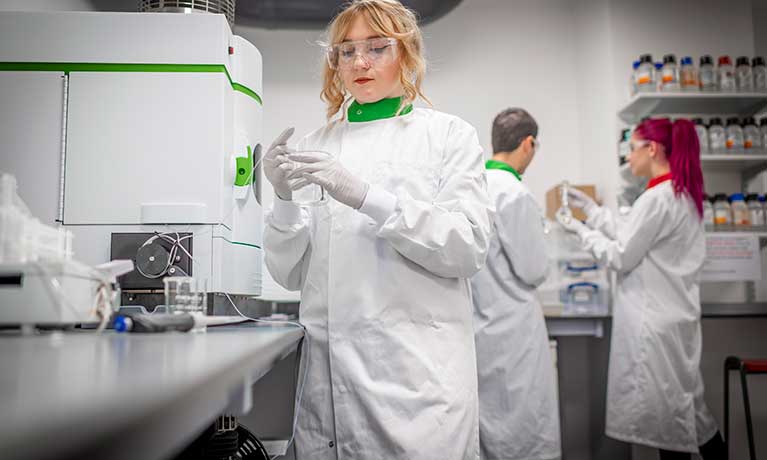
Alison Gingell Building
The Alison Gingell Building is home to microbiology, cell culture, molecular biology/genetics, biochemistry and forensic science laboratories, allowing you to work in a replicated professional environment from day one.
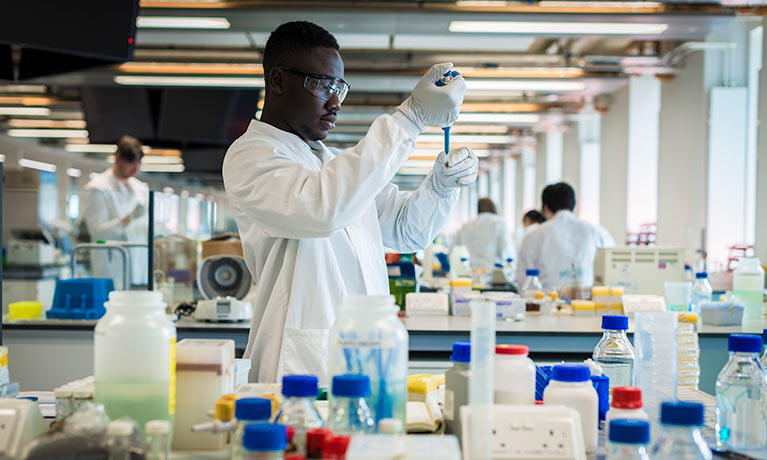
SuperLab
Our SuperLab has facilities for cell culture and equipment for microscopy, DNA, RNA and protein analysis, and forensic testing.
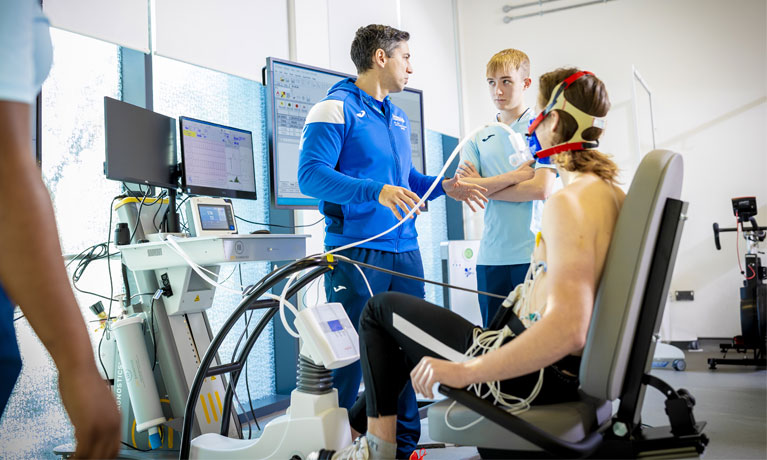
Physiology suite
Separate physiology and health laboratory facilities enable the measurement of physiological parameters such as heart rate, blood pressure, lung function test and neuromuscular functioning.
Facilities are subject to availability. Access to some facilities (including some teaching and learning spaces) may vary from those advertised and/or may have reduced availability or restrictions where the university is following public authority guidance, decisions or orders.
Careers and opportunities
Upon successful completion of this course, you may look to be employed by companies in the pharmaceutical industry, involved in discovering and development drugs and carrying out clinical trials. You may also find the opportunity to work for contract research organisations (CROs) or academic departments within universities on research projects. Or you could pursue a career within government laboratories (including environmental agencies), charity-funded research organisations, such as the Medical Research Council (MRC), and with other research institutes.
The scientific knowledge and skills you acquire during the course can be a useful basis for a career in teaching; technical and scientific writing (such as medical writing or writing for the media); clinical trials; drug registration, patenting or monitoring; medical publishing or other information services; regulatory affairs or sales and marketing.
Where our graduates work
Previous graduates have gone on to careers in drug discovery and development, clinical trials development and governance within the pharmaceutical industry and university and hospital departments. Examples include:
- regulatory strategist and trials manager for Pfizer
- education administrator for Education for Health
- activities coordinator for the TLC group.
Others have used their qualifications to progress into teaching careers, as well as postgraduate study to obtain MSc, MPhil and PhD qualifications.
The graduate destinations listed above illustrate potential career paths. You may need to gain additional qualifications or practical experience, pass professional examinations, complete training, cover associated costs and meet specific visa or immigration requirements to secure employment in these fields.
Further study
The course is an excellent foundation for further postgraduate studies leading to an MSc or PhD. We run a range or related taught MSc courses that allow our graduates to specialise in the area that they have a passion for and would like to pursue a career in.

Discover Phoenix+
Phoenix+ brings you together with other students to learn, experience and develop essential knowledge and skills. Whatever destination you choose, it's about preparing you for life after university.
Learn more about Phoenix+
Disclaimers
You may also like
Coventry University (Coventry)

Biomedical Science/Applied Biomedical Science BSc (Hons)
Coventry University (Coventry)

Human Biosciences BSc (Hons)
Coventry University (Coventry)