Search
Finance and Investment BSc (Hons)
Study level: Undergraduate
Sharpen your understanding of the broad finance and investment area, from corporate finance and international finance to corporate governance and banking.
Course features
Course option
Year of entry
Location
Coventry University (Coventry)
Study mode
Full-time
Sandwich
Duration
3 years full-time
4 years sandwich
UCAS codes
N300
Start date
September 2027
November 2027
January 2028
March 2028
May 2028
July 2028
Course overview
Learn about financial derivatives, financial regulation, investment, risk and portfolio management. Develop the specialist expertise and practical skills required for roles in investment banking, fund management, asset management, corporate finance and wider financial services.
With a strong foundation in finance and investment, combined with analytical, research and quantitative skills, you should be well-prepared for careers in financial services, banking, investment banking, asset and wealth management or broader finance roles.

Rated Gold Overall
Teaching Excellence Framework (TEF) 2023
5 QS Stars for Teaching and Facilities
QS Stars University Ratings
4th Student City in England (Coventry)
QS Best Student Cities Index 2027Why you should study this course
- Explore finance theories and how they're applied to solve real-world problems.
- Learn statistical software widely used in finance and banking sectors.4
- Gain hands-on experience of market-leading financial databases such as Bloomberg, LSEG Workspace, Fitch Connect and Bureau van Dijk.4
- Obtain professional certification in key financial database skills (Bloomberg, LSEG Workspace) at no additional cost.2
- Learn from guest speakers from banking and financial backgrounds.2 Previous speakers include those working at organisations such as the CFA Institute, CFA Society UK and the Chartered Insurance Institute.
- Enrich your student experience by becoming a member of a student-led society such as the Investment Society or the Economics Society.2
- Build your network and take part in visits to financial institutions. Previous visits include Bloomberg, Cooper Parry Wealth and Fidelity International.2
Memberships
Additional certificates
What you'll study
We regularly review our course content to keep it relevant and current for our students. Consequently, we may update modules to reflect the latest industry standards.
How you'll learn
You will be taught utilising our Trading Floor room, giving hands-on experience of market-leading financial databases such as Bloomberg Terminal, Refinitiv Workspace, Fitch Connect and Bureau van Dijk Fame4.
We aim to provide opportunities to meet with guest speakers from leading financial organisations such as CFA UK, CFA and CII (subject to availability).
Typically, a module involves interactive lecture(s) weekly, delivered synchronously online or on campus, followed by a range of active learning sessions such as seminars and workshops.
In addition, you will meet other students on the course and your tutors weekly during term time to engage in community-building activities, receive support and raise concerns relating to the course.
The assessment strategy is designed to be efficient and manageable, and consists of authentic assessments, very similar to those tasks students will have to complete in their future careers.
Teaching contact hours
As a full-time undergraduate student, you will study modules totalling 120 credits each academic year. A typical 30-credit module requires 300 hours of study. Study hours are made up of teaching contact hours and guided and independent study.
Teaching hours
Teaching hours may vary, depending on where you are in your studies, but on average, you will have between 12 and 15 teaching and learning hours each week. You will also have the option to attend additional sessions, including time with a progress coach or to meet with staff for advice and feedback. As you progress through your studies, teaching hours may reduce.
Guided and independent study
Throughout your studies, you will be expected to spend time in guided and independent study to make up the required study hours per module. You will be digging deeper into topics, reviewing what you’ve learnt and completing assignments. This can be completed around your personal commitments. As you progress to the end of your studies, you’ll spend more time on independent learning.
Online learning
As an innovative university, we use different teaching methods, including online tools and emerging technologies. So, some of your teaching hours and assessments may be delivered online.
Assessment
This course will be assessed using a variety of methods which will vary depending upon the module.
Assessment methods may include:
- phase tests
- essays
- group work
- presentations
- reports
- projects
- coursework
- exams
- individual assignments.
The Coventry University Group assessment strategy ensures that our courses are fairly assessed and allows us to monitor student progression towards achieving the intended learning outcomes.
International experience opportunities2
You will have the opportunity to gain an international experience in many ways. Coventry is a multicultural university, so our typically diverse student and staff body helps to facilitate a multicultural learning environment.
Coventry University aims to give you the global opportunities needed to become a truly global graduate, enhancing your employability on a global scale2. Choices can include language classes, studying or working abroad, international field trips, summer schools, leadership development or work experience2.
In the past, our students have had the opportunity to visit universities in China and Malaysia to study alongside students, see how finance is taught internationally, appreciate the issues in different countries and broaden their perspectives.
Closer to home, we aim to offer chances to participate in European field trips as part of events like, the annual Tax Week initiative or the annual Audit Week, both of which are conducted in collaboration with European universities, and see students work collaboratively on related projects2.
Please note that all international experience opportunities may be subject to additional costs, competitive application, availability, and meeting applicable visa and travel requirements, and are therefore not guaranteed2.
I bring real-world scenarios from the world of Finance and bring it into the classroom. Students work through concrete problems and challenges where I play the role of a facilitator in my classes and build student engagement with the help of digital education tools. The underlying idea behind my teaching practice is to prepare students for the job market and increase their employability in preparation for entering into the Investment Banking and Financial Planning sectors. Nurturing the student’s own capabilities and building their subject knowledge so that they walk out of the classroom as a confident learner is what gives me a sense of fulfilment as an academician.
Manisha Dhir, Lecturer in Finance, 2024

Entry requirements
Typical entry requirements:
Not got the required grades? We offer this degree with an integrated foundation year.
Fees and funding
| Student | Full-time | Part-time |
|---|---|---|
| UK, Ireland*, Channel Islands or Isle of Man | 2027/28 fees TBC 2026/27 fees: £9,790 per year |
Not available |
| EU | 2027/28 fees TBC 2026/27 fees: £9,790 per year with EU Support Bursary** 2027/28 fees TBC 2026/27 fees: £17,600 per year without EU Support Bursary** |
Not available |
| International | 2027/28 fees TBC 2026/27 fees: £17,600 per year |
Not available |
If you choose to study this course with a professional placement2 or study abroad year, you will need to pay a tuition fee3 to cover your academic support throughout your placement year. Students commencing their professional placement in the academic year 2028/29 will pay £1,575 if they are paying UK fees, or £1,900 if they are paying international fees.
For advice and guidance on tuition fees and student loans visit our Undergraduate Finance page and see The University’s Tuition Fee and Refund Terms and Conditions.
The University will charge the tuition fees that are stated in the table above for the first Academic Year of study. The University will review tuition fees each year. For UK (home) students, if Parliament permits an increase in tuition fees, the university may increase fees for each subsequent year of study in line with any such changes. Note that any increase is expected to be in line with the Retail Price Index (RPI), a UK measure of inflation that tracks changes in the cost of living.
If you choose to study this course with a professional placement or study abroad year, the University will charge the tuition fees stated above for those on a placement during Academic Year 2028/29. The University will review professional placement tuition fees each year. For UK (home) students, the University may increase fees for each subsequent year of study, but such that it will be no more than 5% above RPI.
For international students, we may increase fees each year, but such increases will be no more than 5% above inflation. If you defer your course start date or have to extend your studies beyond the normal duration of the course (e.g. to repeat a year or resit examinations) you may be charged the tuition fees in force at the time you take that additional period of study, and/or in line with any legislative changes that apply at that time.
We offer a range of International scholarships to students all over the world. For more information, visit our International Scholarships page.
Tuition fees cover the cost of your teaching, assessments, facilities and support services. There may be additional costs not covered by this fee such as accommodation and living costs, recommended reading books, stationery, printing and re-assessments should you need them. Find out what's included in your tuition costs.
The following are additional costs not included in the tuition fees:
- Any optional overseas field trips or visits: £400+ per trip.
- Any costs associated with securing, attending or completing a placement (whether in the UK or abroad) which may include costs of travel, accommodation, equipment or uniform required for the placement and any visa-related costs.
*Irish student fees
The rights of Irish residents to study in the UK are preserved under the Common Travel Area arrangement. If you are an Irish student and meet the residency criteria, you can study in England, pay the same level of tuition fees as English students and utilise the Tuition Fee Loan.
**EU Support Bursary
Following the UK's exit from the European Union, we are offering financial support to all eligible EU students who wish to study an undergraduate or a postgraduate degree with us full-time. This bursary will be used to offset the cost of your tuition fees to bring them in line with that of UK students. Students studying a degree with a foundation year with us are not eligible for the bursary.
How do you know if you need to pay UK or international tuition fees?
Facilities
We have a range of facilities available to support our accounting and finance students in putting the theories you are taught into practice4.
Take a virtual tour

The Trading Floor
The Trading Floor is an invaluable facility that allows you to get hands-on with industry-standard software. Featuring contemporary dual-screen Bloomberg terminals, the facility adds a dynamic practical element to your course.
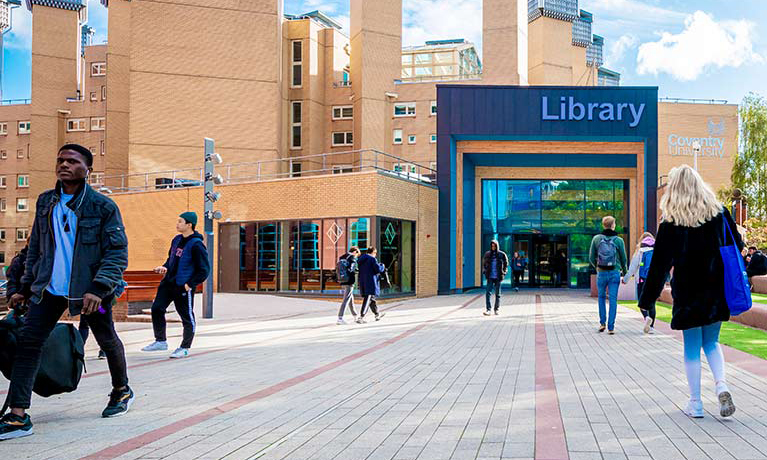
Lanchester Library
The library is usually open 364 days a year. It’s where you can access your course’s specialist Academic Liaison Librarian. It’s also home to specialist teams which can support you with your academic writing and maths and statistics questions.

Careers and employability
Get one-on-one career and employability guidance lasting up to 18 months from the end of your course. We’ll help you find placements and graduate roles, offer CV and application checks, mentoring, skills workshops, employer events and more.
You’ll use facilities through timetabled teaching, practical activities and relevant independent study. Access may vary by module, activity, capacity, supervision or safety requirements. Access may change or be limited where the University needs to follow public authority guidance, decisions or orders.
Careers and opportunities
Upon successful completion of the course, you will be able to:
- use a range of transferable skills such as writing clear and concise reports based on evidence and logic, making effective use of information technology, confident delivery of presentations, creative problem solving, financial skills and self-motivation.
- communicate technical business and financial concepts in a clear manner to a range of relevant stakeholders.
- apply financial theories and empirical methods to real-world scenarios by making appropriate use of data, abstraction, and logical reasoning to analyse corporate and international financial events and issues.
- carry out an independent piece of research on a finance topic using appropriate theories and analytical tools.
- understand the importance and relevance of personal finance and financial services to individuals and corporations.
- apply appropriate mathematical and quantitative techniques to solve business and financial problems.
- evaluate and critique a wide range of financial securities and be able to utilise these products to achieve appropriate investment and risk management goals.
- identify, evaluate and interpret complex financial problems, employing suitable methodologies to ascertain and select appropriate innovative solutions.
Upon successful completion of the course, you should be well placed to pursue a wide variety of potential future careers options in areas such as:
- finance advice and management
- equity trading
- investment banking
- personal and corporate finance
- investment and portfolio management
- other sectors of financial services
- management
- research and finance analyst
- education in private, public and third sector organisations.
The graduate destinations listed above illustrate potential career paths. You may need to gain additional qualifications or practical experience, pass professional examinations, complete training, cover associated costs and meet specific visa or immigration requirements to secure employment in these fields.
Where our graduates work
Our past graduates have progressed to careers across a wide spectrum of industry sectors, from banking, accounting and finance to manufacturing and sales. This includes positions with companies such as Barclays and Jaguar Land Rover.
The graduate destinations listed above illustrate potential career paths. You may need to gain additional qualifications or practical experience, pass professional examinations, complete training, cover associated costs and meet specific visa or immigration requirements to secure employment in these fields.
Further study
Upon successful completion of our Finance and Investment BSc (Hons) course, you may wish to continue to further your studies at postgraduate level with our Finance MSc here at Coventry Business School. You can explore all of your options using our postgraduate course search tool. You may be entitled to an alumni discount on your fees if you decide to extend your time with us by progressing from undergraduate to postgraduate study.
Please note that further study opportunities are subject to competitive application, availability, meeting any applicable visa requirements and additional costs may apply.

Discover Phoenix+
Phoenix+ brings you together with other students to learn, experience and develop essential knowledge and skills. Whatever destination you choose, it's about preparing you for life after university.
Learn more about Phoenix+How to apply
UK students
International students
Disclaimers
You may also like

Coventry University (Coventry)

Accounting and Finance BSc (Hons)
Coventry University (Coventry)

Business and Finance BSc (Hons)
Coventry University (Coventry)