Search
Music and Audio Production BSc (Hons)
Study level: Undergraduate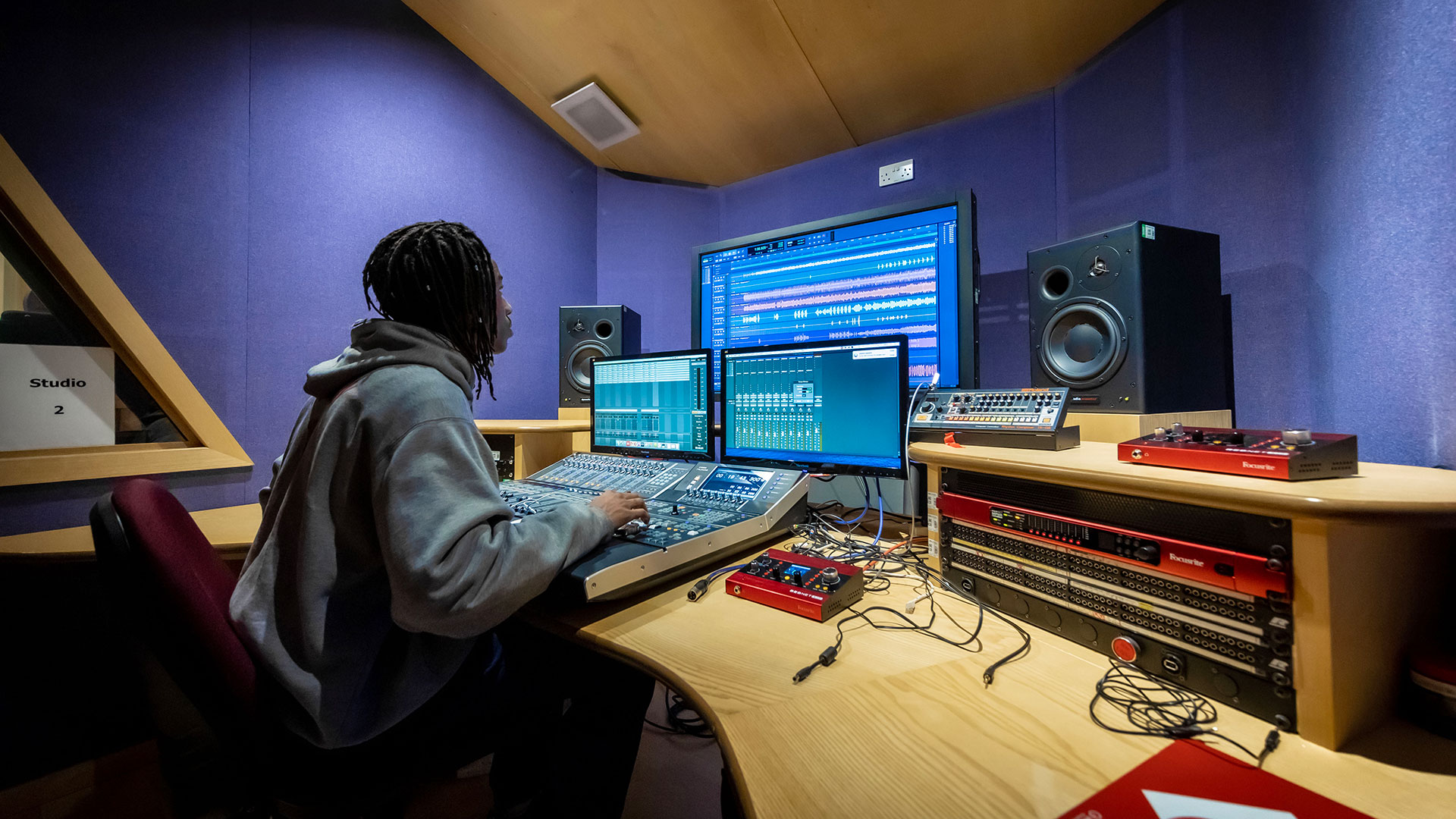
Passionate about creating and producing music? Develop the skills to record, compose, produce, mix and master your own tracks, supported by our expert tutors and industry-standard equipment.
Course features
Year of entry
Location
Coventry University (Coventry)
Study mode
Full-time
Sandwich
Duration
3 years full-time
4 years sandwich
Course code
W374
Start date
September 2027
November 2027
January 2028
March 2028
May 2028
July 2028
Course overview
Are you an aspiring producer, sound designer or audio engineer? Explore the creative and technical world of music and audio production, develop studio skills, use industry-standard technology and build experience relevant to a range of roles in sound.
- Learn about recording, arranging and producing music using modern studio equipment and software.4
- Explore live sound, synthesis and interactive audio design for media, film and games.
- Gain industry insight through modules on music business, marketing and entrepreneurship.

Rated Gold Overall
Teaching Excellence Framework (TEF) 2023
5 QS Stars for Teaching and Facilities
QS Stars University Ratings
4th Student City in England (Coventry)
QS Best Student Cities Index 2027Why you should study this course
- Get practical experience with professional-grade equipment, including SSL, Audient and Neve mixing consoles, to build real-world technical expertise.4
- Collaborate on industry-informed projects to create a standout portfolio for a career in film, TV, radio or interactive media.
- Gain vital insight into music marketing, entrepreneurship and the business of audio to support freelance and employed pathways.
- Develop the skills and versatility to pursue careers such as music producer, composer, audio post-production technician or sound designer.
About the School of Arts and Creative Industries
- Our learning and teaching mirror the needs of the creative industries, so our graduates have the skills and attributes needed to become industry specialists, leaders and innovators.
- Our studio culture seeks to ensure you are socially responsible in our creative community and develop critical thinking in research and making processes.
- Our global initiatives aim to give you skills to become a collaborative communicator and make you culturally competent.
- Our strong industry links typically enable us to host an exciting programme of guest speakers covering topics such as sound design, immersive audio technologies and music production for media.2
- Past students have worked on projects as diverse as designing innovative sound experiences for Jaguar Land Rover, contributing to game audio projects with Mojang Studios (creators of Minecraft and Caller's Bane) and collaborating with the BBC on major movies and TV shows. They have also gained valuable experience working at major live festivals.
Joint 1st
for Learning Resources in Music, across England HEIs
National Student Survey (NSS) 2025
What you'll study
We regularly review our course content to keep it relevant and current for our students. Consequently, we may update modules to reflect the latest industry standards.
How you'll learn
Teaching and learning methods may include:
- lectures
- seminars
- tutorials
- presentations
- group projects
- workshops
- practical studio sessions
- practical workshop sessions.
Teaching contact hours
As a full-time undergraduate student, you will study modules totalling 120 credits each academic year. A typical 30-credit module requires 300 hours of study. Study hours are made up of teaching contact hours and guided and independent study.
Teaching hours
Teaching hours may vary, depending on where you are in your studies, but on average, you will have between 12 and 15 teaching and learning hours each week. You will also have the option to attend additional sessions, including time with a progress coach or to meet with staff for advice and feedback. As you progress through your studies, teaching hours may reduce.
Guided and independent study
Throughout your studies, you will be expected to spend time in guided and independent study to make up the required study hours per module. You will be digging deeper into topics, reviewing what you’ve learnt and completing assignments. This can be completed around your personal commitments. As you progress to the end of your studies, you’ll spend more time on independent learning.
Online learning
As an innovative university, we use different teaching methods, including online tools and emerging technologies. So, some of your teaching hours and assessments may be delivered online.
Assessment
This course is assessed using methods that vary by module. These approaches are intended to prepare you for the complex and evolving contexts of professional practice.
Assessment methods may include:
- artefacts
- practical coursework
- digital coursework
- individual work
- group work
- live presentations
- presentations/poster presentations
- individual assignments.
The Coventry University Group assessment strategy ensures that our courses are fairly assessed and allows us to monitor student progression towards the achieving the intended learning outcomes.
Entry requirements
Typical entry requirements:
Fees and funding
| Student | Full-time | Part-time |
|---|---|---|
| UK, Ireland*, Channel Islands or Isle of Man | 2027/28 fees TBC 2026/27 fees: £9,790 per year |
Not available |
| EU | 2027/28 fees TBC 2026/27 fees: £9,790 per year with EU Support Bursary** 2027/28 fees TBC 2026/27 fees: £20,800 per year without EU Support Bursary** |
Not available |
| International | 2027/28 fees TBC 2026/27 fees: £20,800 per year |
Not available |
If you choose to study this course with a professional placement2 or study abroad year, you will need to pay a tuition fee3 to cover your academic support throughout your placement year. Students commencing their professional placement in the academic year 2028/29 will pay £1,575 if they are paying UK fees, or £1,900 if they are paying international fees.
For advice and guidance on tuition fees and student loans visit our Undergraduate Finance page and see The University’s Tuition Fee and Refund Terms and Conditions.
The University will charge the tuition fees that are stated in the table above for the first Academic Year of study. The University will review tuition fees each year. For UK (home) students, if Parliament permits an increase in tuition fees, the university may increase fees for each subsequent year of study in line with any such changes. Note that any increase is expected to be in line with the Retail Price Index (RPI), a UK measure of inflation that tracks changes in the cost of living.
If you choose to study this course with a professional placement or study abroad year, the University will charge the tuition fees stated above for those on a placement during Academic Year 2028/29. The University will review professional placement tuition fees each year. For UK (home) students, the University may increase fees for each subsequent year of study, but such that it will be no more than 5% above RPI.
For international students, we may increase fees each year, but such increases will be no more than 5% above inflation. If you defer your course start date or have to extend your studies beyond the normal duration of the course (e.g. to repeat a year or resit examinations) you may be charged the tuition fees in force at the time you take that additional period of study, and/or in line with any legislative changes that apply at that time.
We offer a range of International scholarships to students all over the world. For more information, visit our International Scholarships page.
Tuition fees cover the cost of your teaching, assessments, facilities and support services. There may be additional costs not covered by this fee such as accommodation and living costs, recommended reading books, stationery, printing and re-assessments should you need them. Find out what's included in your tuition costs.
The following are additional costs not included in the tuition fees:
- Any optional overseas field trips or visits: £400+ per trip.
- Any costs associated with securing, attending or completing a placement (whether in the UK or abroad) which may include costs of travel, accommodation, equipment or uniform required for the placement and any visa-related costs.
*Irish student fees
The rights of Irish residents to study in the UK are preserved under the Common Travel Area arrangement. If you are an Irish student and meet the residency criteria, you can study in England, pay the same level of tuition fees as English students and utilise the Tuition Fee Loan.
**EU Support Bursary
Following the UK's exit from the European Union, we are offering financial support to all eligible EU students who wish to study an undergraduate or a postgraduate degree with us full-time. This bursary will be used to offset the cost of your tuition fees to bring them in line with that of UK students. Students studying a degree with a foundation year with us are not eligible for the bursary.
How do you know if you need to pay UK or international tuition fees?
Facilities
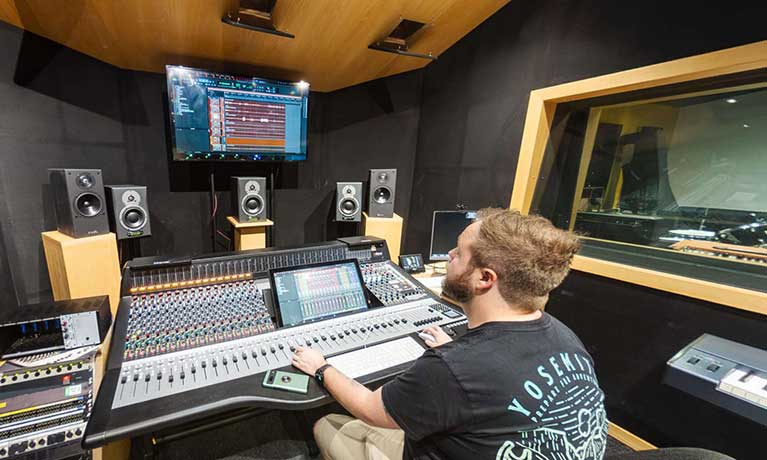
Music recording studio
Our recording space control room allows you to capture the sound of your collaborative creations, providing you with the perfect space to listen back to your work, identify areas for improvement, and take your music to the next level.
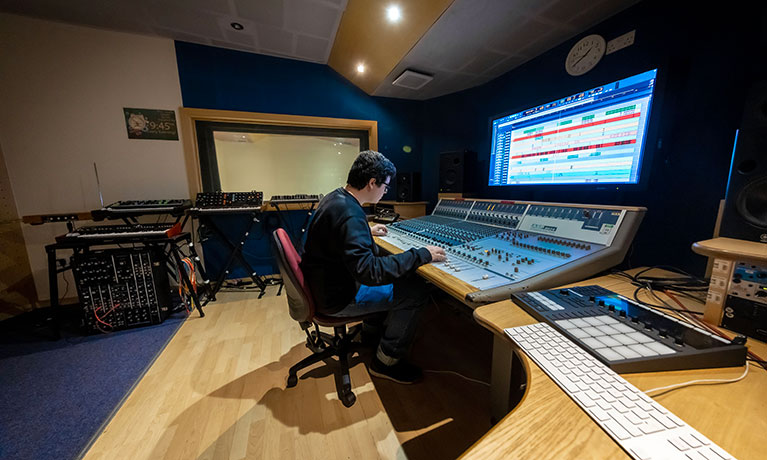
Dolby Atmos studio
This immersive mixing and post-production environment features Adam Audio monitoring, an Avid S3 control surface and Audient Oria for precise object-based routing. With Sound ID Reference calibration and full Dante integration to the wider studio network, it supports high-end spatial audio production across music, film and interactive media.

Neve recording studio performance space
Learn what it’s like to be mixed in real-time. Whether you’re looking to create the next R&B hit, or simply want to record the individual parts of a larger rock piece, this recording space is perfect for improving your skills.
Take a virtual tour
You’ll use facilities through timetabled teaching, practical activities and relevant independent study. Access may vary by module, activity, capacity, supervision or safety requirements. Access may change or be limited where the University needs to follow public authority guidance, decisions or orders.
Careers and opportunities
On successful completion, you should have knowledge of:
- concepts of professionalism within music technology (including composition, recording techniques and technology, Live sound, music production) and related disciplines and their relationship to music technology within a global context.
- the skills, processes and techniques required for the creation, realisation, presentation and management of work as a music technologist, working within the digital age.
You should be equipped with the skills to:
- demonstrate technical skills relating to a range of recording, mastering, Music production, live sound and music composition.
- apply technological and music related skills creatively to a brief to a high standard of aptitude, demonstrating the appropriate breadth and depth of conceptual development.
- apply creative solutions to a brief, using technical means and appropriate application of materials, processes and technologies to develop a coherent body of work that reflects the particular characteristics of your own creative perspective.
There is a strong emphasis within the course on your future career, not only helping you to discover your potential chosen career path but also aiming to ensure that you have the professional level of business skill and knowledge to thrive in this demanding industry.
Where our graduates work
Previous examples of employment include music producers, sound engineers, composers; audio post- production technicians together with work in extensive related fields such as radio and television sound.
The graduate destinations listed above illustrate potential career paths. You may need to gain additional qualifications or practical experience, pass professional examinations, complete training, cover associated costs and meet specific visa or immigration requirements to secure employment in these fields.
Further study
You can choose to continue your studies at Coventry University with:
You may be entitled to an alumni discount on your fees if you decide to extend your time with us by progressing from undergraduate to postgraduate study.

Discover Phoenix+
Phoenix+ brings you together with other students to learn, experience and develop essential knowledge and skills. Whatever destination you choose, it's about preparing you for life after university.
Learn more about Phoenix+How to apply
UK students
International students
Disclaimers
You may also like

Coventry University (Coventry)

Popular Music Performance and Songwriting BA (Hons)
Coventry University (Coventry)

Digital Media BA (Hons)
Coventry University (Coventry)