Search
Mechanical Engineering MEng/BEng (Hons) with foundation year
Study level: Undergraduate
Explore how things work, move and are made. Develop skills and knowledge to design, build and improve mechanical systems used across industries, such as aerospace, automotive and manufacturing.
Course features
Course option
Year of entry
Location
CU Coventry (Coventry) and
Coventry University (Coventry)
Study mode
Full-time
Sandwich
Duration
BEng4 years full-time5 years sandwich
UCAS codes
HMDF
Start date
March 2026
May 2026
June 2026
September 2026
November 2026
January 2027
March 2027
May 2027
July 2027
Course overview

Our degree with foundation year could be the stepping stone you need to achieve your goals. The foundation year aims to prepare you for degree-level study and is a great way to build the confidence, skills and knowledge needed to succeed on your degree course. The degree with foundation year is only available for the BEng option.
Foundation year
This foundation year aims to provide you with the fundamental knowledge and skills needed in mathematics, as well as the theories and concepts of electrical, electronic and mechanical engineering.
Degree
In our ever-changing world, mechanical engineers develop new and differing uses for technologies and materials to improve the mechanical operation of equipment and devices used in anything from food and oil production to international construction projects or the design of toys.
- The BEng in Mechanical Engineering aims to produce mechanical engineering graduates with the versatility and depth of understanding to deal with new and unusual challenges in mechanical engineering, alongside the necessary imagination and creativity to innovate.
- It is designed to give graduates the opportunity to equip themselves with relevant, up-to-date skills and knowledge necessary to work as a mechanical engineer in a broad variety of businesses, including engineering management, research, engineering design, development and consultancy.

Rated Gold Overall
Teaching Excellence Framework (TEF) 2023
5 QS Stars for Teaching and Facilities
QS Stars University Ratings
Top 5 Student City in England (Coventry)
QS Best Student Cities Index 2026Why you should study this course
Foundation year
- Supports you to gain the academic skills required for degree-level study.
- Provides a grounding in key areas of engineering and mathematics.
Degree
- Opportunity to participate in field trips abroad, which have previously included trips to Poland, Bulgaria, China, Belgium and the USA2.
- Dedicated industrial placement tutor, who can help you with your applications for placements and support you if you choose to spend a year in industry. Past placements have included roles in Aston Martin Lagonda, Babcock International Group, Cummins, GE-Aviation and GKN2.
- Access to modern facilities in our High Performance Engineering Centre, which houses a 20% scale model wind tunnel, composites lab, metrology lab, four-pot shaker rig, flow lab, AVL engine test cell, automotive workshop, fatigue and tensile testing (Instron), a full size Harrier Jet, three further simulators, civil engineering specialist testing equipment, a range of CNC machinery and a laser workshop4.
IMechE Membership Partner
We are a Membership Partner with the Institution of Mechanical Engineers (IMechE).
Working in collaboration with the IMechE we aim to ensure our engineers and technical teams meet industry-recognised standards of engineering excellence.
We are committed to the professional development of everyone within our organisation, and recognise that professional registration and recognition are crucial in helping our employees and business grow and excel.

Why I chose mechanical engineering at Coventry University: a student's journey.
Studying Mechanical Engineering MEng/BEng, James is now in his fourth (master’s) year. Here, he shares his experiences of the course at Coventry University.
Read James' storyWhat you'll study
We regularly review our course content, to make it relevant and current for the benefit of our students. For these reasons, course modules may be updated.

Subject Spotlight - Mechanical Engineering
Join Dr Arnaldo Delli Carri in this Mechanical Engineering Subject Spotlight as he explores the fascinating topic of how vibrations affect structures. He starts by thinking about what vibrations actually are, explains the concept of resonance, and documents some famous structural failures due to vibrations. Arnaldo then turns to how we can address vibrations using tuned mass dampers.
He explores how they work, how theyve developed over time, and different types of tuned mass dampers. He then illustrates the different applications of tuned mass dampers through case studies of the Taipei 101 skyscraper, the Stockbridge damper, and F1 cars.
Read storyHow you'll learn
Our ‘Activity-Led Learning’ (ALL) approach means you will be given opportunities to work with staff on real-world problems from industry (subject to availability), commerce and research groups, as you would in professional practice. This provides you with an opportunity to develop professional skills at the same time as learning the technical content of your degree.
Which degree is best for Mechanical Engineering?
Wanita Jones talks about the support students get at the university, the engineering software and facilities offered, as well as engineering societies that students can join to have fun and meet new people at events.
Read Wanita's story
Entry requirements
Typical entry requirements:
Got higher grades? Have you considered direct entry to the degree without foundation year?
Fees and funding
Foundation year
| Student | Full-time | Part-time |
|---|---|---|
| UK, Ireland*, Channel Islands or Isle of Man | Start dates: Sept 2026-July 2027 £9,790 Start dates: March 2026-July 2026 £9,535 |
Not available |
| International/EU | Not currently available*** | Not available |
Degree
| Student | Full-time | Part-time |
|---|---|---|
| UK, Ireland*, Channel Islands or Isle of Man | £9,790 per year | Not available |
| International/EU | Not currently available*** | Not available |
If you choose to study this course with a professional placement2 or study abroad year, you will need to pay a tuition fee3 to cover your academic support throughout your placement year. As an indication, students commencing their professional placement in the academic year 2028/29 will pay £1,575 if they are paying UK fees, or £1,900 if they are paying international fees. The University will charge the tuition fees stated above for those on a placement during Academic Year 2028/29. The University will review professional placement tuition fees each year. For UK (home) students, the University may increase fees for each subsequent year of study, but such that it will be no more than 5% above inflation.
For advice and guidance on tuition fees and student loans visit our undergraduate finance page and see the university’s Tuition Fee and Refund Terms and Conditions.
The University will charge the tuition fees that are stated in the above table for the first Academic Year of study. The University will review tuition fees each year. For UK (home) students, if Parliament permits an increase in tuition fees, the university may increase fees for each subsequent year of study in line with any such changes. Note that any increase is expected to be in line with inflation.
Tuition fees cover the cost of your teaching, assessments, facilities and support services. There may be additional costs not covered by this fee such as accommodation and living costs, recommended reading books, stationery, printing and re-assessments should you need them. Find out what's included in your tuition costs.
Applies to degree only:
The following are additional costs not included in the tuition fees:
- Any optional overseas field trips or visits: £400+ per trip.
- Any costs associated with securing, attending or completing a placement (whether in the UK or abroad).
Foundation year funding
In order to receive funding for degree with foundation year courses, you will need to complete a four-year degree programme which includes the integrated foundation year, otherwise you may be responsible for your foundation year fees. For further information, please refer to the 'Tuition Fee Loan' details in the 'Funding your undergraduate course' section of our 'Fees and finance' page.
*Irish student fees
The rights of Irish residents to study in the UK are preserved under the Common Travel Area arrangement. If you are an Irish student and meet the residency criteria, you can study in England, pay the same level of tuition fees as English students and utilise the Tuition Fee Loan.
**This course with foundation year is not currently available to international students.
How do you know if you need to pay UK or international tuition fees?
Facilities
Our foundation years are taught at CU Coventry’s Mile Lane building, a short walk from the city centre. You’re part of the university from day one, so during your foundation year you’ll have access to the wider facilities at Coventry University. Once you successfully complete your foundation year, you'll transfer over to studying your chosen degree at Coventry University, where you'll be taught on campus in the relevant academic buildings.
Located on our Mile Lane campus, you will have access to our Library and Learning Services (LLS), fully equipped seminar rooms and IT suites4. You can also take advantage of reading rights in Coventry University’s Lanchester Library, make use of sport centre facilities and receive full membership to Your Students' Union.
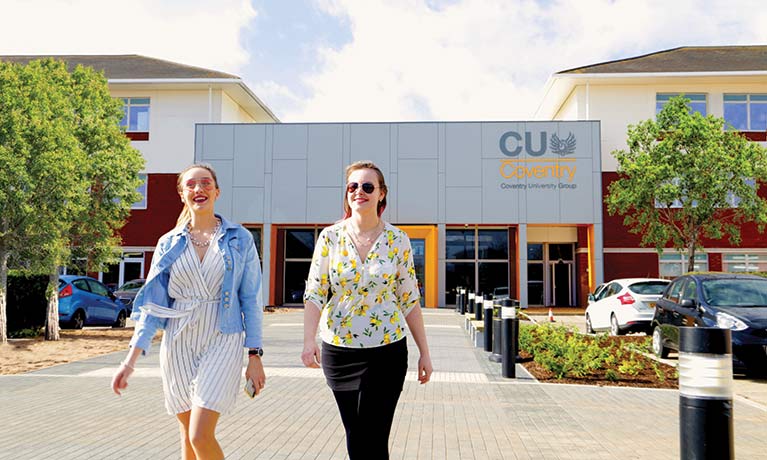
Mile Lane
The campus is home to an on-site library with bookable one-to-one academic writing service and library support sessions, fully equipped seminar rooms, open-access study areas, a café and an IT suite. Our labs contain industry-standard equipment so that you learn using the same equipment as many industry professionals.

The Hub
At The Hub you'll find the Health and Wellbeing Centre, the Students’ Union and Square One (which provides entertainment from quiz nights to live music), the Spirituality and Faith Centre, Tank Studio, Careers Office and a fantastic food court.

Lanchester Library
Coventry University’s Lanchester Library is usually open 364 days a year, and has 1,400 study spaces, including group and silent areas. It also currently offers more than 550 computers and an additional 120 free-to-loan laptops.
Facilities are subject to availability. Access to some facilities (including some teaching and learning spaces) may vary from those advertised and/or may have reduced availability or restrictions where the university is following public authority guidance, decisions or orders.
The engineering and computing buildings house an impressive range of industry standard equipment. Home to flight and driving simulators, a chassis design assembly and test facility and wind tunnels, the High Performance Engineering Centre (HPEC) also houses a fleet of CNC manufacturing machines, a full size vehicle shaker rig and a composite material laboratory4.
Take a virtual tour
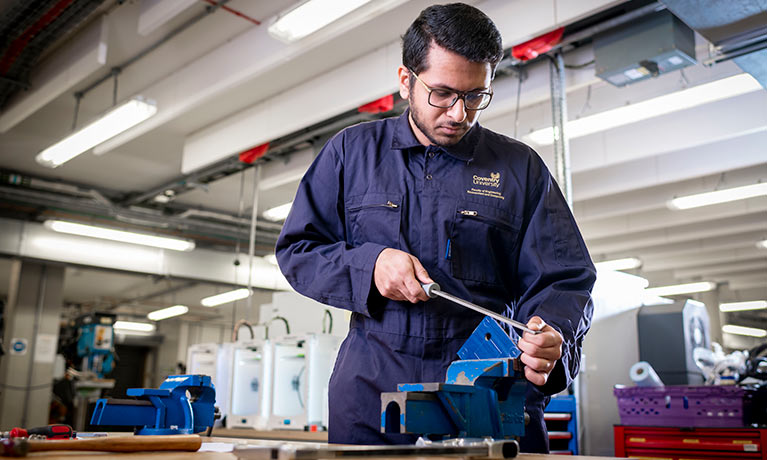
Metals Workshop
Participate in technical work in a hands-on way. The workshop includes lathes, milling machines, fabrication equipment for sheet metal work, CNC machines, work benches, welding lines and a fitting assembly area.
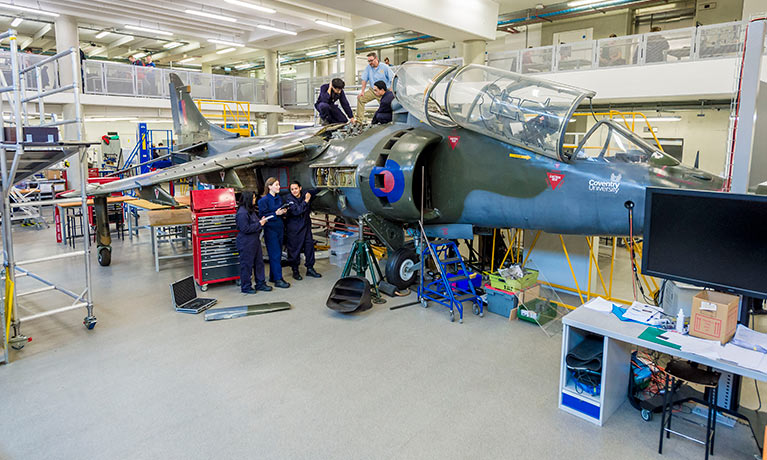
Harrier Jet
Our Harrier T4 allows students to gain hands-on experience with the parts, tools and mechanical aspects of a real aircraft. It is used by many engineering disciplines to learn how an aircraft works and how to maintain it.

Metrology Laboratories
Coventry University is a recognised leader for independent measurement expertise and services in the field of metrology. Facilities in our metrology laboratory include an impressive range of dimensional metrology equipment.
Facilities are subject to availability. Access to some facilities (including some teaching and learning spaces) may vary from those advertised and/or may have reduced availability or restrictions where the university is following public authority guidance, decisions or orders.
Careers and opportunities
Once you successfully complete the course you should be able to:
- apply the necessary study and research skills to support the analytical, critical and reflective requirements of written, oral and group assessments
- contribute to a team with the necessary planning, reviewing, adaptability, drive and leadership to achieve the required objectives and observe work schedules
- clearly communicate research, concepts, solutions, and recommendations, and demonstrate an approach to written and oral presentations appropriate to an engineering professional
- demonstrate knowledge and understanding of the principles, theories and practices found in engineering management and leadership, consultancy, and entrepreneurship
- develop independent learning and problem-solving skills appropriate to current and future study and employment
- apply engineering principles, science, mathematics, processes, materials, design, and management to solve problems of increasing complexity
- apply engineering analysis methods when solving complex problems and develop extended experience in solving problems related to a broad range of mechanical systems and components
- generate, and appropriately communicate, design solutions through the application and comprehensive understanding of the engineering design processes
- critically assess data and information using practical laboratory skills, experimentation, and research, and establish the effect on design
- understand risk assessment and the need for professional and ethical conduct in commercial and social contexts, informed by a knowledge of sustainable development and the regulations/legislation governing engineering activities
- understand and evaluate a range of appropriate engineering materials, components, and systems, identifying their limitations and likely developments.
Successful completion of this course provides a possible route into many careers within the global engineering industry, including such industries as aerospace, automotive, rail, marine, chemical construction and defence.
This includes support in identifying placements2 and employment. Previous placements have included GE Oil and Gas in subsea systems and design; LH Group examining rail industry servicing; vehicle build for Jaguar Land Rover; and engine development for Cummins Engines.
Coventry University is committed to preparing you for your future career and giving you a competitive edge in the graduate job market. The University’s careers team provide a wide range of support services to help you plan and prepare for your career4.
Where our graduates work
- IBM
- Cummins Engines
- TATA Motors
- TATA Technologies
- Jaguar Landrover
- Geely
- Unipart
- Rolls Royce
The graduate destinations listed above illustrate potential career paths. You may need to gain additional qualifications or practical experience, pass professional examinations, complete training, cover associated costs and meet specific visa or immigration requirements to secure employment in these fields.

Discover Phoenix+
Phoenix+ brings you together with other students to learn, experience and develop essential knowledge and skills. Whatever destination you choose, it's about preparing you for life after university.
Learn more about Phoenix+How to apply
This course with foundation year is not available to international students.
UK students
Disclaimers
You may also like
Coventry University (Coventry)
Automotive Engineering MEng/BEng (Hons)
Coventry University (Coventry)

Aerospace Engineering MEng/BEng (Hons)
Coventry University (Coventry)