Search
Social Work BA (Hons)
Study level: Undergraduate
Prepare for a career in social work through practice-based learning, real-world placements and professional skill development.
Course features
Year of entry
Location
Coventry University (Coventry)
Study mode
Full-time
Duration
3 years full-time
Course code
L500
Start date
September 2027
Course overview
If you are motivated to make a difference and ready to build a rewarding career supporting individuals, families, and communities in a range of circumstances, our Social Work BA (Hons) degree could be the right fit for you.
Our modern, practice-focused approach is co-created with employers, current students and people with lived experience to help you gain real-world insights. You will learn in a structured, manageable way by typically studying one module and completing one assessment at a time in focused blocks, balancing your academic studies with substantial hands-on placement experience. This course is designed to help you develop the knowledge, skills and professional values needed for contemporary social work practice in the UK, including safeguarding, social justice, law and ethical decision-making.

Rated Gold Overall
Teaching Excellence Framework (TEF) 2023
5 QS Stars for Teaching and Facilities
QS Stars University Ratings
4th Student City in England (Coventry)
QS Best Student Cities Index 2027Why you should study this course
Social work offers the opportunity to make a lasting difference, supporting vulnerable people, protecting individuals from harm and improving life chances.
- Gain 170 days of placement2,5 experience: over two placements and 30 skills days which are delivered during teaching, contributing towards the professional requirement for practice-based learning in social work training.
- Hands-on learning: develop the knowledge, values and practical skills through academic study, skills development and placement experience.
- Learn through real-world application: develop your skills through case studies, simulations, role play and learning with practitioners and people with lived experience.
- Focused and structured learning: study one module at a time, typically over seven weeks with assessment submission in week seven.
- Career-focused course design: build the knowledge, behaviours and values required for practice, informed by employer input and placement experience.
- Build skills for today’s social challenges: develop the knowledge and capability to work with diverse communities and respond to contemporary social issues in a thoughtful and professional way.
- Support that helps you succeed: you’ll benefit from a comprehensive induction and ongoing support, including a Student Success Coach, welfare services, peer mentors and a dedicated personal tutor. This support runs alongside your learning, helping you build the confidence and professionalism to respond effectively to real-world social work challenges.
1st for
Student Satisfaction in Health Studies
The Complete University Guide 2027

Studying Social Work
Why social work matters so much, and what it's like to study it at Coventry University.
Find out moreWhat you'll study
This course is designed to help build your knowledge of social work theory, law and ethics alongside real-world experience. You’ll apply what you learn in two placements2,5, developing the skills to work with children, families and adults, while being supported to strengthen your confidence, decision-making and reflective practice. By the final year, you should be ready to manage complex situations in social work.
Placements
Placements are a compulsory and central part of this course. You will complete two placements in contrasting settings, typically in Year 2 and Year 3. Together, these contribute towards at least 170 days of practice-based learning.
During placements, you will be supported by qualified social work practitioners, with opportunities to apply your learning in practice and build your skills in real-world context.
We regularly review our course content to keep it relevant and current for our students. Consequently, we may update modules to reflect the latest industry standards.
How you'll learn
Teaching and learning methods may include:
- lectures
- seminars
- tutorials
- presentations
- group projects
- workshops
- practical studio sessions3
- practical simulation sessions3.
Teaching contact hours
As a full-time undergraduate student, you will study modules totalling 120 credits each academic year. A typical 30 credit module requires a total of 300 hours study. This is made up of teaching contact hours, guided and independent study.
Teaching hours
Teaching hours vary each semester, year of study and due to module selection. During your first year you can expect 15-18 teaching hours each week. You will also have the option to attend optional sessions including time with a progress coach or to meet with staff for advice and feedback. As you progress through your studies, teaching hours may reduce.
Guided and independent study:
Throughout your studies, you will be expected to spend time in guided and independent study to make up the required study hours per module. You'll be digging deeper into topics, review what you've learnt and complete assignments. This can be completed around your personal commitments. As you progress through your studies, you'll spend more time in independent study.
Online learning:
As an innovative university, we use different teaching methods including online tools and emerging technologies. So, some of your teaching hours and assessments may be delivered online.
Assessment
Assessments are designed to reflect real-world social work practice, supporting you to develop relevant professional skills.
This course will be assessed using a variety of methods which will vary depending upon the module.
Assessment methods may include:
- portfolios
- case studies
- presentations
- group work
- coursework
- reflective writing
- essays
- reports.
The Coventry University Group assessment strategy ensures that our courses are fairly assessed and allows us to monitor student progression towards achieving the intended learning outcomes.
International experience opportunities
The course includes opportunities2 to develop a global perspective through collaborative online learning with international collaborators and engagement with global social work issues.
Optional international experiences, such as mobility programmes or collaborative projects, may be available.
Please note that all international experience opportunities may be subject to additional costs, competitive application, availability and meeting applicable visa and travel requirements are therefore not guaranteed2.
When deciding which university to pick, Coventry University stood out to me because the admissions process had a human touch. Throughout the process, the admissions tutor was there to update us and answer any questions. This meant that, when we turned up on the first day, we already had a familiar face. My experience of the course so far has been brilliant. The tutors are committed to our learning and development, and we have been provided with opportunities for interactive learning, with the Simulation Day in particular being a fantastic chance to put our learning into practice.
Alice Belcher, BA Social Work, quoted 2026
Entry requirements
Typical entry requirements:
Fees and funding
| Student | Full-time | Part-time |
|---|---|---|
| UK, Ireland*, Channel Islands or Isle of Man | 2027/28 fees TBC 2026/27 fees: £9,790 per year |
Not available |
| EU | 2027/28 fees TBC 2026/27 fees: £9,790 per year with EU Support Bursary** 2027/28 fees TBC 2026/27 fees: £17,600 per year without EU Support Bursary** |
Not available |
| International | 2027/28 fees TBC 2026/27 fees: £17,600 per year |
Not available |
For advice and guidance on tuition fees and student loans visit our Undergraduate Finance page and see The University’s Tuition Fee and Refund Terms and Conditions.
The University will charge the tuition fees stated in the table above for the first Academic Year of study. The University will review tuition fees each year. For UK (home) students, if the Parliament permits an increase in tuition fees, the University may increase fees for each subsequent year of study in line with any such changes. Note that any increase is expected to be in line with the Retail Price Index (RPI), a UK measure of inflation that tracks changes in the cost of living.
For international students, we may increase fees each year, but such increases will be no more than 5% above RPI. If you defer your course start date or have to extend your studies beyond the normal duration of the course (e.g. to repeat a year or resit examinations), you may be charged the tuition fees in force at the time you take that additional period of study, and/or in line with any legislative changes that apply at that time.
We offer a range of International scholarships to students all over the world. For more information, visit our International Scholarships page.
Tuition fees cover the cost of your teaching, assessments, facilities and support services. There may be additional costs not covered by this fee such as accommodation and living costs, recommended reading books, stationery, printing and re-assessments should you need them. Find out what's included in your tuition costs.
The following are additional costs not included in the tuition fees:
- Any optional overseas field trips or visits: £400+ per trip.
- Any costs associated with securing, attending or completing a placement (whether in the UK or abroad) which may include costs of travel, accommodation, equipment or uniform required for the placement and any visa-related costs.
*Irish student fees
The rights of Irish residents to study in the UK are preserved under the Common Travel Area arrangement. If you are an Irish student and meet the residency criteria, you can study in England, pay the same level of tuition fees as English students and utilise the Tuition Fee Loan.
**EU Support Bursary
Following the UK's exit from the European Union, we are offering financial support to all eligible EU students who wish to study an undergraduate or a postgraduate degree with us full-time. This bursary will be used to offset the cost of your tuition fees to bring them in line with that of UK students. Students studying a degree with a foundation year with us are not eligible for the bursary.
How do you know if you need to pay UK or international tuition fees?
Facilities
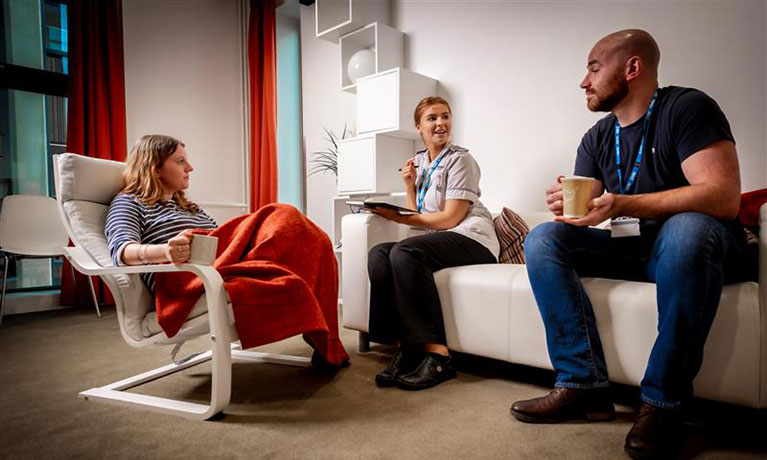
Community Houses
Our two full-size community homes can be used for sessions simulating working with patients outside of a hospital setting.
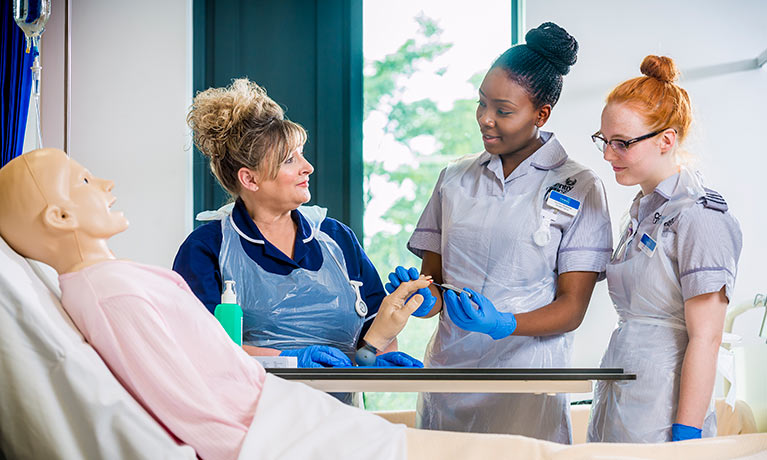
Mock Hospital Wards
Our mock hospital wards and critical care settings give you the chance to experience patient scenarios in a real-world environment.

VR CAVE
Experience the future of learning with this huge simulation screen covering three walls. Using 3D headsets, you can step into realistic, interactive and immersive healthcare scenarios to practice your clinical skills and interact with simulated patients.
You’ll use facilities through timetabled teaching, practical activities and relevant independent study. Access may vary by module, activity, capacity, supervision or safety requirements. Access may change or be limited where the University needs to follow public authority guidance, decisions or orders.
Careers and opportunities
On successful completion, you will have had the opportunity to develop the knowledge, skills and values required for contemporary social work practice.
Graduates may progress into a range of social work and related roles, subject to meeting any professional registration requirements in place at the time of graduation. Our employer collaborations help inform the course and provide opportunities for practice-based learning. Graduates may progress into roles across local authorities, the NHS and voluntary sector organisations.
Graduates may choose to explore opportunities in private companies, public sector organisations, charities, start-ups, consultancy settings, marketing and communications teams, HR teams, operations teams, project teams or business development functions.
These are examples of possible career paths. Some roles may require further training, professional accreditation or experience.
Where our graduates work
Previous graduates have benefited from our links with employers such as the West Midlands Social Work Teaching Partnership, and especially Coventry City Council, Warwickshire County Council and Solihull Metropolitan Borough Council.
How to apply
UK students
International students
Disclaimers
You may also like

Coventry University (Coventry)
Social Work MA/PGDip
Coventry University (Coventry)
Occupational Therapy BSc (Hons)
Coventry University (Coventry)