Business Economics BSc (Hons) with foundation year
Study level: Undergraduate
Our Business Economics BSc (Hons) course provides training in analytical and empirical methods that can be applied to a wide range of real-world economic and business problems.
Course option
Year of entry
Location
CU Coventry (Coventry) and
Coventry University (Coventry)
Study mode
Full-time
Sandwich
Duration
4 years full-time
5 years sandwich
UCAS codes
L1DF
Start date
September 2025
November 2025
Course overview
Our degree with foundation year could be the stepping stone you need to achieve your goals. The foundation year aims to prepare you for degree-level study and is a great way to build the confidence, skills and knowledge needed to succeed on your degree course.
Foundation year
The foundation year aims to provide a credible broad-based preparatory course that will equip you with the necessary skills and competencies to study at degree level.
Degree
This course covers current real-world issues and aims to help you understand how economics can be applied to solve problems and address challenges affecting businesses, financial organisations and wider society.

Joint Top Modern University for Career Prospects
Guardian University Guide 2021 and 2022
5 QS Stars for Teaching and Facilities
QS Stars University Ratings
Top 10 UK Student City (Coventry)
QS Best Student Cities Index 2024Why you should study this course
Foundation year
- Supports you to gain the academic skills required for degree-level study.
- Provides a grounding in key areas of economics and finance.
Degree
- tailor your studies
Our wide range of economics and finance courses share a common year one and aim to offer you opportunities to achieve a thorough grounding in economic and financial concepts and principles. - build industry insight
Learn from experienced staff who have worked extensively in economics and hear from industry professionals who in the past, have included speakers from HM Treasury, Lloyds Bank, Barclays and the European Commission2. (Staff may be subject to change). - Explore both microeconomics and macroeconomics with extensive exposure to how businesses and other organisations operate in a global context, drawing on business case studies from the UK and internationally.
- Develop highly sought-after skills in economic analysis as well as a wide range of transferable skills relevant for a variety of career paths including those in business, finance, and the public sector.
- Access maths and statistics support: our sigma centre offer maths and statistics support thought drop-in sessions and bookable appointments with experienced tutors.
Accreditation and professional recognition

Chartered Insurance Institute
This course is recognised by the Chartered Insurance Institute (CII) for the 2025/26 intakes. CII recognition allows students to gain certain exemptions from some professional examinations, upon successful completion of this course (subject to application, availability, meeting applicable visa requirements and additional fees may apply). If there is any change to the recognition of this course by the CII, we would seek to notify applicants and students as soon as possible.
-
Additional certificates
As part of the degree you will have the option to work towards two additional certifications (outside of your study modules):
[1] Bloomberg Market Concepts Certificate: Optional certification to help our students stand out and demonstrate their understanding of financial markets, central banking and the application of economic indicators, as well as hone their skills in utilising Bloomberg terminal functionalities for a fast moving market.
[2] Bloomberg ESG Certificate: Optional certification for students to demonstrate their understanding of the Environmental, Social and Governance factors, and their implications for strategy development and regulatory compliance.
-
Memberships
CISI – Chartered Institute for Securities Investment
We offer students the opportunity to take a professional exam - Introduction to Investment and Securities. This is offered as we are awarded Centre of Excellence for its teaching in Securities and Investments by CISI, as an official education partner teaching certain modules (verified by CISI) that covers the syllabus or meets the standard benchmark for one of the certificates.
Chartered Association of Business Schools (CABS)
Coventry Business School is currently an active member of the Chartered Association of Business Schools, which has a membership of over 120 business schools and higher education providers, and supports its members in maintaining world-class standards of teaching and research.
European Foundation for Management Development (EFMD)
Coventry Business School is currently an active member of the European Foundation for Management Development, a global membership organisation dedicated to management development, covering over 900 members across 91 countries.
PRME - The Principles for Responsible Management Education
Coventry Business School is currently an active member of The Principles for Responsible Management Education (PRME). PRME is a United Nations-supported initiative founded in 2007 that aims to raise the profile of sustainability in their classrooms through seven principles focused on serving society and safeguarding our planet.
AACSB- The Association to Advance Collegiate Schools of Business
Coventry Business School is currently an active member of the Association to Advance Collegiate Schools of Business (AACSB). AACSB is the world’s largest network of business schools and organisations committed to advancing business education and making a lasting, positive impact on society to create next generation of great leaders.
BGA - Business Graduates Association
Coventry Business School is currently an active member of the Business Graduates Association (BGA). BGA’s student and graduate benefits have been crafted to enhance your learning experience, providing a range of tools to support professional and personal development.
SBC - Small Business Charter
Coventry Business School is a recipient of the Small Business Charter (SBC) Award. The award is a mark of excellence for business schools, recognising their expertise in supporting small businesses, student entrepreneurship, and effective engagement in the local economy.
Memberships are reviewed on an annual basis and are not guaranteed. Applicants and students will be informed of any changes as soon as possible.
The support and insight provided by the educators was exceptional from all modules, across all three years of the degree. I truly felt that everyone in the Economics department had my best interests at heart from recommended reading to coursework feedback.
One of my most enjoyable experiences within course included the annual participation of Collaborative Online International Project (COIL) with other students from foreign universities where we would tackle a topical economic issue and provide policy recommendations for governments in our respective countries.
Alex Hill, Economics BSc (quoted 2023)

What you'll study
We regularly review our course content, to make it relevant and current for the benefit of our students. For these reasons, course modules may be updated.
How you'll learn
My research background is in the economics of healthcare, and I am passionate about applying research to contemporary global challenges. In my teaching, I embed research findings into economic concepts, which helps to stimulate a continuous learning process beyond the classroom. Learners begin to view their environments with an economic lens and become economic advisors, seeing the real impact of economic decisions in the world around them.
Dr Judith Kabajulizi, Assistant Professor in Economics, 2024

Entry requirements
Typical entry requirements:
Got higher grades? Have you considered direct entry to the degree without foundation year?
Fees and funding
Foundation year
| Student | Full-time | Part-time |
|---|---|---|
| UK, Ireland*, Channel Islands or Isle of Man | 2025/26 fees TBC 2024/25 fees - £7,950 |
Not available |
| International/EU | Not currently available*** | Not available |
Degree
| Student | Full-time | Part-time |
|---|---|---|
| UK, Ireland*, Channel Islands or Isle of Man | 2025/26 fees TBC 2024/25 fees - £9,250 per year |
Not available |
| International/EU | Not currently available*** | Not available |
If you choose to study this course with a professional placement2 or study abroad year, you will need to pay a tuition fee3 of £1,250 to cover your academic support throughout your placement year.
For advice and guidance on tuition fees and student loans visit our Undergraduate Finance page and see The University’s Tuition Fee and Refund Terms and Conditions.
The University will charge the tuition fees that are stated in the above table for the first Academic Year of study. The University will review tuition fees each year. For UK (home) students, if Parliament permits an increase in tuition fees, the university may increase fees for each subsequent year of study in line with any such changes. Note that any increase is expected to be in line with inflation.
For international students, we may increase fees each year, but such increases will be no more than 5% above inflation. If you defer your course start date or have to extend your studies beyond the normal duration of the course (e.g. to repeat a year or resit examinations) the University reserves the right to charge you fees at a higher rate and/or in accordance with any legislative changes during the additional period of study.
We offer a range of international scholarships to students all over the world. For more information, visit our international scholarships page.
Tuition fees cover the cost of your teaching, assessments, facilities and support services. There may be additional costs not covered by this fee such as accommodation and living costs, recommended reading books, stationery, printing and re-assessments should you need them.
Applies to degree only:
The following are additional costs not included in the tuition fees:
- Any optional overseas field trips or visits: £400+ per trip.
- Any costs associated with securing, attending or completing a placement (whether in the UK or abroad).
Condensed course – January start date
If you choose to start this degree in January please make sure you check the Fees and Finance page for more information. Although starting this course in January does not prohibit you from being eligible for student finance, the way it is paid in your first year differs from those who start their course in September.
If you start the degree in January, your tuition fees will be paid in accordance with the university’s Tuition Fees, Refund and Withdrawal Terms and Conditions for January starters and for any further years of study, your fees will be paid in accordance with the terms for September starters.
*Irish student fees
The rights of Irish residents to study in the UK are preserved under the Common Travel Area arrangement. If you are an Irish student and meet the residency criteria, you can study in England, pay the same level of tuition fees as English students and utilise the Tuition Fee Loan.
**This course with foundation year is not currently available to international students. If you do not meet the entry requirements to directly join year 1 of the degree, please take a look at our International Pathways Programme for additional options.
-
How do you know if you need to pay UK or international tuition fees?
We carry out an initial fee status assessment based on the information you provide in your application. Your fee status determines your tuition fees, and what financial support and scholarships may be available to you. The rules about who pays UK (home) or international (overseas) fees for higher education courses in England are set by the Department for Education. The regulations identify all the different categories of student who can insist on paying the home rate. The regulations can be difficult to understand, so the UK Council for International Student Affairs (UKCISA) has provided fee status guidance to help you identify whether you are eligible to pay the home or overseas rate.
If you meet all the criteria required by any one category, including any residence requirements, your institution must charge you the home rate. You only need to find one category that you fit into.
Facilities
Our foundation years are taught at CU Coventry’s Mile Lane building, a short walk from the city centre. You’re part of the university from day one, so during your foundation year you’ll have access to the wider facilities4 at Coventry University. Once you successfully complete your foundation year, you'll transfer over to studying your chosen degree at Coventry University, where you'll be taught on campus in the relevant academic buildings.
Located on our Mile Lane campus, you will have access to our Library and Learning Services (LLS), fully equipped seminar rooms and IT suites4. You can also take advantage of reading rights in Coventry University’s Lanchester Library, make use of sport centre facilities and receive full membership to Your Students' Union.
Study location
The Foundation Year study route will be delivered by CU, part of the Coventry University Group, for and on behalf of Coventry University. If you choose to study at CU Coventry for your Foundation Year, then your learning will be based at CU Coventry, Mile Lane, Coventry. Subject to meeting requirements you will then transition to the relevant Coventry University subject building for your progression degree.
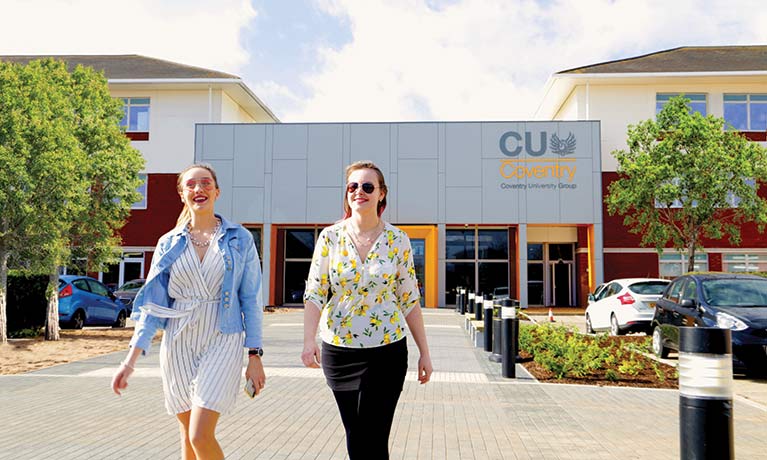
Mile Lane
The campus is home to an on-site library with bookable one-to-one academic writing service and library support sessions, fully equipped seminar rooms, open-access study areas, a café and an IT suite. Our labs contain industry-standard equipment so that you learn using the same equipment as many industry professionals.

The Hub
At The Hub you'll find the Health and Wellbeing Centre, the Students’ Union and Square One (which provides entertainment from quiz nights to live music), the Spirituality and Faith Centre, Tank Studio, Careers Office and a fantastic food court.

Lanchester Library
You will have full reading rights in Coventry University’s Lanchester Library. The library is open 24/7, 364 days a year and has many study spaces, including group and silent areas. It also currently offers touchdown computers and free-to-loan laptops.
Careers and opportunities
Upon successful completion, you will be able to:
- critically evaluate modern economic theory and the empirical methods used by economists,
- demonstrate knowledge of the workings of economic systems and business organisations, both within the UK and the wider global economy, including the ability to interpret relevant data and evaluate business strategies and government policies,
- apply economic theories and empirical methods to real-world business scenarios by making appropriate use of data, abstraction, and logical reasoning to analyse economic events and issues,
- communicate technical concepts related to economic analysis and policy debates to a diverse range of audiences, and develop the ability to influence relevant stakeholders, thus allowing students to successfully proceed to a professional career or further study,
- examine issues of sustainability and ethics from an economic perspective, and critically appraise the ethical and sustainability implications of business operations and relevant economic policies,
- integrate issues of national economic policy and analysis into a global business context, and hence appreciate the value of international cooperation,
- use a range of transferable, entrepreneurial and innovative skills, such as writing clear and concise reports based on evidence and logic, making effective use of information technology, confident delivery of presentations, creative problem solving, financial skills and self-motivation.
Upon successful graduation, you should possess an in-depth knowledge of economic theories and models, with strong analytical and problem-solving skills and mathematical ability. You should also be able to demonstrate a wide range of desirable professional skills, including team working, critical evaluation, self-directed learning, problem-solving, action planning and organising, written and oral communication, questioning and listening. The following personal qualities will also be addressed in each of the skills modules: achievement orientation, initiative and creativity, self-confidence, decisiveness, reflectiveness, adaptability and flexibility.
Where our graduates work
Upon successful completion, you should be well placed to pursue a wide variety of potential future career options in investment banking, accountancy, business data analysis, the public sector, auditing, management, business consultancy, mergers and acquisitions, and many more. Past graduates have found employment in a wide variety of careers at the managerial level in both the private and public sectors.
Further study
Alternatively, you may decide to pursue postgraduate study opportunities which could further enhance your employability by studying courses such as our Accounting and Financial Management MSc or Finance MSc at Coventry Business School, or our Global Finance MSc, Global Financial Trading MSc or Financial Technology (FinTech) MSc. You may be entitled to an alumni discount on your fees if you decide to extend your time with us by progressing from undergraduate to postgraduate study.
How to apply
-
UK students
Applications open for this course in May 2024. In the meantime you can register your interest in Coventry University.
Part-time students should apply directly to the university.
If you'd like further support or more information about your course get in touch with us today.
Chat with our admissions team
Complete our contact form
-
International students
International codes:
How to apply
CFBLU087IFor further support for international applicants applying for an undergraduate degree view our International hub.
You can also download our International guide which contains lots of useful information about our courses, accommodation and tips for travel.
Get in touch with us today for further advice and guidance.
Chat with our admissions team
Complete our contact form
-
Disclaimers
Study location
The Foundation Year study route will be delivered by CU, part of the Coventry University Group, for and on behalf of Coventry University.
If you choose to study at CU Coventry for your Foundation Year, then your learning will be based at CU Coventry. Mile Lane, Coventry. Subject to meeting requirements you will then transition to the relevant Coventry University subject faculty building for your progression degree.
Coventry University together with Coventry University London, Coventry University Wrocław, CU Coventry, CU London, CU Scarborough, and Coventry University Online come together to form part of the Coventry University Group (the University) with all degrees awarded by Coventry University.
1Accreditations
The majority of our courses have been formally recognised by professional bodies, which means the courses have been reviewed and tested to ensure they reach a set standard. In some instances, studying on an accredited course can give you additional benefits such as exemptions from professional exams (subject to availability, fees may apply). Accreditations, partnerships, exemptions and memberships shall be renewed in accordance with the relevant bodies’ standard review process and subject to the university maintaining the same high standards of course delivery.
2UK and international opportunities
Please note that we are unable to guarantee any UK or international opportunities (whether required or optional) such as internships, work experience, field trips, conferences, placements or study abroad opportunities and that all such opportunities may be unpaid and/or subject to additional costs (which could include, but is not limited to, equipment, materials, bench fees, studio or facilities hire, travel, accommodation and visas), competitive application, availability and/or meeting any applicable travel, public authority guidance, decisions or orders and visa requirements. To ensure that you fully understand any visa requirements, please contact the International Office.
3Tuition fees
The University will charge the tuition fees that are stated in the above table for the first Academic Year of study. The University will review tuition fees each year. For UK (home) students, if Parliament permit an increase in tuition fees, the University may increase fees for each subsequent year of study in line with any such changes. Note that any increase is expected to be in line with inflation.
For international students, we may increase fees each year, but such increases will be no more than 5% above inflation. If you defer your course start date or have to extend your studies beyond the normal duration of the course (e.g. to repeat a year or resit examinations) the University reserves the right to charge you fees at a higher rate and/or in accordance with any legislative changes during the additional period of study.
4Facilities
Facilities are subject to availability. Access to some facilities (including some teaching and learning spaces) may vary from those advertised and/or may have reduced availability or restrictions where the university is following public authority guidance, decisions or orders.
Student Contract
By accepting your offer of a place and enrolling with us, a Student Contract will be formed between you and the university. A copy of the current 2024/2025 contract is available on the website for information purposes however the 2025/2026 contract will apply for the 2025/2026 intake. The Contract details your rights and the obligations you will be bound by during your time as a student and contains the obligations that the university will owe to you. You should read the Contract before you accept an offer of a place and before you enrol at the university.
You may also like

Coventry University (Coventry)

Business and Finance BSc (Hons)
Coventry University (Coventry)

Economics BSc (Hons)
Coventry University (Coventry)