Search
Accounting and Finance BSc (Hons) with foundation year
Study level: Undergraduate
This course offers you the chance to gain a solid foundation in a broad range of potential career options within finance, accountancy, financial management or fiscal management.
Course features
Course option
Year of entry
Location
CU Coventry (Coventry) and
Coventry University (Coventry)
Study mode
Full-time
Sandwich
Duration
4 years full-time
5 years sandwich
UCAS codes
NNDF
Start date
March 2026
May 2026
June 2026
September 2026
November 2026
January 2027
March 2027
May 2027
July 2027
Course overview

Our degree with foundation year could be the stepping stone you need to achieve your goals. The foundation year aims to prepare you for degree-level study and is a great way to build the confidence, skills and knowledge needed to succeed on your degree course.
Foundation year
This year aims to provide the fundamental knowledge and skillset in a range of mathematical and business principles, as well as the theories and concepts involved in investment risk and professional ethics.
Degree
Sound financial knowledge and accountancy skills help businesses make informed decisions, develop the right strategies and achieve growth, while also considering ethics and sustainability. Management roles often require budgeting and financial administration skills to keep a business on track and achieve targets. Coventry University’s Accounting and Finance BSc (Hons) course is designed to help you develop these capabilities.

Rated Gold Overall
Teaching Excellence Framework (TEF) 2023
5 QS Stars for Teaching and Facilities
QS Stars University Ratings
Top 5 Student City in England (Coventry)
QS Best Student Cities Index 2026Why you should study this course
Shape your future in accounting and finance with a degree designed for flexibility, professional recognition and real-world experience.
Foundation year
- Supports you to gain the academic skills required for degree-level study.
- Provides a grounding in key areas of accounting and finance.
Degree
- Tailor your study to your chosen career path: in your first year, you will study a range of subjects aimed at giving you a grounded understanding of the principles around accounting, finance and financial management. In your second and final years, you will build on this foundation and narrow down your focus to specialise in your area of interest.
- Prepare for professional qualifications: our degree is closely aligned to the syllabi of professional accountancy bodies, including the Association of Chartered Certified Accountants (ACCA), Chartered Institute of Management Accountants (CIMA) and the Institute of Chartered Accountants in England and Wales (ICAEW).
- Enjoy an engaging student experience: participate in events2 such as International Audit Week and International Tax Week, where you get to network with industry partners, engage with student delegations from international universities and compete in a simulated environment, bringing academic learning to life.
- Put your skills to the test: prepare and analyse financial statements and study the impact of finance on real businesses through case studies of a range of organisations.
- Develop practical skills in our Bloomberg Trading Floor:4 gain hands-on experience of market-leading financial databases such as Bloomberg, LSEG Workspace, Fitch Connect and Bureau van Dijk Fame, along with opportunities for professional certifications for Bloomberg, LSEG Workspace and in ESG.2,4
- Benefit from real-world exposure: boost your employability with an optional sandwich year2, offering you the chance to gain hands-on industry placement experience. Past students have undertaken placements at PwC, Ernst & Young, Deloitte, Jaguar Land Rover and the NHS.
- Join like-minded communities: enrich your student experience by becoming a member of a student-led society such as the Investment Society or the Economics Society.2
Accreditation and professional recognition
Association of Chartered Certified Accountants (ACCA)
This course is currently accredited by the Association of Chartered Certified Accountants (ACCA) for the 2025/26 intakes and is subject to re-accreditation for the 2026/27 intakes. Upon successful completion of the course, you will be eligible for exemption from a number of Applied Skills level ACCA papers, depending on the modules studied. Please note that additional papers will be required to be taken in order to attain the ACCA qualification, which will incur additional costs. You will also need to fulfil the practical experience requirement, register with ACCA and apply for relevant exemptions as well as meet any applicable visa requirements. For more information, please visit the ACCA website.
Chartered Institute of Management Accountants (CIMA)
This course is currently accredited by the Chartered Institute of Management Accountants (CIMA) for the 2025/26 intakes and is subject to re-accreditation for the 2026/27 intakes. Successful completion of the course entitles students to exemptions from a number of CIMA papers. Please note that additional papers will be required to be taken in order to attain the CIMA qualification, which will incur additional costs. You will also need to fulfil the practical experience requirement and register with CIMA and apply for relevant exemptions. Please see the CIMA website for more details. Should CIMA accreditation not be received we will write to you as soon as possible.
Chartered Accountants in England and Wales (ICAEW)
This course is currently accredited by the Institute of Chartered Accountants in England and Wales (ICAEW) for the 2025/26 intakes and is subject to re-accreditation for the 2026/27 intakes. Subject to the accreditation being approved, upon successful completion of this course, and obtaining a minimum mark of 50% on the specified modules you will be able to secure exemptions from certain ICAEW papers. Additional papers are required to be taken in order to attain the ICAEW qualification. These will incur additional costs, and you will need to fulfil the practical experience requirement. You will also need to register with ICAEW and apply for the relevant exemptions. Please visit the ICAEW website for more details.
International Audit Week
International Audit Week is usually held annually, and is dedicated to helping students develop their auditing skills, with a view to successful careers in the audit and accounting sectors.
What you'll study
We regularly review our course content, to make it relevant and current for the benefit of our students. For these reasons, course modules may be updated.
Why study economics, finance and accounting at Coventry University?
Dr Uchenna Tony Okeke discusses what makes studying at Coventry University’s School of Economics, Finance and Accounting a great choice.
Read Dr Okeke's blog
My experience at Coventry University was characterised by exceptional education and unwavering support from faculty members. They demonstrated a profound sense of responsibility, nurturing both my academic achievements and my personal growth. During seminars, teachers diligently addressed my queries, and their prompt responses to emails further demonstrated their dedication to my learning. Additionally, Coventry University offers an outstanding academic environment, featuring a 24-hour accessible library and abundant scholarly resources, which greatly facilitated my learning endeavours.
Leyi Chen, Accounting and Finance BSc (2024)

How you'll learn
My passion is to help build students' confidence in their own abilities to disentangle the complex issues of accounting and finance. It’s great when students question assumptions, consider alternative perspectives, reflect on ethical dilemmas, and discuss wider social or environmental implications. I qualified with two professional accounting bodies (CIMA & CPA Australia) and worked as an auditor and commercial analyst. Subsequently, I taught for many years at various institutions in several countries. Whilst I share my experience with learners, I also listen to them as well as hope to inspire them, so they embrace the life-changing possibilities this course offers them.
Dr Simon Huston, Associate Course Director 2024

Entry requirements
Typical entry requirements:
Got higher grades? Have you considered direct entry to the degree without foundation year?
Fees and funding
Foundation year
| Student | Full-time | Part-time |
|---|---|---|
| UK, Ireland*, Channel Islands or Isle of Man | £5,760 | Not available |
| International/EU | Not currently available*** | Not available |
Degree
| Student | Full-time | Part-time |
|---|---|---|
| UK, Ireland*, Channel Islands or Isle of Man | £9,790 per year | Not available |
| International/EU | Not currently available*** | Not available |
If you choose to study this course with a professional placement2 or study abroad year, you will need to pay a tuition fee3 to cover your academic support throughout your placement year. As an indication, students commencing their professional placement in the academic year 2028/29 will pay £1,575 if they are paying UK fees, or £1,900 if they are paying international fees. The University will charge the tuition fees stated above for those on a placement during Academic Year 2028/29. The University will review professional placement tuition fees each year. For UK (home) students, the University may increase fees for each subsequent year of study, but such that it will be no more than 5% above inflation.
For advice and guidance on tuition fees and student loans visit our undergraduate finance page and see the university’s Tuition Fee and Refund Terms and Conditions.
The University will charge the tuition fees that are stated in the above table for the first Academic Year of study. The University will review tuition fees each year. For UK (home) students, if Parliament permits an increase in tuition fees, the university may increase fees for each subsequent year of study in line with any such changes. Note that any increase is expected to be in line with inflation.
Tuition fees cover the cost of your teaching, assessments, facilities and support services. There may be additional costs not covered by this fee such as accommodation and living costs, recommended reading books, stationery, printing and re-assessments should you need them. Find out what's included in your tuition costs.
Applies to degree only:
The following are additional costs not included in the tuition fees:
- Any optional overseas field trips or visits: £400+ per trip.
- Any costs associated with securing, attending or completing a placement (whether in the UK or abroad).
Foundation year funding
In order to receive funding for degree with foundation year courses, you will need to complete a four-year degree programme which includes the integrated foundation year, otherwise you may be responsible for your foundation year fees. For further information, please refer to the 'Tuition Fee Loan' details in the 'Funding your undergraduate course' section of our 'Fees and finance' page.
*Irish student fees
The rights of Irish residents to study in the UK are preserved under the Common Travel Area arrangement. If you are an Irish student and meet the residency criteria, you can study in England, pay the same level of tuition fees as English students and utilise the Tuition Fee Loan.
**This course with foundation year is not currently available to international students.
How do you know if you need to pay UK or international tuition fees?
Facilities
Our foundation years are taught at CU Coventry’s Mile Lane building, a short walk from the city centre. You’re part of the university from day one, so during your foundation year you’ll have access to the wider facilities at Coventry University. Once you successfully complete your foundation year, you'll transfer over to studying your chosen degree at Coventry University, where you'll be taught on campus in the relevant academic buildings.
Located on our Mile Lane campus, you will have access to our Library and Learning Services (LLS), fully equipped seminar rooms and IT suites4. You can also take advantage of reading rights in Coventry University’s Lanchester Library, make use of sport centre facilities and receive full membership to Your Students' Union.

Mile Lane
The campus is home to an on-site library with bookable one-to-one academic writing service and library support sessions, fully equipped seminar rooms, open-access study areas, a café and an IT suite. Our labs contain industry-standard equipment so that you learn using the same equipment as many industry professionals.

The Hub
At The Hub you'll find the Health and Wellbeing Centre, the Students’ Union and Square One (which provides entertainment from quiz nights to live music), the Spirituality and Faith Centre, Tank Studio, Careers Office and a fantastic food court.

Lanchester Library
Coventry University’s Lanchester Library is usually open 364 days a year, and has 1,400 study spaces, including group and silent areas. It also currently offers more than 550 computers and an additional 120 free-to-loan laptops.
We have a range of facilities4 available to support our students in putting the theories you are taught into practice.
Take a virtual tour

The Trading Floor
The Trading Floor is an invaluable facility that allows you to get hands-on with industry-standard software. Featuring contemporary dual-screen Bloomberg terminals, the facility can add a dynamic, practical element to your course.
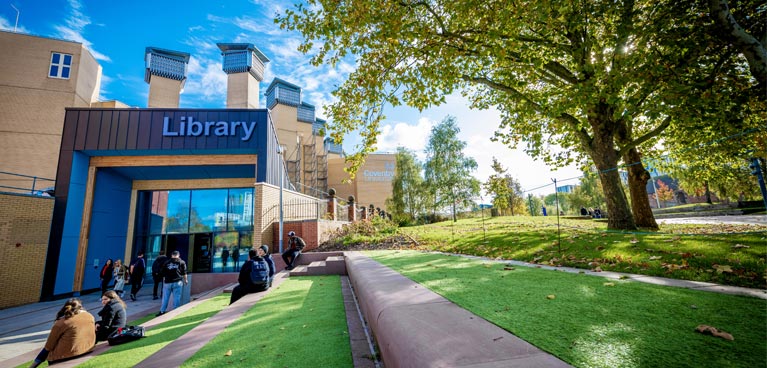
Lanchester Library
The library is open 364 days a year. It’s where you can access your course’s specialist Academic Liaison Librarian. It’s also home to specialist teams that can support you with your academic writing and maths and statistics questions.

Careers and employability
Get one-on-one career and employability guidance lasting up to 18 months from the end of your course. We’ll help you find placements and graduate roles, offer CV and application checks, mentoring, skills workshops, employer events and more.
Careers and opportunities
According to the Hays 2025 UK salary and recruiting trends data, a trainee accountant in the UK can earn anything between £22,500 and £37,000, while part-qualified can earn as much as £50,000.
The global average salary for a newly qualified ACA in 2025 is £55,000 according to ICAEW data, with the average salary for members across all sectors standing at £107,000. For members working in industry, the average global salary rises to £132,000.
You should graduate this course with highly sought-after technical, analytical and professional skills, ready to launch an impressive global career. You should be well placed to pursue a wide variety of potential future career options in areas such as:
- finance
- management
- accounting
- banking
- auditing
- personal and corporate finance
- business
- education in private, public and third sector organisations.
Alternatively, this course could set you on the path towards further study for a professional qualification as a Chartered Accountant.
The graduate destinations listed above illustrate potential career paths. You may need to gain additional qualifications or practical experience, pass professional examinations, complete training, cover associated costs and meet specific visa or immigration requirements to secure employment in these fields.
Where our graduates work
Our graduates have gone on to work for companies spanning a range of sectors such as BDO, Britvic, Meggit, ICON plc, and The Wigley Group.
Further study
Upon successful completion of our Accounting and Finance BSc (Hons) course, you may wish to continue to further your studies at postgraduate level with our Finance MSc here at Coventry Business School.
You can explore all of your options using our postgraduate course search tool.
You may be entitled to an alumni discount on your fees if you decide to extend your time with us by progressing from undergraduate to postgraduate study.
Please note that further study opportunities2 are subject to competitive application, availability, meeting any applicable visa requirements and additional costs may apply.
Accountancy at Coventry
Student Caleb Mellen talks about the skills and experience he’s learning on his 3rd year work placement.

Discover Phoenix+
Phoenix+ brings you together with other students to learn, experience and develop essential knowledge and skills. Whatever destination you choose, it's about preparing you for life after university.
Learn more about Phoenix+How to apply
This course with foundation year is not available to international students.
UK students
Disclaimers
You may also like

Coventry University (Coventry)

Accountancy BSc (Hons)
Coventry University (Coventry)

Business Economics BSc (Hons)
Coventry University (Coventry)