Search
Disaster and Emergency Management BSc (Hons) with foundation year
Study level: Undergraduate
Explore disaster and emergency management in a global context, developing skills in risk reduction, humanitarian relief and resilience to support responses to crises and emergencies.
Course features
Course option
Year of entry
Location
CU Coventry (Coventry) and
Coventry University (Coventry)
Study mode
Full-time
Sandwich
Duration
4 years full-time
5 years sandwich
UCAS codes
NHDF
Start date
March 2026
May 2026
June 2026
September 2026
November 2026
January 2027
March 2027
May 2027
July 2027
Course overview

Our degree with foundation year could be the stepping stone you need to achieve your goals. The foundation year aims to prepare you for degree-level study and is a great way to build the confidence, skills and knowledge needed to succeed on your degree course.
Foundation year
The foundation year will introduce you to the world of business with a strong focus on management, business communications and marketing in a global context. It creates opportunities for you to develop vital business skills, as well as preparing you for study at undergraduate level. You will put theory, both traditional and contemporary, into practice with real-world scenarios.
Degree
Disaster and emergency management professionals play a critical role in reducing the impact of human, technological and environmental catastrophes. Develop the skills to manage these events, blending theory with hands-on learning through simulations, fieldwork and industry collaborations.

Rated Gold Overall
Teaching Excellence Framework (TEF) 2023
5 QS Stars for Teaching and Facilities
QS Stars University Ratings
Top 5 Student City in England (Coventry)
QS Best Student Cities Index 2026Why you should study this course
Foundation year
- Supports you to gain the academic skills required for degree-level study.
- Provides a grounding in key areas of business and management.
Degree
- Comprehensive skill development: gain the knowledge to identify, critically analyse and respond to a wide range of crisis, emergency and disaster situations. Prepare for roles in practitioner, policy and management sectors.
- Practical learning opportunities: participate in or design emergency exercises in the university’s Simulation Centre, enhancing your practical experience in disaster scenarios.4
- Fieldwork and real-world exposure: fieldwork helps you to understand the risks and challenges faced by communities and responders. Guest lectures, site visits and field trip practical activities in the UK and internationally offer exposure to disaster risks and reduction measures in different contexts.2
- Strong industry connections: opportunities to work with agencies across various sectors to develop practical emergency and disaster simulation exercises, ensuring you gain insights from current industry practices.2
- Established expertise: we have over 20 years of experience in disaster and emergency management education, providing undergraduate and postgraduate programmes, bespoke training, professional development courses, research and consultancy in this field.
Why I chose the Disaster and Emergency Management course
I enjoy learning alternative ways to prevent or mitigate disasters and emergencies and how to implement plans effectively. Most of all, I enjoy the potential for improving people’s wellbeing and quality of life.
Read more from our second year student
What you'll study
Equip yourself with the skills to assess risks, coordinate responses and build resilience. Through simulations, fieldwork and industry placements, study crisis management, humanitarian aid and disaster recovery aligned with UN and UK frameworks. Gain hands-on experience for careers in emergency planning, risk consultancy or humanitarian relief.
We regularly review our course content, to make it relevant and current for the benefit of our students. For these reasons, course modules may be updated.
How you'll learn
Entry requirements
Typical entry requirements:
Got higher grades? Have you considered direct entry to the degree without foundation year?
Fees and funding
Foundation year
| Student | Full-time | Part-time |
|---|---|---|
| UK, Ireland*, Channel Islands or Isle of Man | £5,760 | Not available |
| International/EU | Not currently available*** | Not available |
Degree
| Student | Full-time | Part-time |
|---|---|---|
| UK, Ireland*, Channel Islands or Isle of Man | £9,790 per year | Not available |
| International/EU | Not currently available*** | Not available |
If you choose to study this course with a professional placement2 or study abroad year, you will need to pay a tuition fee3 to cover your academic support throughout your placement year. As an indication, students commencing their professional placement in the academic year 2028/29 will pay £1,575 if they are paying UK fees, or £1,900 if they are paying international fees. The University will charge the tuition fees stated above for those on a placement during Academic Year 2028/29. The University will review professional placement tuition fees each year. For UK (home) students, the University may increase fees for each subsequent year of study, but such that it will be no more than 5% above inflation.
For advice and guidance on tuition fees and student loans visit our undergraduate finance page and see the university’s Tuition Fee and Refund Terms and Conditions.
The University will charge the tuition fees that are stated in the above table for the first Academic Year of study. The University will review tuition fees each year. For UK (home) students, if Parliament permits an increase in tuition fees, the university may increase fees for each subsequent year of study in line with any such changes. Note that any increase is expected to be in line with inflation.
Tuition fees cover the cost of your teaching, assessments, facilities and support services. There may be additional costs not covered by this fee such as accommodation and living costs, recommended reading books, stationery, printing and re-assessments should you need them. Find out what's included in your tuition costs.
Applies to degree only:
The following are additional costs not included in the tuition fees:
- Any optional overseas field trips or visits: £400+ per trip.
- Any costs associated with securing, attending or completing a placement (whether in the UK or abroad).
Foundation year funding
In order to receive funding for degree with foundation year courses, you will need to complete a four-year degree programme which includes the integrated foundation year, otherwise you may be responsible for your foundation year fees. For further information, please refer to the 'Tuition Fee Loan' details in the 'Funding your undergraduate course' section of our 'Fees and finance' page.
*Irish student fees
The rights of Irish residents to study in the UK are preserved under the Common Travel Area arrangement. If you are an Irish student and meet the residency criteria, you can study in England, pay the same level of tuition fees as English students and utilise the Tuition Fee Loan.
**This course with foundation year is not currently available to international students.
How do you know if you need to pay UK or international tuition fees?
Facilities
Our foundation years are taught at CU Coventry’s Mile Lane building, a short walk from the city centre. You’re part of the university from day one, so during your foundation year you’ll have access to the wider facilities at Coventry University. Once you successfully complete your foundation year, you'll transfer over to studying your chosen degree at Coventry University, where you'll be taught on campus in the relevant academic buildings.
Located on our Mile Lane campus, you will have access to our Library and Learning Services (LLS), fully equipped seminar rooms and IT suites. You can also take advantage of reading rights in Coventry University’s Lanchester Library, make use of sport centre facilities and receive full membership to Your Students' Union.
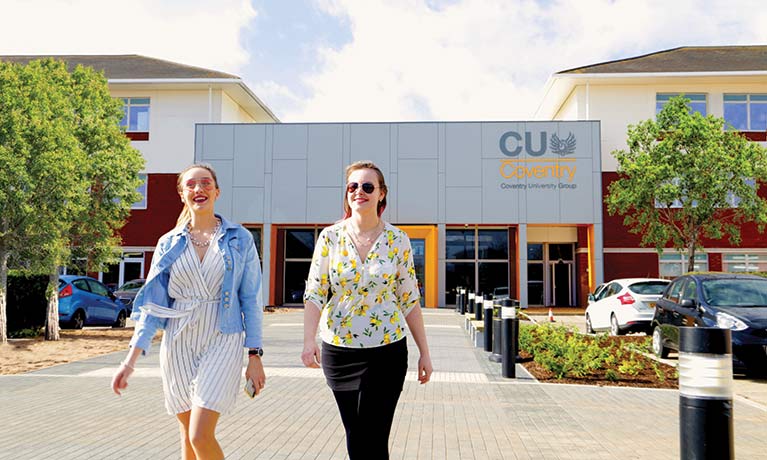
Mile Lane
The campus is home to an on-site library with bookable one-to-one academic writing service and library support sessions, fully equipped seminar rooms, open-access study areas, a café and an IT suite. Our labs contain industry-standard equipment so that you learn using the same equipment as many industry professionals.

The Hub
At The Hub you'll find the Health and Wellbeing Centre, the Students’ Union and Square One (which provides entertainment from quiz nights to live music), the Spirituality and Faith Centre, Tank Studio, Careers Office and a fantastic food court.

Lanchester Library
Coventry University’s Lanchester Library is usually open 364 days a year, and has 1,400 study spaces, including group and silent areas. It also currently offers more than 550 computers and an additional 120 free-to-loan laptops.
Facilities are subject to availability. Access to some facilities (including some teaching and learning spaces) may vary from those advertised and/or may have reduced availability or restrictions where the university is following public authority guidance, decisions or orders.
Your studies will be centred in high-specification learning environments that benefit from extensive social learning facilities, well-appointed laboratories, industry-standard equipment, lecturing facilities and classrooms, facilitating our innovative teaching methods across a diverse suite of courses.
Take a virtual tour
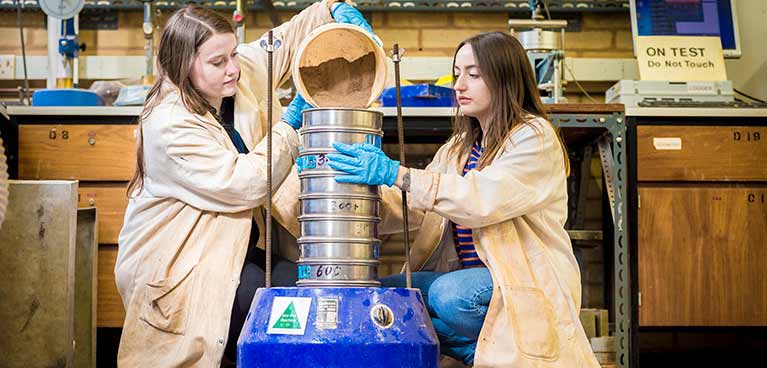
Geotechnics Laboratory
This specialist lab contains triaxial cells, direct shear box apparatus, a dimensional compression oedometer, California Bearing Ratio apparatus, soil classification equipment and Marshall test apparatus for asphalt mixes.
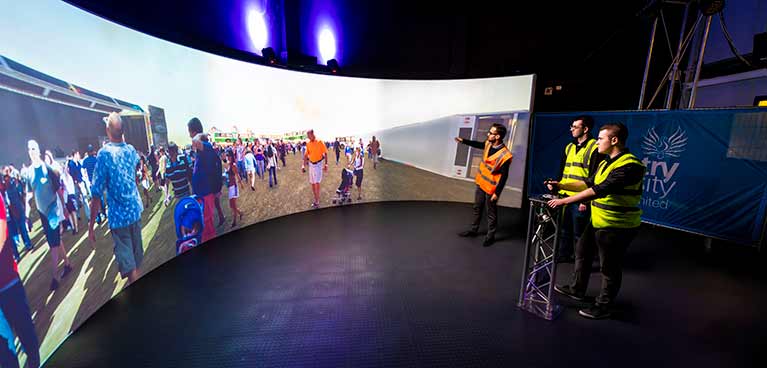
Simulation Centre
Our Simulation Centre uses an interactive screen and real-life scenarios to create a ‘virtual’ training environment. Role-play exercises are part of the course to help prepare you for situations in the workplace.

Informal Study Areas
You will have access to a range of informal study areas. These include hot-desk computers, with access to specialist software you may need for studying, and bookable spaces where you can meet with academics or work in small groups.
Facilities are subject to availability. Access to some facilities (including some teaching and learning spaces) may vary from those advertised and/or may have reduced availability or restrictions where the university is following public authority guidance, decisions or orders.
Careers and opportunities
Our blend of academic and practical study seeks to provide you with a specialist understanding of all aspects of disaster management, as well as the specific emergency planning and management skills needed to prepare you for employment in this sector.
The course aims to develop your skills in problem-solving, teamwork and leadership, project management and communication, all of which are qualities employers demand. We strive to produce graduates who can demonstrate the capabilities required by international relief and development organisations, private sector consultancies, national government, local authorities and United Nations agencies operating around the world; namely, the ability to make difficult decisions whilst being culturally sensitive, ethical and compassionate.
Where our graduates work
Recent graduates have gone on to work for the public sector, for example, in the emergency services, the NHS, The Environment Agency, Foreign and Commonwealth Office, Cabinet Office, Department for International Development, as well as sectors such as high-risk manufacturing, energy and aviation companies; the military; consultancy with PricewaterhouseCoopers; financial risk, insurance and banking; as well as international disaster risk and response agencies, such as the Asian Disaster Preparedness Center; RedR, India; Oxfam GB and the Catholic Overseas Development Agency (CAFOD).
The graduate destinations listed above illustrate potential career paths. You may need to gain additional qualifications or practical experience, pass professional examinations, complete training, cover associated costs and meet specific visa or immigration requirements to secure employment in these fields.
Further study
- Sustainability and Environmental Management MSc
- Disaster Management and Resilience MSc
- Emergency Management and Resilience MSc
You may be entitled to an alumni discount on your fees if you decide to extend your time with us by progressing from undergraduate to postgraduate study.

Discover Phoenix+
Phoenix+ brings you together with other students to learn, experience and develop essential knowledge and skills. Whatever destination you choose, it's about preparing you for life after university.
Learn more about Phoenix+How to apply
This course with foundation year is not available to international students.
UK students
Disclaimers
You may also like

Coventry University (Coventry)

Geography BA (Hons)
Coventry University (Coventry)
Geography and Environmental Hazards BSc (Hons)
Coventry University (Coventry)