Search
Building Surveying BSc (Hons)
Study level: Undergraduate
Build technical, analytical and management skills relevant to surveying, renovation and sustainable construction with this industry-informed course.
Course features
Course option
Year of entry
Location
Coventry University (Coventry)
Study mode
Full-time
Sandwich
Duration
3 years full-time
4 years sandwich
UCAS codes
K230
Start date
September 2027
November 2027
January 2028
March 2028
May 2028
July 2028
Course overview
Combine technical expertise, sustainability and innovation while gaining hands-on experience with industry-standard technology. Work on real-world projects and develop skills relevant to construction, property development and heritage conservation.
- Get practical experience through live projects, site visits and collaboration.2
- Develop expertise in using VR, drones, thermal imaging and building information modelling (BIM) to assess and manage buildings effectively.
- Learn to implement energy-efficient, low-carbon solutions, heritage conservation and modern construction techniques to shape the future of sustainable urban development.

Rated Gold Overall
Teaching Excellence Framework (TEF) 2023
5 QS Stars for Teaching and Facilities
QS Stars University Ratings
4th Student City in England (Coventry)
QS Best Student Cities Index 2027Why you should study this course
- Hands-on experience with advanced technology: gain practical skills using industry-standard equipment such as VR, 3D scanners, thermal imaging cameras and drones, ensuring readiness for modern surveying challenges.4
- Sustainability and smart cities: learn how to apply energy-efficient, low-carbon solutions, protect cultural heritage and use modern construction techniques to help shape a more sustainable future for our cities.
- Multidisciplinary learning environment: a common first year allows you to collaborate with students from related disciplines, broadening your knowledge and fostering a holistic understanding of the construction and property sectors.
- Global perspective and opportunities: get the chance to participate in study abroad programmes, enriching your educational experience and global outlook.
Joint 3rd
for Graduate Outcomes in Building
The Complete University Guide 2026
Accreditation and professional recognition
Royal Institution of Chartered Surveyors (RICS)
This course is accredited by the Royal Institute of Chartered Surveyors (RICS) up to and including the September 2028 intakes.

Careers in the built environment
Associate Head for School of the Environment, Dave Roberts, explains what types of careers are available in the built environment and the different courses we offer including, Quantity Surveying and Commercial Management BSc (Hons), Building Surveying BSc (Hons), Real Estate and Property Management BSc (Hons) and Construction Project Management BSc (Hons).
Read moreWhat you'll study
We regularly review our course content to keep it relevant and current for our students. Consequently, we may update modules to reflect the latest industry standards.
How you'll learn
We strive to provide you with as much real-life experience as possible and are fortunate that the city of Coventry has such a rich medieval history, offering excellent examples of many period buildings within walking distance of the university’s main campus.
The highly practical nature of the course enables you to work with staff and students on real-world problems from industry, commerce and research groups. This means that while you learn the technical content of your degree, these projects develop the professional skills required including problem analysis and design; project, task and time management; risk assessment; team work and leadership; technical report and bench assessment; troubleshooting and more.
Teaching contact hours
As a full-time undergraduate student, you will study modules totalling 120 credits each academic year. A typical 30-credit module requires 300 hours of study. Study hours are made up of teaching contact hours and guided and independent study.
Teaching hours
Teaching hours may vary, depending on where you are in your studies, but on average, you will have between 12 and 15 teaching and learning hours each week. You will also have the option to attend additional sessions, including time with a progress coach or to meet with staff for advice and feedback. As you progress through your studies, teaching hours may reduce.
Guided and independent study
Throughout your studies, you will be expected to spend time in guided and independent study to make up the required study hours per module. You will be digging deeper into topics, reviewing what you’ve learnt and completing assignments. This can be completed around your personal commitments. As you progress to the end of your studies, you’ll spend more time on independent learning.
Online learning
As an innovative university, we use different teaching methods, including online tools and emerging technologies. So, some of your teaching hours and assessments may be delivered online.
Assessment
This course will be assessed using a variety of methods which will vary depending upon the module.
Assessment methods may include:
- coursework
- reports
- projects
- phase tests
- group work
- presentations
- laboratories
- posters.
The Coventry University Group assessment strategy ensures that our courses are fairly assessed and allows us to monitor student progression towards achieving the intended learning outcomes.
Entry requirements
Typical entry requirements:
Not got the required grades? We offer this degree with an integrated foundation year.
Fees and funding
| Student | Full-time | Part-time |
|---|---|---|
| UK, Ireland*, Channel Islands or Isle of Man | 2027/28 fees TBC 2026/27 fees: £9,790 per year |
Not available |
| EU | 2027/28 fees TBC 2026/27 fees: £9,790 per year with EU Support Bursary** 2027/28 fees TBC 2026/27 fees: £20,800 per year without EU Support Bursary** |
Not available |
| International | 2027/28 fees TBC 2026/27 fees: £20,800 per year |
Not available |
If you choose to study this course with a professional placement2 or study abroad year, you will need to pay a tuition fee3 to cover your academic support throughout your placement year. Students commencing their professional placement in the academic year 2028/29 will pay £1,575 if they are paying UK fees, or £1,900 if they are paying international fees.
For advice and guidance on tuition fees and student loans visit our Undergraduate Finance page and see The University’s Tuition Fee and Refund Terms and Conditions.
The University will charge the tuition fees that are stated in the table above for the first Academic Year of study. The University will review tuition fees each year. For UK (home) students, if Parliament permits an increase in tuition fees, the university may increase fees for each subsequent year of study in line with any such changes. Note that any increase is expected to be in line with the Retail Price Index (RPI), a UK measure of inflation that tracks changes in the cost of living.
If you choose to study this course with a professional placement or study abroad year, the University will charge the tuition fees stated above for those on a placement during Academic Year 2028/29. The University will review professional placement tuition fees each year. For UK (home) students, the University may increase fees for each subsequent year of study, but such that it will be no more than 5% above RPI.
For international students, we may increase fees each year, but such increases will be no more than 5% above inflation. If you defer your course start date or have to extend your studies beyond the normal duration of the course (e.g. to repeat a year or resit examinations) you may be charged the tuition fees in force at the time you take that additional period of study, and/or in line with any legislative changes that apply at that time.
We offer a range of International scholarships to students all over the world. For more information, visit our International Scholarships page.
Tuition fees cover the cost of your teaching, assessments, facilities and support services. There may be additional costs not covered by this fee such as accommodation and living costs, recommended reading books, stationery, printing and re-assessments should you need them. Find out what's included in your tuition costs.
The following are additional costs not included in the tuition fees:
- Any optional overseas field trips or visits: £400+ per trip.
- Any costs associated with securing, attending or completing a placement (whether in the UK or abroad) which may include costs of travel, accommodation, equipment or uniform required for the placement and any visa-related costs.
*Irish student fees
The rights of Irish residents to study in the UK are preserved under the Common Travel Area arrangement. If you are an Irish student and meet the residency criteria, you can study in England, pay the same level of tuition fees as English students and utilise the Tuition Fee Loan.
**EU Support Bursary
Following the UK's exit from the European Union, we are offering financial support to all eligible EU students who wish to study an undergraduate or a postgraduate degree with us full-time. This bursary will be used to offset the cost of your tuition fees to bring them in line with that of UK students. Students studying a degree with a foundation year with us are not eligible for the bursary.
How do you know if you need to pay UK or international tuition fees?
Facilities
Your studies will be centred in high-specification learning environments that benefit from extensive social learning facilities, well-appointed laboratories, industry-standard equipment, lecturing facilities and classrooms, facilitating our innovative teaching methods across a diverse suite of courses.

Simulation Centre
Our interactive training centre includes a ‘virtual’ construction site with fully equipped site cabins and an observation deck. Here, you can take part in role-play exercises to prepare you for a range of situations in the workplace.
Structures laboratory
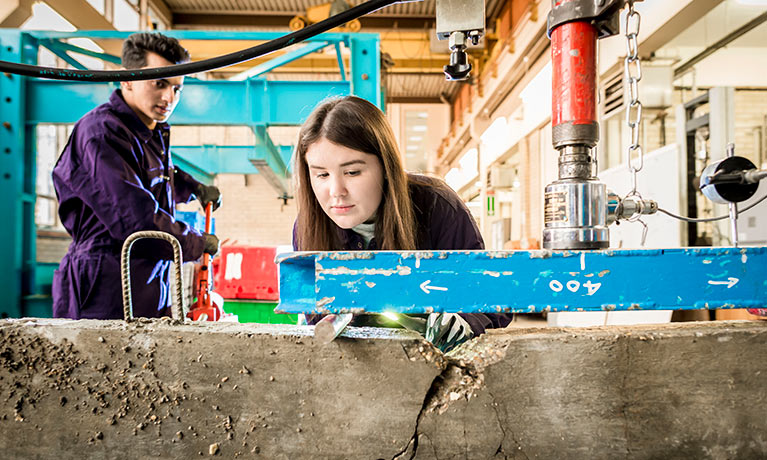
The wood workshop, eight test frames and our industry-standard Instron universal test machines are ready for you to bring your theoretical learning to life. Additionally, the strong floor area features framing and ancillary measurement devices.
Concrete and materials laboratory
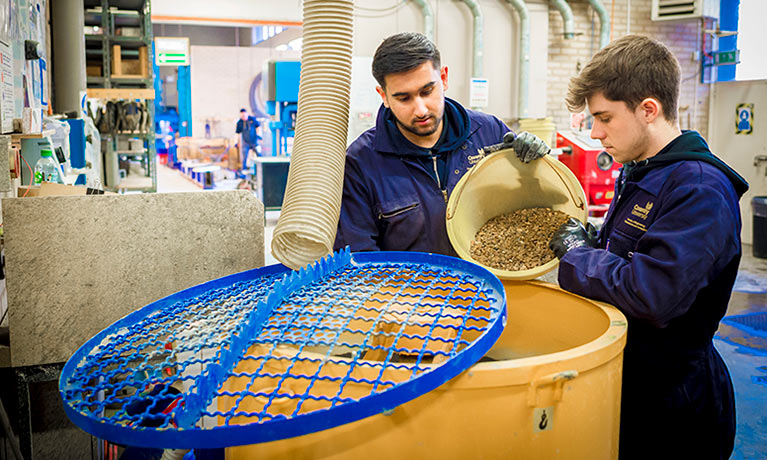
Gain an in-depth understanding of material science in this extensive lab setup. Get hands-on experience using dedicated equipment for testing and analysing materials — the same equipment you’ll see in the world of work.
You’ll use facilities through timetabled teaching, practical activities and relevant independent study. Access may vary by module, activity, capacity, supervision or safety requirements. Access may change or be limited where the University needs to follow public authority guidance, decisions or orders.
Careers and opportunities
Building surveying offers a rewarding and challenging career where no two days are ever likely to be the same.
You could find yourself involved in all aspects of construction and it is now one of the broadest areas of surveying practice, taking in projects from a domestic extension to a major retail development. Building surveyors offer advice on many aspects of design and construction, including maintenance, repair, refurbishment and restoration of proposed and existing buildings.
They offer quality assessments and report on defects in, or ways of improving, all kinds of buildings. As well as finding structural faults, building surveyors recommend solutions. They can advise on the feasibility of a building project, how much it might cost to carry out, or how suitable a building could be for a particular purpose.
Where our graduates work
Our graduates from similar courses have found employment in private practices, commercial organisations and local/central government, regionally, nationally and internationally. They work with companies such as Mace, Galliford Try, Balfour Beatty Plc, Lain O’ Rourke, Barrett Home Ltd, Watts Construction Ltd and BAM Construction.
The graduate destinations listed above illustrate potential career paths. You may need to gain additional qualifications or practical experience, pass professional examinations, complete training, cover associated costs and meet specific visa or immigration requirements to secure employment in these fields.
Further study
Subject to meeting all the progression requirements, you could choose to continue your studies at Coventry University with the Construction Project and Cost Management MSc, Construction Management with BIM MSc or Sustainability and Environmental Management MSc.
You may be entitled to an alumni discount on your fees if you decide to extend your time with us by progressing from undergraduate to postgraduate study

Discover Phoenix+
Phoenix+ brings you together with other students to learn, experience and develop essential knowledge and skills. Whatever destination you choose, it's about preparing you for life after university.
Learn more about Phoenix+How to apply
UK students
International students
Disclaimers
You may also like
Coventry University (Coventry)
Architectural Technology BSc (Hons) / Architectural Design and Technology MSci
Coventry University (Coventry)

Quantity Surveying and Commercial Management BSc (Hons)
Coventry University (Coventry)