Search
Aerospace Engineering MEng/BEng (Hons)
Study level: Undergraduate
Develop skills in designing and analysing aerospace systems through a course taught in Coventry, a city known for its historic role in aircraft manufacturing. You will have the opportunity to use specialist facilities and benefit from industry-informed teaching.
Course features
Course option
Year of entry
Location
Coventry University (Coventry)
Study mode
Full-time
Sandwich
Duration
BEng:3 years full-time4 years sandwich
MEng:4 years full-time5 years sandwich
UCAS codes
H410 / H411
Start date
September 2027
November 2027
January 2028
March 2028
May 2028
July 2028
Course overview
Designed for those interested in the future of flight, this course combines theory and applied learning in aerospace engineering, helping you build the skills needed to prepare for roles in aviation, defence and emerging technologies.
- Study flight dynamics, propulsion, avionics and materials.
- Learn about technologies such as sustainable aviation and unmanned aerial vehicles (UAVs).
- Benefit from pathways to upgrade from BEng (Hons) to MEng (subject to meeting progression requirements), allowing you to study at the postgraduate level while paying undergraduate tuition fees throughout.

Rated Gold Overall
Teaching Excellence Framework (TEF) 2023
5 QS Stars for Teaching and Facilities
QS Stars University Ratings
4th Student City in England (Coventry)
QS Best Student Cities Index 2027Why you should study this course
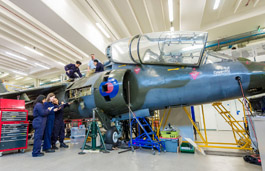
- Hands-on learning with industry-standard facilities: gain practical experience using flight simulators, wind tunnels and real aircraft (including a Harrier Jump Jet), alongside advanced CFD and FEA software.4
- Strong industry connections and employability: work on real-world projects from Airbus, Rolls-Royce and BAE Systems through in-class case studies. You may have the opportunity to apply for optional placements with other industry connections.2
- Future-focused curriculum: study emerging technologies including sustainable aviation, hydrogen propulsion and UAVs, helping you understand developments shaping the future of aerospace engineering.
- Global career opportunities: boost your prospects with opportunities to apply for optional industry placements, internships and an optional study abroad year.
1st
for Student Satisfaction in the West Midlands for Aeronautical and Aerospace Engineering
The Complete University Guide 2027
What you'll study
Gain the specialist knowledge to design, build and test next-generation aircraft and systems. Study key topics including aerodynamics, propulsion, structures, avionics and sustainability, while developing core engineering skills in maths, electronics and design.
Apply theory using industry-standard tools like computational fluid dynamics (CFD) and gain practical experience through labs, flight testing and a group-based systems integration project.4 Explore the role of aerospace in addressing global challenges, with a focus on efficiency and innovation. This course aims to prepare you for a wide range of careers across the aerospace and aviation industries.
We regularly review our course content to keep it relevant and current for our students. Consequently, we may update modules to reflect the latest industry standards.
How you'll learn
We encourage you to learn through stimulating activity, such as a project, problem, scenario, case study or enquiry in a classroom, laboratory or work setting. When considering avionic systems, for example, we study a number of real-life case studies, including the design and development of hands-on Arduino based projects for aircraft data logging and control.
We aim to present aerospace engineering knowledge in an integrated way to reflect the multiplicity and interaction between many types of scientific, commercial, manufacturing and managerial skills and knowledge, necessary to produce a successful engineering product or system.
You will have the opportunity to work with staff on real-world problems from industry, commerce and research groups, as you would in professional practice; this means that you can develop all of the professional skills at the same time as learning the technical content of your degree.
Teaching contact hours
As a full-time undergraduate student, you will study modules totalling 120 credits each academic year. You will normally study one 30-credit module at a time. A typical 30-credit module requires a total of 300 hours of study made up of teaching contact hours, guided and independent study.
Teaching hours
Teaching hours may vary depending on your year of study and selected modules. During your first year, you can expect 12-15 teaching hours each week. You will also have the option to attend additional sessions, including time with a progress coach or to meet with staff for advice and feedback. As you progress through your studies, teaching hours may reduce.
Guided and independent study
Throughout your studies, you will be expected to spend time in guided and independent study to make up the required study hours per module. You'll be digging deeper into topics, review what you've learned and complete assignments. This can be completed around your personal commitments. As you progress through your studies, you'll spend more time in independent study.
Online learning
As an innovative university, we use different teaching methods including online tools and emerging technologies. So, some of your teaching hours and assessments may be delivered online
Assessment
This course will be assessed using a variety of methods which will vary depending upon the module.
Assessment methods may include:
- formal examinations
- phase tests
- essays
- group work
- presentations
- reports
- projects
- coursework
- exams
- individual assignments
- laboratories.
The Coventry University Group assessment strategy ensures that our courses are fairly assessed and allows us to monitor student progression towards achieving the intended learning outcomes.
International experience opportunities
The university is committed to providing a global educational experience and we encourage you to undertake a placement year or study year abroad after your second year of study. We will endeavour to support you in finding a placement anywhere in the world and in seeking financing for that experience.
The majority of work placements have been within the UK, but previous students have been placed in GKN Aerospace (Munich, Germany), Bertrandt (Hamburg, Germany) and Airbus (Toulouse, France). The majority of study abroad students have studied at high education institutions within Europe, including Aerospace Engineering at UPM, Spain.
Previous students on the programme have had the opportunity to gain experience of the industry first-hand through our exciting industry-focused field trips, which have previously included the National Transportation Safety Board (NTSB) and NASA Goddard Space Flight Centre in the US and Airbus (Toulouse), Airbus (Marseille) and Finmeccanica in Europe.
Please note that all UK and international experience opportunities may be subject to additional costs, competitive application, availability, and meeting applicable visa and travel requirements are therefore not guaranteed2.
Entry requirements
Typical entry requirements:
Not got the required grades? We offer this degree with an integrated foundation year.
Fees and funding
| Student | Full-time | Part-time |
|---|---|---|
| UK, Ireland*, Channel Islands or Isle of Man | 2027/28 fees TBC 2026/27 fees: £9,790 per year |
Not available |
| EU | 2027/28 fees TBC 2026/27 fees: £9,790 per year with EU Support Bursary** 2027/28 fees TBC 2026/27 fees: £20,800 per year without EU Support Bursary** |
Not available |
| International | 2027/28 fees TBC 2026/27 fees: £20,800 per year |
Not available |
If you choose to study this course with a professional placement2 or study abroad year, you will need to pay a tuition fee3 to cover your academic support throughout your placement year. Students commencing their professional placement in the academic year 2028/29 will pay £1,575 if they are paying UK fees, or £1,900 if they are paying international fees.
For advice and guidance on tuition fees and student loans visit our Undergraduate Finance page and see The University’s Tuition Fee and Refund Terms and Conditions.
The University will charge the tuition fees that are stated in the table above for the first Academic Year of study. The University will review tuition fees each year. For UK (home) students, if Parliament permits an increase in tuition fees, the university may increase fees for each subsequent year of study in line with any such changes. Note that any increase is expected to be in line with the Retail Price Index (RPI), a UK measure of inflation that tracks changes in the cost of living.
If you choose to study this course with a professional placement or study abroad year, the University will charge the tuition fees stated above for those on a placement during Academic Year 2028/29. The University will review professional placement tuition fees each year. For UK (home) students, the University may increase fees for each subsequent year of study, but such that it will be no more than 5% above RPI.
For international students, we may increase fees each year, but such increases will be no more than 5% above inflation. If you defer your course start date or have to extend your studies beyond the normal duration of the course (e.g. to repeat a year or resit examinations) you may be charged the tuition fees in force at the time you take that additional period of study, and/or in line with any legislative changes that apply at that time.
We offer a range of International scholarships to students all over the world. For more information, visit our International Scholarships page.
Tuition fees cover the cost of your teaching, assessments, facilities and support services. There may be additional costs not covered by this fee such as accommodation and living costs, recommended reading books, stationery, printing and re-assessments should you need them. Find out what's included in your tuition costs.
The following are additional costs not included in the tuition fees:
- Any optional overseas field trips or visits: £400+ per trip.
- Any costs associated with securing, attending or completing a placement (whether in the UK or abroad) which may include costs of travel, accommodation, equipment or uniform required for the placement and any visa-related costs.
*Irish student fees
The rights of Irish residents to study in the UK are preserved under the Common Travel Area arrangement. If you are an Irish student and meet the residency criteria, you can study in England, pay the same level of tuition fees as English students and utilise the Tuition Fee Loan.
**EU Support Bursary
Following the UK's exit from the European Union, we are offering financial support to all eligible EU students who wish to study an undergraduate or a postgraduate degree with us full-time. This bursary will be used to offset the cost of your tuition fees to bring them in line with that of UK students. Students studying a degree with a foundation year with us are not eligible for the bursary.
How do you know if you need to pay UK or international tuition fees?
Facilities
Our excellent practical facilities include a full-size Harrier Jet (used for teaching), six full-scale flight simulators, wind tunnels, UAV workshop, flow and heat transfer labs, composites lab, metrology lab, electrical/electronics lab, fatigue and tensile testing (Instron), a range of CNC machinery, banks of 3D printers and a laser workshop.4
Take a virtual tour
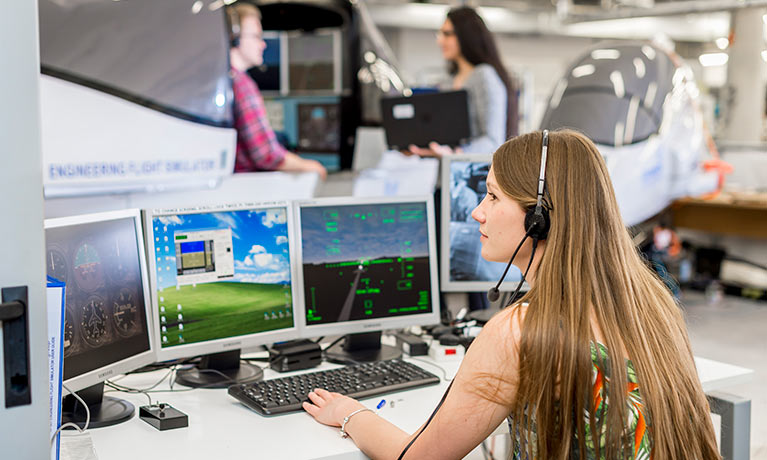
Flight Simulators
Our simulators create an exciting way to learn, with 61 channels of flight data which can be analysed to assess the accuracy of a student's own design. The simulators are incorporated into an air traffic control environment.
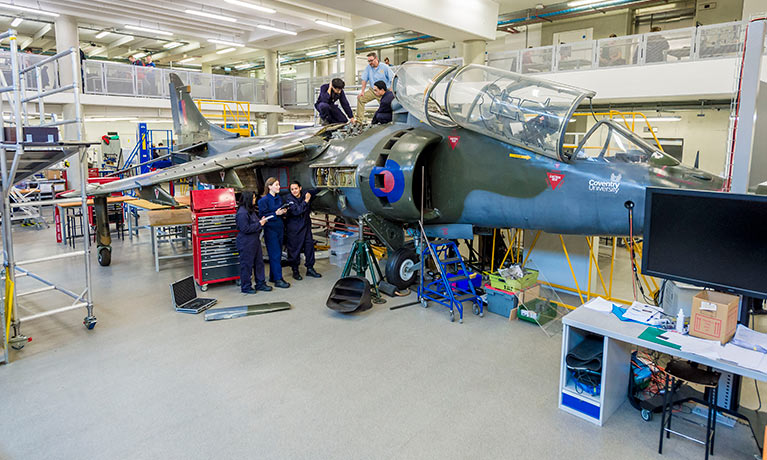
Harrier Jet
Our Harrier T4 allows students to gain hands-on experience with the parts, tools and mechanical aspects of a real aircraft. It is used by many engineering disciplines to learn how an aircraft works and how to maintain it.
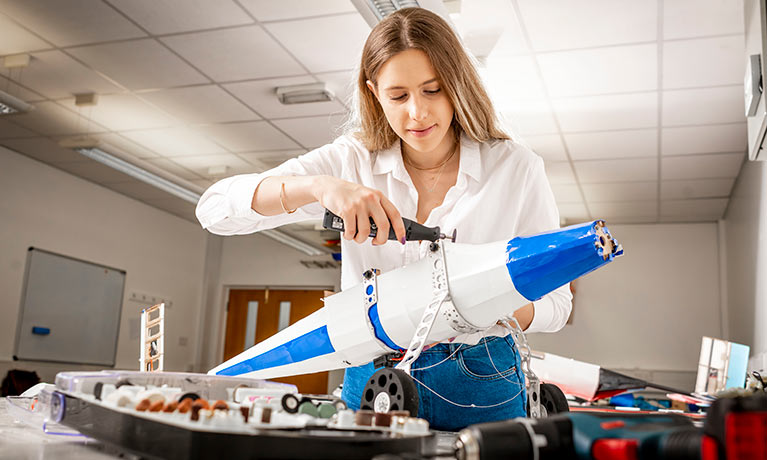
Model Making Shop
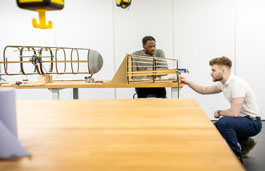
Used by our aerospace students to build model aircrafts. The workshop includes laser cutting, wood working and foam cutting technology to help bring our students' designs into the real world.
You’ll use facilities through timetabled teaching, practical activities and relevant independent study. Access may vary by module, activity, capacity, supervision or safety requirements. Access may change or be limited where the University needs to follow public authority guidance, decisions or orders.
Careers and opportunities
The MEng and BEng Aerospace Engineering courses are designed to provide you with the opportunity to acquire the vital skills required, to join the teams of engineers designing and developing systems for the next generation of aircraft.
The course is centred upon systems for aerospace vehicles and the requirement to design total system solutions including both practical and virtual design skills. Previous graduates have obtained jobs as systems design engineers for large aircraft and propulsion manufacturers as well as systems suppliers to the aviation industry.
Aerospace Engineering graduates seek not only employment within the aerospace industry, but their problem-solving skill sets can make them highly employable within a variety of industries.
This course aims to produce graduates with the skills to become successful system-design engineers and engineering managers, both in aerospace and the wider engineering context, in fields such as aircraft and components design and manufacture, maintenance and testing, propulsion systems, flight simulation, aviation, avionics, patent engineering, financial services and many more.
Where our graduates work
Previous graduates have obtained jobs as systems design engineers for large aircraft and propulsion manufacturers e.g. Airbus, BAE Systems, GE Aviation and Rolls Royce, as well as systems suppliers to the aviation industry including Meggitt, Goodrich, Moog and Collins Aerospace.
The graduate destinations listed above illustrate potential career paths. You may need to gain additional qualifications or practical experience, pass professional examinations, complete training, cover associated costs and meet specific visa or immigration requirements to secure employment in these fields.

Discover Phoenix+
Phoenix+ brings you together with other students to learn, experience and develop essential knowledge and skills. Whatever destination you choose, it's about preparing you for life after university.
Learn more about Phoenix+How to apply
UK students
International students
Disclaimers
You may also like
Coventry University (Coventry)
Aerospace Technology BEng (Hons)
Coventry University (Coventry)

Mechanical Engineering MEng/BEng (Hons)
Coventry University (Coventry)