Search
Nutrition and Health BSc (Hons)
Study level: Undergraduate
Explore the science of nutrition and its impact on health and wellbeing. Gain practical skills to support healthy lifestyles and prepare for a career in public health, nutrition or the food industry.
Course features
Course option
Year of entry
Location
Coventry University (Coventry)
Study mode
Full-time
Sandwich
Duration
3 years full-time
4 years sandwich
UCAS codes
B400
Start date
September 2027
November 2027
January 2028
March 2028
May 2028
July 2028
Course overview
Nutritionists play a vital role in improving lives. They work with individuals, communities, the food industry and policymakers to promote healthier diets, influence food choices and support positive change in public health.
- This course is designed to equip you with a thorough understanding of the scientific basis of nutrition with an emphasis on human health and disease. An important part of the course is applying theory in real professional consultations, helping you develop practical skills and improve consultation techniques focused on individual needs.
- This course provides a high-quality nutrition education by offering you access to modern laboratories, kitchen facilities and nutritional analysis software, such as Nutritics 4. This course develops practical food preparation skills and teaches you how to tailor menus to meet the needs of different individuals, including older adults, athletes, and children.
- Assessments are designed to mimic real-life scenarios, such as analysing nutrient intake from a food diary, developing dietary interventions and designing health promotion campaigns. This course also embraces an international perspective, while recognising the key underpinning principles of UK-based nutritional guidance.

Rated Gold Overall
Teaching Excellence Framework (TEF) 2023
5 QS Stars for Teaching and Facilities
QS Stars University Ratings
4th Student City in England (Coventry)
QS Best Student Cities Index 2027Why you should study this course
- Supported by a teaching team comprising of experienced registered nutritionists, food scientists, microbiologists, and food safety experts, ensuring that students are supported by highly qualified professionals who will bring you the latest issues on a wide range of nutritional and health topics (staff subject to change).
- Gain hands-on experience of a wide range of industry techniques in our modern laboratories.4
- The course uses educational technologies, such as Kahoot!, Padlet and Mentimeter, to enhance your learning experience and make the course interactive and engaging.
- Undertake an independent research-based project in a related area of your interest.
- Gain a comprehensive understanding of nutrition’s role in human health and disease prevention, as well as modules such as food product design, enabling you to specialise and embark on a range of careers in nutrition, public health or the food industry.
- Develop key transferable skills in independent research, data analysis and statistical analysis to give you a competitive career advantage.
What you'll study
We regularly review our course content to keep it relevant and current for our students. Consequently, we may update modules to reflect the latest industry standards.
How you'll learn
Teaching and learning methods may include:
- lectures
- seminars
- tutorials
- presentations
- group projects
- workshops
- case studies
- practical lab sessions.
Teaching contact hours
As a full-time undergraduate student, you will study modules totalling 120 credits each academic year. A typical 30-credit module requires 300 hours of study. Study hours are made up of teaching contact hours and guided and independent study.
Teaching hours
Teaching hours may vary, depending on where you are in your studies, but on average, you will have between 12 and 15 teaching and learning hours each week. You will also have the option to attend additional sessions, including time with a progress coach or to meet with staff for advice and feedback. As you progress through your studies, teaching hours may reduce.
Guided and independent study
Throughout your studies, you will be expected to spend time in guided and independent study to make up the required study hours per module. You will be digging deeper into topics, reviewing what you’ve learnt and completing assignments. This can be completed around your personal commitments. As you progress to the end of your studies, you’ll spend more time on independent learning.
Online learning
As an innovative university, we use different teaching methods, including online tools and emerging technologies. So, some of your teaching hours and assessments may be delivered online.
Assessment
This course will be assessed using a variety of methods which will vary depending upon the module. Assessment methods may include:
- tests
- essays
- group work
- presentations
- reports
- projects
- coursework
- individual assignments.
The Coventry University Group assessment strategy ensures that our courses are fairly assessed and allows us to monitor student progression towards achieving the intended learning outcomes.
International experience opportunities
Coventry University is committed to developing global graduates. Throughout the course, we will aim to explore international, national and local food and nutrition practices and policies. This course attracts many international students, providing a diverse learning experience. This aims to enhance the discussion of issues such as globalisation of foods and is designed to provide all students with a global perspective of developments in food, health and nutrition.
The university runs several schemes to allow students periods of overseas study or work experience2. Past students in our department have been successful in securing places to study in Spain, France, Canada and the US.
Please note that all international experience opportunities may be subject to additional costs, competitive application, availability, and meeting applicable visa and travel requirements, and are therefore not guaranteed2.
Entry requirements
Typical entry requirements:
Not got the required grades? We offer this degree with an integrated foundation year.
Fees and funding
| Student | Full-time | Part-time |
|---|---|---|
| UK, Ireland*, Channel Islands or Isle of Man | 2027/28 fees TBC 2026/27 fees: £9,790 per year |
Not available |
| EU | 2027/28 fees TBC 2026/27 fees: £9,790 per year with EU Support Bursary** 2027/28 fees TBC 2026/27 fees: £19,200 per year without EU Support Bursary** |
Not available |
| International | 2027/28 fees TBC 2026/27 fees: £19,200 per year |
Not available |
If you choose to study this course with a professional placement2 or study abroad year, you will need to pay a tuition fee3 to cover your academic support throughout your placement year. Students commencing their professional placement in the academic year 2028/29 will pay £1,575 if they are paying UK fees, or £1,900 if they are paying international fees.
For advice and guidance on tuition fees and student loans visit our Undergraduate Finance page and see The University’s Tuition Fee and Refund Terms and Conditions.
The University will charge the tuition fees that are stated in the table above for the first Academic Year of study. The University will review tuition fees each year. For UK (home) students, if Parliament permits an increase in tuition fees, the university may increase fees for each subsequent year of study in line with any such changes. Note that any increase is expected to be in line with the Retail Price Index (RPI), a UK measure of inflation that tracks changes in the cost of living.
If you choose to study this course with a professional placement or study abroad year, the University will charge the tuition fees stated above for those on a placement during Academic Year 2028/29. The University will review professional placement tuition fees each year. For UK (home) students, the University may increase fees for each subsequent year of study, but such that it will be no more than 5% above RPI.
For international students, we may increase fees each year, but such increases will be no more than 5% above inflation. If you defer your course start date or have to extend your studies beyond the normal duration of the course (e.g. to repeat a year or resit examinations) you may be charged the tuition fees in force at the time you take that additional period of study, and/or in line with any legislative changes that apply at that time.
We offer a range of International scholarships to students all over the world. For more information, visit our International Scholarships page.
Tuition fees cover the cost of your teaching, assessments, facilities and support services. There may be additional costs not covered by this fee such as accommodation and living costs, recommended reading books, stationery, printing and re-assessments should you need them. Find out what's included in your tuition costs.
The following are additional costs not included in the tuition fees:
- Any optional overseas field trips or visits: £400+ per trip.
- Any costs associated with securing, attending or completing a placement (whether in the UK or abroad) which may include costs of travel, accommodation, equipment or uniform required for the placement and any visa-related costs.
*Irish student fees
The rights of Irish residents to study in the UK are preserved under the Common Travel Area arrangement. If you are an Irish student and meet the residency criteria, you can study in England, pay the same level of tuition fees as English students and utilise the Tuition Fee Loan.
**EU Support Bursary
Following the UK's exit from the European Union, we are offering financial support to all eligible EU students who wish to study an undergraduate or a postgraduate degree with us full-time. This bursary will be used to offset the cost of your tuition fees to bring them in line with that of UK students. Students studying a degree with a foundation year with us are not eligible for the bursary.
How do you know if you need to pay UK or international tuition fees?
Facilities
The course is taught at the Coventry University campus, primarily in the Alison Gingell building4.
Take a virtual tour

SuperLab
Our state-of-the-art SuperLab can hold up to 250 students at one time and has facilities for cell culture and equipment for microscopy and growing microorganisms aerobically and anaerobically, DNA, RNA and protein extraction and analysis.
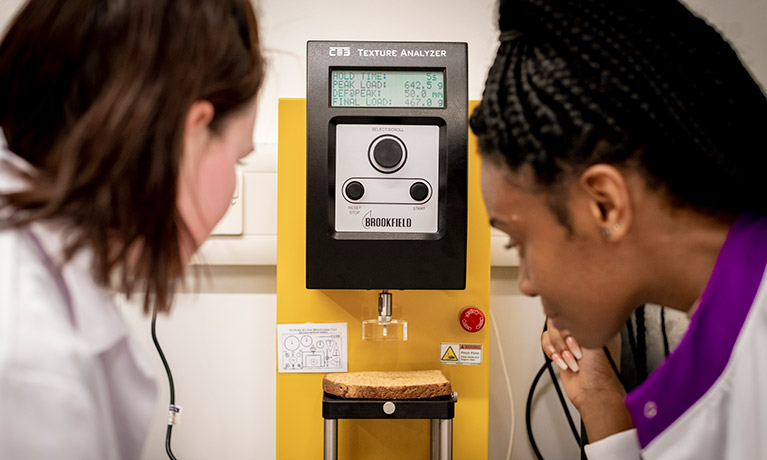
Analytical chemistry suite
You will develop your laboratory skills and will have the opportunity to use analytical techniques for example in the proximate analysis of food e.g. fat or protein content, and using analytical techniques such as UV spectroscopy and chromatography.

Teaching kitchen
You will enhance your cooking skills, design meals to meet different requirements and develop new food or drink products through sessions in our teaching kitchen.
You’ll use facilities through timetabled teaching, practical activities and relevant independent study. Access may vary by module, activity, capacity, supervision or safety requirements. Access may change or be limited where the University needs to follow public authority guidance, decisions or orders.
Careers and opportunities
The need for nutritionists is growing with the increasing incidence of diet-related health conditions such as obesity, heart disease, type 2 diabetes and cancer.
Consequently, graduates from this course should be well equipped for a wide range of roles in the field of nutrition and health – from working on emergency relief projects in low income countries to devising health initiatives to target dietary intakes of specific groups, such as pregnant women, school children and the elderly.
Opportunities may exist within local authorities, charitable organisations, the NHS, parenting organisations, health promotion, and the food and leisure industries. You could also find yourself advising policy makers, regulatory bodies or working in education or the media.
Typical job roles include:
- Hospital nutritionist
- Community nutritionist
- Sports nutritionist
- Communications and health promotion
- Product development
- School food advisor
- Weight management advisor
- Process technologist
- Quality assurance
- Food or favour technologist.
Where our graduates work
Our graduates have secured roles in companies including:
- The Health Security Agency
- NHS
- Mondelēz International
- PURE International
- Healthy Lifestyles Coventry.
The graduate destinations listed above illustrate potential career paths. You may need to gain additional qualifications or practical experience, pass professional examinations, complete training, cover associated costs and meet specific visa or immigration requirements to secure employment in these fields.
Further study
The course is an excellent foundation for further postgraduate studies such as Public Health Nutrition MSc or Dietetics and Leadership (pre-registration) MSc.

Discover Phoenix+
Phoenix+ brings you together with other students to learn, experience and develop essential knowledge and skills. Whatever destination you choose, it's about preparing you for life after university.
Learn more about Phoenix+How to apply
UK students
International students
Disclaimers