Search
Learning Disabilities Nursing BSc (Hons) with foundation year
Study level: UndergraduateProfessionally Accredited Programmes

This degree combines theory with practice-based learning to lead you to professional registration and a rewarding career as a learning disabilities nurse.
Course features
Course option
Year of entry
Location
CU Coventry (Coventry) and
Coventry University (Coventry)
Study mode
Full-time
Duration
4 years full-time
UCAS codes
H06F
Start date
September 2027
November 2027
Course overview
Learning disabilities nurses provide specialist healthcare and support to people with a significantly reduced ability to understand new or complex information. They work across a range of settings including people’s homes, primary and community settings, schools and specialist services, in-patient hospitals and care homes.
This course aims to equip you to support, empower and safeguard people with learning disabilities. It emphasises the importance of involving individuals, their families and support networks in the holistic assessment, planning, implementation and evaluation of care.
- Successful completion of this course makes you eligible to apply for professional registration as a learning disabilities nurse with the Nursing & Midwifery Council (NMC) (please see Accreditation section for more information).
- Gain the skills to deliver professional, impactful, evidence-informed care across a range of dynamic and diverse healthcare environments.
- Learn to collaborate and thrive as a learning disabilities nurse across and within multidisciplinary teams to coordinate safe, evidenced-based care delivery.
- Study one module at a time, with five weeks of learning followed by one week of assessment per module.
- 50% of your learning will take place in diverse practice-based learning environments where you will apply your theoretical knowledge to the real world.2,5
- All eligible learners on this course can apply for a minimum payment from the government of £5,000 per year. You can apply for additional payments if you incur childcare costs6. This funding is not available for the foundation year of this course.

Rated Gold Overall
Teaching Excellence Framework (TEF) 2023
5 QS Stars for Teaching and Facilities
QS Stars University Ratings
Top 5 Student City in England (Coventry)
QS Best Student Cities Index 2026Why study this course
The course is aimed at committed and enthusiastic individuals who embody a compassionate attitude and are eager to acquire the skills to deliver professional, impactful and evidence-informed care.
- Our approach supports you to develop a strong sense of professional identity as a learning disabilities nurse from the outset.
- Learn to thrive in dynamic healthcare environments and multidisciplinary teams, developing your relationship management skills.
- Focus on one academic module at a time, with five weeks of learning followed by one week of assessment per module.
- Gain a strong sense of professional accountability, in preparation to lead, influence and supervise others.
- Delivered by a team that includes highly skilled, knowledgeable, nursing and allied health professionals.
- Focusing on digital fluency, curiosity, critical and reflective thinking, this course instils you with the ability to access, evaluate and apply evidence to inform your practice.
- Access to success coaches, placement supervisors, health and wellbeing services and specialist support for mathematics and academic writing4.
Studying in the School of Health and Care
Gain the skills and experience to transform lives, communities and the future of healthcare delivery. We aim to empower you to become a stand-out healthcare professional, capable, competent and confident in your field and role within the wider healthcare team.
While continuously developing your sense of professional identity as a learning disabilities nurse from day one, you'll also collaborate with learners from other School of Health and Care fields, learning in an environment that puts inclusivity, diversity and dignity at its heart.
Joint 1st
for Student Satisfaction in the West Midlands in Nursing & Midwifery
The Complete University Guide 2026
Accreditation and professional recognition
Nursing & Midwifery Council
The Learning Disabilities Nursing BSc (Hons) programme is approved by the Nursing & Midwifery Council (NMC) for the 2027-28 intake.1
Nursing at Coventry University
We have an excellent reputation for the quality of the education provided to trainee and qualified nurses.
Why study with us
Tracey’s journey into Learning Disabilities Nursing
Hear how Tracey returned to study, balanced family life and found real purpose through Learning Disabilities Nursing.
Read more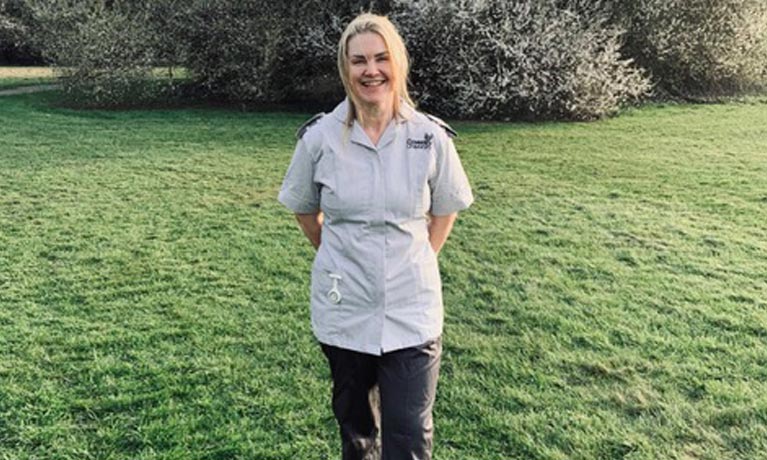
What you'll study
You will study various cross-field modules as well as modules specific to your nursing field. Throughout the course you will study:
- clinical skills
- pharmacology
- communications
- nursing models and theory
- nursing assessments and interventions
- interprofessional working
- research.
We regularly review our course content to keep it relevant and current for our students. Consequently, we may update modules to reflect the latest industry standards.
How you'll learn
The academic staff have vast knowledge supporting people with learning disabilities, autism and mental health. The team have worked closely with the criminal justice system as well as working with individuals with profound learning disabilities.
Ijaz Mahmood, Assistant Professor, 2025

Entry requirements
Typical entry requirements:
Got higher grades? Have you considered direct entry to the degree without foundation year?
Fees and funding
Foundation year
| Student | Full-time | Part-time |
|---|---|---|
| UK, Ireland*, Channel Islands or Isle of Man | 2027/28 fees TBC 2026/27 fees: £9,790 |
Not available |
| International/EU | Not currently available*** | Not available |
Degree
| Student | Full-time | Part-time |
|---|---|---|
| UK, Ireland*, Channel Islands or Isle of Man | 2027/28 fees TBC 2026/27 fees: £9,790 per year |
Not available |
A non-repayable grant of £5,000 and extra payments worth up to £3,000 may be available to eligible home students for each year of degree study6. Read more about this in the NHS Learning Support Fund information booklet. This funding is not available for the foundation year of this course.
For advice and guidance on tuition fees and student loans visit our Undergraduate Finance page and see The University’s Tuition Fee and Refund Terms and Conditions.
The University will charge the tuition fees that are stated in the table above for the first Academic Year of study. The University will review tuition fees each year. For UK (home) students, if Parliament permits an increase in tuition fees, the university may increase fees for each subsequent year of study in line with any such changes. Note that any increase is expected to be in line with the Retail Price Index (RPI), a UK measure of inflation that tracks changes in the cost of living.
For international students, we may increase fees each year, but such increases will be no more than 5% above inflation. If you defer your course start date or have to extend your studies beyond the normal duration of the course (e.g. to repeat a year or resit examinations) you may be charged the tuition fees in force at the time you take that additional period of study, and/or in line with any legislative changes that apply at that time.
Tuition fees cover the cost of your teaching, assessments, facilities and support services. There may be additional costs not covered by this fee such as accommodation and living costs, recommended reading books, stationery, printing and re-assessments should you need them. Find out what's included in your tuition costs.
Applies to degree only
The following are additional costs not included in the tuition fees:
- Any optional overseas field trips or visits: £400+ per trip.
- Any costs associated with securing, attending or completing a placement (whether in the UK or abroad) which may include costs of travel, accommodation, equipment or uniform required for the placement and any visa-related costs.
Foundation year funding
To secure funding for a degree with a foundation year, you must complete the full four-year programme. If you do not finish the entire course, including the integrated foundation year, you may have to pay the foundation year fees yourself. For further information, please refer to the 'Tuition Fee Loan' details in the 'Funding your undergraduate course' section of our 'Fees and finance' page.
*Irish student fees
The rights of Irish residents to study in the UK are preserved under the Common Travel Area arrangement. If you are an Irish student and meet the residency criteria, you can study in England, pay the same level of tuition fees as English students and utilise the Tuition Fee Loan.
**This degree with foundation year is not currently available to international students who require a student visa to study in the UK.
How do you know if you need to pay UK or international tuition fees?
Facilities
You’ll spend your foundation year at our CU Coventry Mile Lane building, just a short walk from Coventry city centre. You can still make the most of all the facilities at the main Coventry University campus whenever you like.
Once you successfully complete your foundation year, you’ll move over to the Coventry University campus to study your degree.





Facilities are subject to availability4. Access to some facilities (including some teaching and learning spaces) may vary from those advertised and/or may have reduced availability or restrictions where the university is following public authority guidance, decisions or orders.
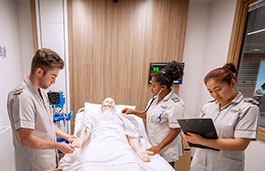
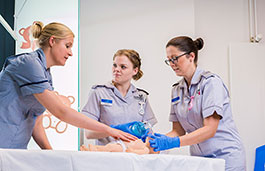
Our multi-million-pound Alison Gingell Building features a range of mock healthcare settings, including hospital wards, ambulance, therapy suites and community houses, giving you the opportunity to replicate real-life situations before you go on placement.4
You’ll have the opportunity to make use of our extensive simulation facilities – from basic life support manikins to high tech simulation manikins, which emulate patient responses and test resuscitation skills. You will also use healthcare devices found in the real world of practice.
Take a virtual tour

Mock hospital wards
Our fully-equipped mock hospital wards are built to NHS standards and give you the chance to experience patient scenarios in a real-world environment.

Community houses
Learn how to work with patients outside of a hospital setting in our simulated, two full-size community homes, specifically built for teaching.

Mock operating theatre
Our Alison Gingell building includes a full-size mock operating theatre, containing scrub sinks and theatre lights.
Facilities are subject to availability4. Access to some facilities (including some teaching and learning spaces) may vary from those advertised and/or may have reduced availability or restrictions where the university is following public authority guidance, decisions or orders.
Careers and opportunities
There are currently over 3,000 learning disabilities nurses within the NHS and demand for these specialist nurses is high. Typically, past final year students have been offered a range of posts within the NHS and the private sector prior to qualifying.
As a learning disability nurse, you will have opportunities to support people of all ages with learning disabilities in a range of settings, which may include:
- hospital wards such as epilepsy and palliative care
- mental health trusts
- adult education
- residential and community centres
- patients' homes
- workplaces
- schools.
During your three years on the programme, you will have the opportunity5 to undertake six placements in a range of service settings, with the chance to work with and alongside qualified learning disability nurses, and therefore potential local and regional employers. On graduating successfully from this course, you can apply for registration with the Nursing & Midwifery Council (NMC), which can enable you to practise immediately (additional costs apply)1.
Where our graduates work
The majority of our graduates find employment as qualified nurses in the NHS with a growing emphasis on community settings, in acute hospitals, military nursing or within the private and independent healthcare sector, in private hospitals, nursing or care homes. As your career progresses, a number of options are open to you as a lecturer or specialist practitioner, advanced nurse practitioner, consultant nurse or manager.
Recent graduates have gone on to roles such as working in forensic services, generic and specialised children’s services, end of life care (adults and children), neurology services, dementia services, prison and court diversion, police diversion, schools, research and many more.
How to apply
This course with foundation year is not available to international students.
UK students
Disclaimers
You may also like
Coventry University (Coventry)
Adult Nursing BSc (Hons)
Coventry University (Coventry)
Children and Young People's Nursing BSc (Hons)
Coventry University (Coventry)