Search
Accountancy BSc (Hons) with foundation year
Study level: Undergraduate
Develop your knowledge and skills to help businesses and organisations manage finances, make management decisions, face economic challenges and grow ethically and sustainably.
Course features
Course option
Year of entry
Location
CU Coventry (Coventry) and
Coventry University (Coventry)
Study mode
Full-time
Sandwich
Duration
4 years full-time
5 years sandwich
UCAS codes
N4DF
Start date
March 2026
May 2026
June 2026
September 2026
November 2026
January 2027
March 2027
May 2027
July 2027
Course overview

Our degree with foundation year could be the stepping stone you need to achieve your goals. The foundation year aims to prepare you for degree-level study and is a great way to build the confidence, skills and knowledge needed to succeed on your degree course.
Foundation year
This year aims to provide the fundamental knowledge and skillset in a range of mathematical and business principles, as well as the theories and concepts involved in investment risk and professional ethics.
Degree
Accountants with the skills to monitor the flow of money for a business while being able to spot and protect against potential challenges, are highly sought after. Global uncertainty and the challenges of the economic climate, mean that skills in this field could be more important than ever before.

Rated Gold Overall
Teaching Excellence Framework (TEF) 2023
5 QS Stars for Teaching and Facilities
QS Stars University Ratings
Top 5 Student City in England (Coventry)
QS Best Student Cities Index 2026Why you should study this course
Foundation year
- Supports you to gain the academic skills required for degree-level study.
- Provides a grounding in key areas of accounting and finance.
Degree
- Develop practical skills in our Bloomberg Trading Floor:4 gain hands-on experience of market-leading financial databases such as Bloomberg, LSEG Workspace, Fitch Connect, Bureau van Dijk Fame, along with opportunities for professional certifications for Bloomberg, LSEG Workspace and in ESG at no additional cost.2
- Enjoy an engaging student experience: participate in events such as International Audit Week and International Tax Week, where you get to network with industry collaborators, engage with student delegations from international universities and compete in a simulated environment, bringing academic learning to life.2
- Put your skills to the test: prepare and analyse financial statements and study the impact of finance on real businesses through case studies of a range of organisations.
- Access maths and statistics support: the sigma Centre offers free maths and statistics support through drop-in sessions and bookable appointments.
- Benefit from real-world exposure: boost your employability with an optional sandwich year2, offering you the chance to gain hands-on industry placement experience. Past students have undertaken placements at PwC, Ernst & Young, Deloitte, Jaguar Land Rover and the NHS.
- Join like-minded communities: enrich your student experience by becoming a member of a student-led society such as the Investment Society, the Economics Society and the Coventry Business Club Society.
Accreditation and professional recognition
The degree is accredited1 and recognised by the following bodies:
Association of Chartered Certified Accountants (ACCA)
This course is currently accredited by the Association of Chartered Certified Accountants (ACCA) for the 2025/26 intakes and is subject to re-accreditation for the 2026/27 intakes. Upon successful completion of the course, you will be eligible for exemption from a number of Applied Skills level ACCA papers, depending on the modules studied. Please note that additional papers will be required to be taken in order to attain the ACCA qualification, which will incur additional costs. You will also need to fulfil the practical experience requirement, register with ACCA and apply for relevant exemptions as well as meet any applicable visa requirements. For more information, please visit the ACCA website.
Chartered Institute of Management Accountants (CIMA)
This course is currently accredited by the Chartered Institute of Management Accountants (CIMA) for the 2025/26 intakes and is subject to re-accreditation for the 2026/27 intakes. Successful completion of the course entitles students to exemptions from a number of CIMA papers. Please note that additional papers will be required to be taken in order to attain the CIMA qualification, which will incur additional costs. You will also need to fulfil the practical experience requirement and register with CIMA and apply for relevant exemptions. Please see the CIMA website for more details. Should CIMA accreditation not be received we will write to you as soon as possible.
Institute of Chartered Accountants in England and Wales (ICAEW)
This course is currently accredited by the Institute of Chartered Accountants in England and Wales (ICAEW) for the 2025/26 intakes and is subject to re-accreditation for the 2026/27 intakes. Subject to the accreditation being approved, upon successful completion of this course, and obtaining a minimum mark of 50% on the specified modules you will be able to secure exemptions from certain ICAEW papers. Additional papers are required to be taken in order to attain the ICAEW qualification. These will incur additional costs, and you will need to fulfil the practical experience requirement. You will also need to register with ICAEW and apply for the relevant exemptions. Please visit the ICAEW website for more details.
Additional certificates
Memberships
What you'll study
We regularly review our course content, to make it relevant and current for the benefit of our students. For these reasons, course modules may be updated.
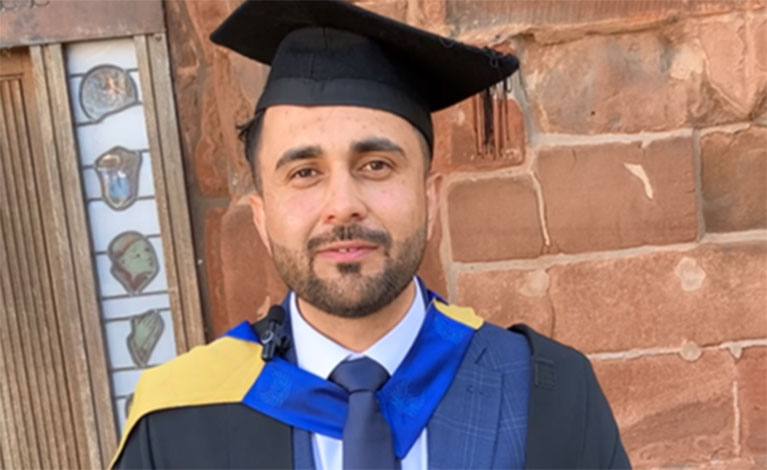
The tutors are really helpful and there to listen, they don’t mind putting in their own time to ensure we would understand and encouraged us to ask questions. This is something that really impressed me and helped me to achieve in my studies.
Rahmatullah Amanullah (Course Tutor Prize Winner), Accountancy, 2023
How you'll learn
Our teaching has a strong focus on merging theory and practice. You will be engaged in simulation and practical exercises, such as preparing and analysing financial statements or assessing financial investment options, giving you the opportunity to apply theory to real-life scenarios that professional accountants encounter on a day-to-day basis.
Entry requirements
Typical entry requirements:
Got higher grades? Have you considered direct entry to the degree without foundation year?
Fees and funding
Foundation year
| Student | Full-time | Part-time |
|---|---|---|
| UK, Ireland*, Channel Islands or Isle of Man | £5,760 | Not available |
| International/EU | Not currently available*** | Not available |
Degree
| Student | Full-time | Part-time |
|---|---|---|
| UK, Ireland*, Channel Islands or Isle of Man | £9,790 per year | Not available |
| International/EU | Not currently available*** | Not available |
If you choose to study this course with a professional placement2 or study abroad year, you will need to pay a tuition fee3 to cover your academic support throughout your placement year. As an indication, students commencing their professional placement in the academic year 2028/29 will pay £1,575 if they are paying UK fees, or £1,900 if they are paying international fees. The University will charge the tuition fees stated above for those on a placement during Academic Year 2028/29. The University will review professional placement tuition fees each year. For UK (home) students, the University may increase fees for each subsequent year of study, but such that it will be no more than 5% above inflation.
For advice and guidance on tuition fees and student loans visit our undergraduate finance page and see the university’s Tuition Fee and Refund Terms and Conditions.
The University will charge the tuition fees that are stated in the above table for the first Academic Year of study. The University will review tuition fees each year. For UK (home) students, if Parliament permits an increase in tuition fees, the university may increase fees for each subsequent year of study in line with any such changes. Note that any increase is expected to be in line with inflation.
Tuition fees cover the cost of your teaching, assessments, facilities and support services. There may be additional costs not covered by this fee such as accommodation and living costs, recommended reading books, stationery, printing and re-assessments should you need them. Find out what's included in your tuition costs.
Applies to degree only:
The following are additional costs not included in the tuition fees:
- Any optional overseas field trips or visits: £400+ per trip.
- Any costs associated with securing, attending or completing a placement (whether in the UK or abroad).
Foundation year funding
In order to receive funding for degree with foundation year courses, you will need to complete a four-year degree programme which includes the integrated foundation year, otherwise you may be responsible for your foundation year fees. For further information, please refer to the 'Tuition Fee Loan' details in the 'Funding your undergraduate course' section of our 'Fees and finance' page.
*Irish student fees
The rights of Irish residents to study in the UK are preserved under the Common Travel Area arrangement. If you are an Irish student and meet the residency criteria, you can study in England, pay the same level of tuition fees as English students and utilise the Tuition Fee Loan.
**This course with foundation year is not currently available to international students.
How do you know if you need to pay UK or international tuition fees?
Facilities
Our foundation years are taught at CU Coventry’s Mile Lane building, a short walk from the city centre. You’re part of the university from day one, so during your foundation year you’ll have access to the wider facilities at Coventry University. Once you successfully complete your foundation year, you'll transfer over to studying your chosen degree at Coventry University, where you'll be taught on campus in the relevant academic buildings.
Facilities are subject to availability. Access to some facilities (including some teaching and learning spaces) may vary from those advertised and/or may have reduced availability or restrictions where the university is following public authority guidance, decisions or orders.
Located on our Mile Lane campus, you will have access to our Library and Learning Services (LLS), fully equipped seminar rooms and IT suites4. You can also take advantage of reading rights in Coventry University’s Lanchester Library, make use of sport centre facilities and receive full membership to Your Students' Union.

Mile Lane
The campus is home to an on-site library with bookable one-to-one academic writing service and library support sessions, fully equipped seminar rooms, open-access study areas, a café and an IT suite. Our labs contain industry-standard equipment so that you learn using the same equipment as many industry professionals.

The Hub
At The Hub you'll find the Health and Wellbeing Centre, the Students’ Union and Square One (which provides entertainment from quiz nights to live music), the Spirituality and Faith Centre, Tank Studio, Careers Office and a fantastic food court.

Lanchester Library
Coventry University’s Lanchester Library is usually open 364 days a year, and has 1,400 study spaces, including group and silent areas. It also currently offers more than 550 computers and an additional 120 free-to-loan laptops.
Teaching and learning take place in state-of-the art facilities on the main Coventry University campus near to the Hub, Students Union and library4. Extensive use is made of seminar and workshop rooms for smaller groups to facilitate active group learning.
Take a virtual tour

The Trading Floor
The Trading Floor is an invaluable facility that allows you to get hands-on with industry-standard software. Featuring contemporary dual-screen Bloomberg terminals, the facility adds a dynamic practical element to your course.
Lanchester Library
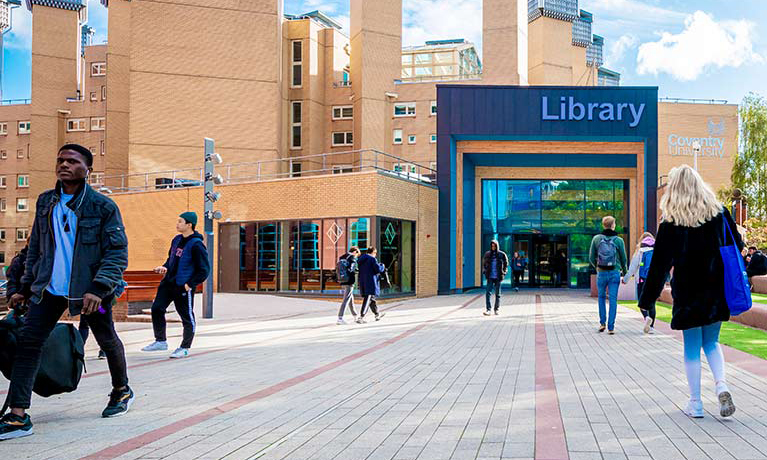
The library is usually open 364 days a year. It’s where you can access your course’s specialist Academic Liaison Librarian. It’s also home to specialist teams which can support you with your academic writing and maths and statistics questions.

Careers and employability
Get one-on-one career and employability guidance lasting up to 18 months from the end of your course. We’ll help you find placements and graduate roles, offer CV and application checks, mentoring, skills workshops, employer events and more.
Careers and opportunities
Upon completion of the course, you will be able to:
- explore and evaluate the complex and dynamic global business environment in which accounting operates including detailed analysis of the legal and ethical frameworks applicable to accounting and business, and awareness of interdependencies between the regulatory, legal, ethical and economic frameworks.
- identify, extract and interpret data from a variety of financial and other numerical sources using appropriate analysis techniques and an appreciation of statistical concepts.
- record and summarise transactions and other global economic events; prepare financial statements in compliance with relevant regulatory requirements; and demonstrate awareness of the contexts in which accounting data and information is processed and used, by different stakeholder groups.
- critically evaluate different theories of taxation, describe the principal types, rules and requirements of UK taxation and prepare computations of the income tax liability for employees, sole traders, partnerships and corporations.
- critically evaluate a range of contemporary theories, models and concepts in accounting, and synthesise these to devise optimal strategies for entities.
- apply critical, analytical and problem-solving skills, including critical analysis and evaluation of data, drawing reasoned conclusions to formulate effective strategies for individuals or organisations.
- use digital information and communications technology for the acquisition, analysis and communication of information.
- effectively communicate and present quantitative and qualitative information, analysis and findings in a form appropriate to the intended audience.
- evidence effective critical self-reflection, ethical awareness, intercultural awareness and well-developed interpersonal skills including numeracy, collaborative problem-solving and effective time management.
Upon completion, you should have the confidence to give sound financial advice and make effective financial decisions. You should be well-placed to pursue a wide variety of potential future careers options in areas such as:
- accounting
- finance
- management
- banking
- personal and Corporate Finance
- business
- education in private, public and third sector organisations.
In addition, this course could set you on the path towards a professional qualification as a Chartered Accountant.
Where our graduates work
Past students have gone on to work for prestigious companies including Samsung, HSBC and Greene King.
Typical roles that graduates of this course may progress to include Graduate Financial Accountant, Trainee Tax Advisor, Finance Graduate Scheme, and Finance Assistant.
Further study
Upon successful completion of our Accountancy BSc (Hons) course, you may wish to continue to further your studies at postgraduate level with our Finance MSc here at Coventry Business School, or our Professional Accounting MSc at Coventry University London. You can explore all of your options using our postgraduate course search tool. You may be entitled to an alumni discount on your fees if you decide to extend your time with us by progressing from undergraduate to postgraduate study.

Managing your money
Managing your money can help you make the most of university life. Discover our top tips for budgeting and the support available to Coventry University students.
Learn how to be smart with your money
Discover Phoenix+
Phoenix+ brings you together with other students to learn, experience and develop essential knowledge and skills. Whatever destination you choose, it's about preparing you for life after university.
Learn more about Phoenix+How to apply
This course with foundation year is not available to international students.
UK students
Disclaimers
You may also like

Coventry University (Coventry)

Accounting and Finance BSc (Hons)
Coventry University (Coventry)

Business Economics BSc (Hons)
Coventry University (Coventry)