Search
Global Journalism and Public Relations MA
Study level: Postgraduate
Develop practical journalism and public relations skills while exploring global affairs, including politics, conflict, technology, development and the environment.
Course features
Year of entry
Location
Coventry University (Coventry)
Study mode
Full-time
Duration
1 year full-time
Course code
CAST019
Start date
November 2026
January 2027
March 2027
May 2027
July 2027
Course overview
Combine practical journalism and public relations skills with an exploration of global affairs, examining the political, regulatory and professional contexts that shape media while considering the challenges of reporting on global issues.
- Connected to the industry: explore how journalism and media operate in a global context, drawing on real-world insights, industry connections and Coventry's proximity to major creative and media hubs, including Birmingham and London.
- Professional journalism and communications skills: build the practical, creative and technical skills employers value, producing a range of journalistic content, exploring global affairs and developing your own public relations (PR) and communications strategies. Develop a portfolio of journalism and communications work that can be used to demonstrate your skills and experience to employers.
- Technology-driven storytelling: bring your ideas to life through innovative, multiplatform storytelling. Use modern, industry-standard facilities4 and equipment to create compelling content for today’s fast-moving digital media landscape.

5 QS Stars for Teaching and Facilities
QS Stars University Ratings
Ranked 1st for Engagement
Postgraduate Taught Experience Survey (PTES) 2026
Ranked 5th for Overall Satisfaction
Postgraduate Taught Experience Survey (PTES) 2026Why you should study this course
- Practical hands-on experience: take part in studio-based and on-location production learning, with opportunities to report on local, national and global events/happenings, helping you build practical reporting experience and confidence.
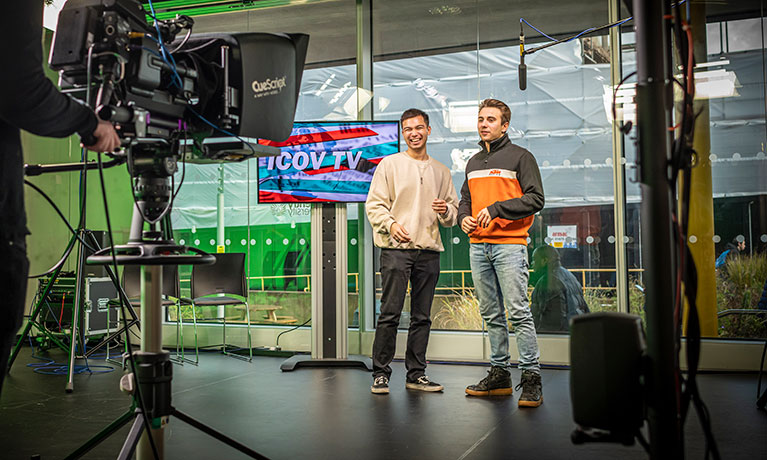
- Multiplatform training: gain hands-on skills in writing, broadcasting, editing and social media optimisation using our modern industry-standard facilities and equipment, helping you develop practical journalism, media and communications skills valued by employers. Facilities include The Tank TV Studio.
- Creative collaboration: work and learn with other postgraduate students on related courses within our School of Social Sciences and Humanities and College of the Arts and Society. You’ll be part of a wider community that includes alumni and industry professionals, with opportunities2 to take part in Collaborative International Online Learning activities such as Global News Relay and Global Pop-Up Newsroom.
- Project-based learning: develop your portfolio through learning and coursework designed to mirror the pace and pressures of real newsroom environments, with opportunities to produce news, features, commentary and analysis, helping you prepare to deliver professional-standard work that showcase your employability and career readiness.
- Experienced and supportive staff: delivered by a team that includes internationally oriented academics, practising journalists and industry professionals, and benefitting from relevant subject links within the University (for example research centres on Peace and Security, Postdigital Cultures, Global Learning) and contacts over the years with global journalism and media-communication organisations and outlets.
What you'll study
Learn how to write, edit and disseminate news, feature stories and opinion articles for print, broadcast and digital platforms and audiences using modern industry-standard facilities, equipment and software while developing an understanding of relevant legal and ethical frameworks. You will also get to explore creative and collaborative approaches to journalism and public relations alongside opportunities2 for professional networking and development. Get an insight into global affairs, issues and theories to build authority and voice in your career.
We regularly review our course content, to make it relevant and current for the benefit of our students. For these reasons, course modules may be updated.
How you'll learn
Our teaching and learning methods are designed to help you develop critical, analytical, reflective and creative journalism skills alongside specialist knowledge of the contemporary media landscape and develop cross-media and cross-platform skills (especially print, broadcast and digital).
We go beyond conventional lectures, seminars, tutorials and workshops, to include:
- practical studio sessions
- news days/production days
- group/collaborative projects
- live-brief challenges
- presentations
- creative workshops
- portfolio development sessions
- specialist journalism/PR project supervisory meetings.
We apply a project-based, interactive approach to teaching and learning, using real-world and current events in global journalism and PR as case studies to develop practical journalism skills, including the use of new and emerging technologies and strategies.
Teaching contact hours
As a full-time postgraduate student, you will study modules totalling 180 credits each academic year. A typical 30-credit module requires a total of 300 hours of study. Study hours are made up of teaching contact hours and guided and independent study.
Teaching hours
Teaching hours may vary, depending on where you are in your studies, but on average, you will have between 8 and 12 teaching and learning hours each week. You will also have the opportunity to attend optional sessions including time with a Success Coach or to meet with staff for advice and feedback.
Guided and independent study
Throughout your studies, you will be expected to spend time in guided and independent study to make up the required study hours per module. You will be digging deeper into topics, reviewing what you’ve learnt and completing assignments. This can be completed around your personal commitments. As you progress to the end of your studies, you’ll spend more time on independent learning.
Online learning
As an innovative university, we use different teaching methods, including online tools and emerging technologies. So, some of your teaching hours and assessments may be delivered online.
Assessment
This course incorporates standard as well as new and innovative assessment methods aligned with current industry standards, providing opportunities to develop practical journalism and communications skills while building a portfolio of work across a range of formats and platforms.
Assessment methods may include:
- news reports (including as part of broadcast bulletins)
- feature stories
- social media shorts
- commentary
- blog posts
- essays (including audio/video essays)
- reflections
- presentations
- communication strategy
- research paper
- projects (e.g. documentary, international collaboration)
- individual assignments
- group work.
The Coventry University assessment strategy aims to ensure that our courses are fairly assessed and allows us to monitor student progression towards achieving the intended learning outcomes.
International experience opportunities
You will be actively encouraged to explore international stories and coverage opportunities2 across your studies. The course team will assist you with developing international connections, where appropriate, to this end.

Focus with block learning
Most courses use block learning. You study one module for six weeks, then move on to the next. It's a simple, structured way to stay organised and build confidence in your studies.
Explore block learningSome of the most exciting moments on this course are those in which students have glints in their eyes as a result of going through real-life practice experience - for instance when they cover a live event such as global campaign against modern slavery Red Sand Project, during live broadcasts such as Global Pop-up Newsroom collaboration, after they’ve watched the broadcast of their segment on Global News Relay project, when they rub shoulders with distinguished guests speakers, or when their course magazine is just published online. These sometimes challenging yet rewarding undertakings help students build their confidence, portfolios, and networks useful for professional experience and employability.
Dr Fred Mudhai, Global Journalism and Public Relations MA Course Director, 2026

Entry requirements
Typical entry requirements:
Fees and funding
| Student | Full-time | Part-time |
|---|---|---|
| UK, Ireland*, Channel Islands or Isle of Man | £11,700 | Not available |
| EU | £11,700 per year with EU Support Bursary** £19,500 per year without EU Support Bursary** |
Not available |
| International | £19,500 | Not available |
For advice and guidance on tuition fees3 and student loans visit our Postgraduate Finance page and see the University's Tuition Fee and Refund Terms and Conditions.
We offer a range of International scholarships to students all over the world. For more information, visit our international scholarships page.
Tuition fees cover the cost of your teaching, assessments, facilities and support services. There may be additional costs not covered by this fee, such as accommodation and living costs, recommended reading books, stationery, printing and re-assessments should you need them.
The following are additional costs not included in the tuition fees:
- Any optional overseas field trips or visits: £400+ per trip.
- Any costs associated with securing, attending or completing a placement (whether in the UK or abroad).
*Irish student fees
The rights of Irish residents to study in the UK are preserved under the Common Travel Area arrangement. If you are an Irish student and meet the residency criteria, you can study in England, pay the same level of tuition fees as English students and utilise the Postgraduate Master's Loan.
**EU Support Bursary
Following the UK's exit from the European Union, we are offering financial support to all eligible EU students who wish to study an undergraduate or a postgraduate degree with us full-time. This bursary will be used to offset the cost of your tuition fees to bring them in line with that of UK students. Students studying a degree with a foundation year with us are not eligible for the bursary.
How do you know if you need to pay UK or international tuition fees?
Facilities
Our journalism courses have a dedicated area within the Ellen Terry Building consisting of three interconnected rooms that currently comprise two newsrooms, one of them doubling as a seminar room and the other as a Mac Lab with Adobe software. There's access to two fully equipped radio studios, and your practical teaching and technical instruction takes place in the Tank TV Studio in the Hub.

Media loan service
Borrow specialist equipment to support your projects and assignments. Whatever you need for your audio, video or photography requirements, we probably have it. We can also offer technical advice and help with using equipment.
Television studio
You'll have access to our on-site television studio The Tank, offering specialist equipment such as large cameras, mixing facilities and fibre-optic wiring throughout.

Mac studio
Whether you’re editing images, creating videos or more, our Mac studios provide all our students with a range of software options you would need to bring your creativity to life.
You’ll use facilities through timetabled teaching, practical activities and relevant independent study. Access may vary by module, activity, capacity, supervision or safety requirements. Access may change or be limited where the University needs to follow public authority guidance, decisions or orders.
Careers and opportunities
Potential career paths include:
- Journalist
- Public relations management
- Project management and coordination
- Staff writer
- News planner
- Social media content creator
- Immersive journalist
- Marketing content specialist
- Public relations executive
- Editor
- Social media manager.
On successful completion of this course, you will be able to:
- apply systematic knowledge of key issues, debates, practices and processes relating to global politics and international relations
- understand and strategically apply advanced principles and techniques of global journalism and PR including written, audio, video and presentation with respect to conventions, legal and ethical codes and specific genres
- critically evaluate the influence of marketing communications on media and markets
- demonstrate systematic engagement with and evaluation of journalistic work within their specialist field with reference to academic and professional conventions
- produce journalistic work that shows advanced understanding of key issues, concepts and principles in their area of specialisation and an awareness of specialist and non-specialist audience needs
- engage with and strategically utilise research methods and specific research methodologies such as textual analysis and interviews
- demonstrate an advanced understanding of the evolving nature of journalistic and PR practice and apply appropriate skills to the production of work for emerging media platforms.
Where our graduates work
Due to the focused and transferable skills that this course offers, our graduates have secured jobs in diverse areas that include:
- TV reporter and presenter at Porto Canal channel in Portugal
- Radio reporter with German public broadcaster NDR in Hamburg
- Staff journalist at a Turkish news agency foreign desk
- Freelance journalist
- Managing editor for a specialist UK outlet on camping and caravanning
- Web publisher at global public relations and advertising agency Cheil
- Marketing for retail chain Sonae MC in Portugal
- Public relations and marketing communications with London-based Four Agency Worldwide
- Strategic relationships at associate director level with UK regulator Ofqual
- Digital workplace manager in Europe, the Middle East and Africa for Canada-based international investment agency Colliers.
How to apply
UK students
International students
Disclaimers
You may also like

Coventry University (Coventry)

Automotive Journalism MA
Coventry University (Coventry)

Sports Journalism MA
Coventry University (Coventry)