Search
Coventry University study finds retailer’s farming programme boosting climate resilience across South Africa
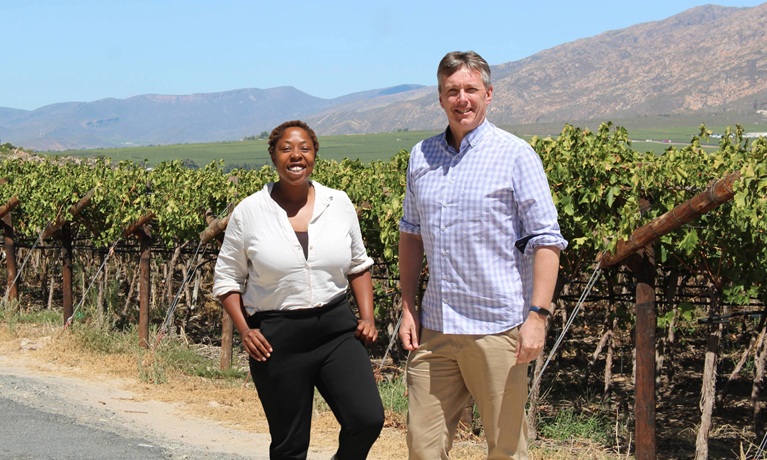
PhD student Catherine Mazhandu with Professor David Bek on a South African farm during her fieldwork.
University news / Research news
Wednesday 11 March 2026
Press contact
New Coventry University research has found that a South Africa–based retail company’s programme is helping farmers cope with water scarcity and other climate‑change impacts.
The study shows that the long‑running Woolworths South Africa’s Farming for the Future (FFF) programme – now in its 17th year – is improving soil health, water efficiency and biodiversity across fresh‑produce farms, offering a model for how retailers can support climate‑smart agriculture and secure more stable food supply chains.
The research – the first independent, in‑depth review of a retailer‑led sustainability assurance scheme – was carried out as part of a four‑year PhD project by Catherine Mazhandu at Coventry University’s Research Centre for Arts and Creative Cultures, funded through the UK Government’s Global Challenges Research Fund.
Our research shows that safeguarding natural resources amid climate pressures is a shared responsibility - not something governments or farmers can manage alone. Meaningful progress depends on collaboration across sectors and regions. Farming for the Future demonstrates this in practice, with the retailer working closely with farmers, scientific advisors, academics and consumers to deliver measurable environmental improvements and actively influence how food is produced.
The study also gave us a rare opportunity to examine the supply‑chain relationships behind everyday produce. Future models could strengthen social sustainability too - supporting farmer livelihoods, skills development and more inclusive decision‑making - so environmental progress is matched by positive social and economic outcomes.
Catherine Mazhandu, a PhD student at Coventry University’s Research Centre for Arts and Creative Cultures
Drawing on 16 years of data and on‑farm research, the study shows that producers involved in the programme make steady, measurable improvements in environmental management, with long‑term participants seeing the strongest gains. Improvements are particularly evident in irrigation, water‑use efficiency and pest and plant management, helping farmers cut costs and cope better with water scarcity and other risks like power supply issues.
Economically, Woolworths’ co‑investment model has helped producers reduce resource use, improve yields per hectare and remain more resilient during major shocks such as prolonged droughts and the Covid‑19 pandemic, supporting more stable supplies of high‑quality produce.
This study affirms what we have seen through our partnerships with farmers, since we introduced our FFF programme seventeen years ago, that environmental stewardship and commercial resilience go hand in hand.
Our Farming for the Future programme is one of Woolworths’ leading initiatives to build climate resilience, restore biodiversity and ensure food security, using science-based and regenerative farming techniques to improve soil health and strengthen ecosystems.
Latiefa Behardien Woolworths Foods Chief Technology and Sustainability Officer
Lead supervisor Professor David Bek said the findings confirm FFF as a global benchmark for retailer‑led sustainability and a model for long‑term collaboration between retailers and growers.
What makes this research especially important is that Woolworths opened the programme up to full independent scrutiny - something retailers almost never do. Our analysis shows steady, meaningful improvements that really matter on the ground.
Farming is becoming harder everywhere as droughts, extreme weather and other climate‑related pressures intensify, and this study shows that long‑term partnerships between retailers and growers can strengthen supply chains and protect ecosystems. I’ve been researching this programme for 15 years and what stands out is the genuine, sustained impact it’s having on South African agriculture.
Professor David Bek, of Coventry University’s Research Centre for Arts and Creative Cultures
The full report will be available online soon.