Search
Coventry University researcher helping uncover hidden history of ancient Greece
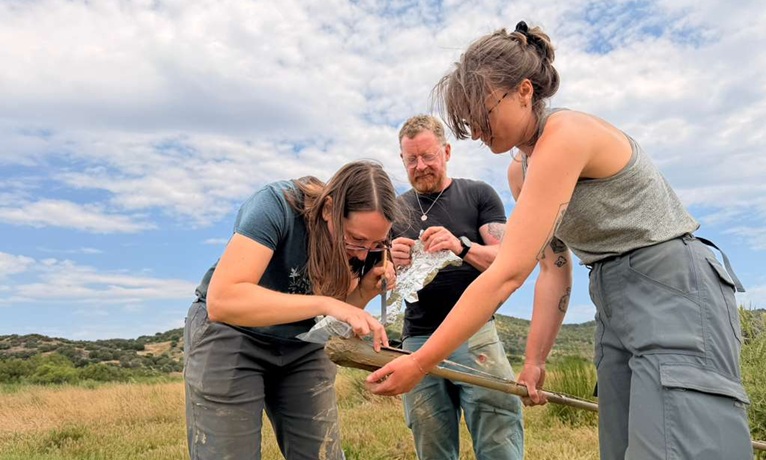
Dr Michelle Farrell (left), from Coventry University’s Research Centre for Agroecology, Water and Resilience, with colleagues James Bendle and Isabella deVito-Brown from the University of Birmingham.
University news / Research news / Sustainability, Clean Growth and Manufacturing
Tuesday 14 July 2026
Press contact
A Coventry University researcher is playing a key role in a major new international project exploring the everyday lives of people in ancient Greece.
The Attica Regional Integrated Environmental and Material Survey (ARTEMIS) has been awarded funding by the Arts and Humanities Research Council (AHRC) to investigate the rural history of ancient Greece, offering a more complete picture of how ordinary people lived.
Dr Michelle Farrell, Assistant Professor in Coventry University’s Research Centre for Agroecology, Water and Resilience (CAWR), is leading the project’s palaeoenvironmental reconstructions, helping to reveal how climate and environment shaped daily life for ancient communities.
The project is led by Dr Maeve McHugh (University of Birmingham) and brings together Dr Farrell and researchers from the University of Patras, the University of Innsbruck and the Ephorate of Antiquities of East Attica, in partnership with the British School at Athens and the Ephorate of Antiquities of East Attica. Archaeological fieldwork is conducted under the directorship of Dr Eleni Andrikou, Ephor of Antiquities of East Attica.
ARTEMIS will focus on the ancient site of Brauron in eastern Attica, which had great significance for Athenian women and girls. The project will use archaeological, environmental and climate data to reconstruct the natural and cultural landscapes around the site.
By examining artefacts, land use and environmental conditions together, the team aims to build a clearer picture of life beyond the cities, uncovering fresh insights into ancient life and the often-overlooked experiences of women, children and rural communities.
Histories are often dominated by elite voices, but by exploring the lives of ordinary people in ancient Greece we can work to make these histories more accessible and inclusive. The project aims to challenge traditional narratives that have focused on urban centres and elite perspectives, instead bringing forward the voices of women, children and rural communities whose stories are less often told.
By examining artefacts, land use and environmental conditions together, we’re aiming to build a richer picture of life beyond the cities and offer fresh insights into the everyday experiences of people in ancient Greece.
There is often a focus on what was happening in the cities, but these urban centres were incredibly reliant on rural areas to sustain them so it’s important that we also consider those living outside of the cities and the role they played – and understanding the environment that they lived and worked in is a key part of this.
Dr Michelle Farrell, from the Research Centre for Agroecology, Water and Resilience
Working in collaboration with colleagues from Innsbruck and Patras, Dr Farrell aims to use pollen records and advanced modelling techniques to map land cover change across the project area over time, showing what the land was used for, what types of crops were grown, and in what locations.
Alongside colleagues at the University of Birmingham exploring changes in climate, she wants to examine how such changes potentially impacted how the land was used at different times.
The pollen-based land cover models that we plan to use were developed in North America and Northern Europe, in very different landscapes to those of the Mediterranean. This means that there is currently a lack of calibration data, including estimates of how much pollen is produced by different species, for Mediterranean plant taxa, and so this type of modelling has not yet been widely applied in the region.
We will be developing these calibration datasets as part of the ARTEMIS project - which is really exciting as it will enable these types of modelling approaches to be much more widely used by researchers across the Mediterranean region in the future.
Dr Michelle Farrell
The five-year project, which began in the summer of 2025 and is now in its second year, includes plans for public engagement and community events in Greece and beyond.
Find out more about Coventry University’s Research Centre for Agroecology, Water and Resilience.