Search
Islamic Finance MSc Progression Route

Candidates who have successfully completed the Advanced Diploma in Islamic Finance (ADIF) qualification will be eligible to enrol on this MSc Islamic Finance degree.
Course code
CBLT024
Location
100% online study
Study mode
Part-time
Duration
1 year part-time
Fees
£9,500
Start date
May 2026
Course overview
Candidates who have successfully completed the Advanced Diploma in Islamic Finance (ADIF) qualification will be eligible to enrol on this MSc Islamic Finance degree.
This course has been developed in partnership with the Bahrain Institute of Banking and Finance.
Course detail
The first delivery of modules will be in May 2026 during which you will complete the following modules:
Semester one
Corporate Finance and Risk Management – 30 credits
The module facilitates a critical examination of pivotal issues in the global corporate finance landscape. Students will explore, from finance, accounting and economic perspectives, the relevance of issues such as financial management, asset pricing, capital structure and pay-out policies. The module emphasises the implications of risk exposure and management in dynamic political, economic, financial, operational, and regulatory environments. Students will foster an anticipatory view to deal with risk and changes based on financial and non-financial hedging methods.
The module fosters student confidence to question established norms, practices, and decisions, and develop a habit of critical evaluation of theoretical frameworks and reported empirical tests related to risk management and strategic decision-making.
Semester two
Governance, Ethics and Sustainability – 30 credits
This module provides a comprehensive understanding of the key issues concerning sustainability, ethics and governance for the global financial and economic landscape. Students will examine the influence of national and global regulations, corporate governance frameworks and ethical principles that drive sustainable and responsible business practices.
Students will critically analyse the prevailing corporate governance norms, the allocation of decision-making powers, and their implications for businesses, economies, financial markets and society. The module elevates societal priorities for creating long-term shareholder value while balancing conflicting social and economic interests. Drawing on the United Nations Sustainable Development Goals (UN SDGs), it prepares students to become responsible leaders who are mindful of the ethical, social and environmental impact of their decisions.
Data Analysis and Research Methods – 30 credits
This module seeks to equip students with the skills and knowledge necessary to undertake independent research. It will cover key quantitative techniques commonly used by financial analysts, economists, accountants and investors to give students a grounding in fundamental econometric methods for data analysis. Using global economic and financial data, the module explores statistical techniques of descriptive analysis, estimation, hypothesis testing, and modelling. Emphasis is placed on the understanding and interpretation of quantitative results for economic and financial decision making.
Students will formulate fitting research objectives and select appropriate methodologies to develop their competence in designing and evaluating successful qualitative and quantitative research projects. Through experimentation on diverse data sources, students will elevate their analytical and reflective abilities, preparing them for contemporary data driven challenges.
Semester three
Postgraduate Project – 30 credits
This flagship module applies knowledge and insights from across the course to develop independent and ethical researchers. Students will conduct a substantive research project related to their choice of topics in economics, finance or accounting to evidence intellectual, technical and analytical skills.
Students receive personalised support and guidance from a dedicated supervisor but also benefit from critical discussions and cross fertilisation in group supervision sessions. All project titles are approved by supervisors prior to commencing the research project. Students will undertake a research project on an approved topic which may take the form of a traditional dissertation or researching a business issue facing an organisation. This inclusive approach allows students to apply their learning in a practical context to a topic and in a manner that fits their individual expertise and skillset.
Successful completion of the above modules will enable students to qualify for an MSc in Islamic Finance awarded by Coventry University.
For further details about this top-up course, please direct enquiries to Dr Aqsa Aziz, Course Director.
Assessment
Coursework, examination, online phase test and individual dissertation.
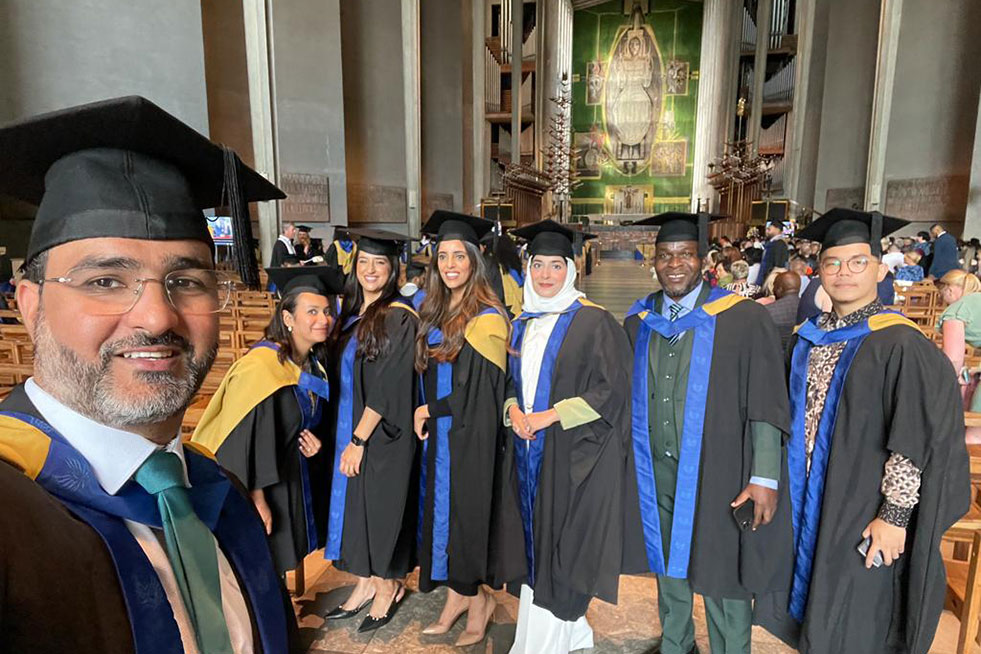
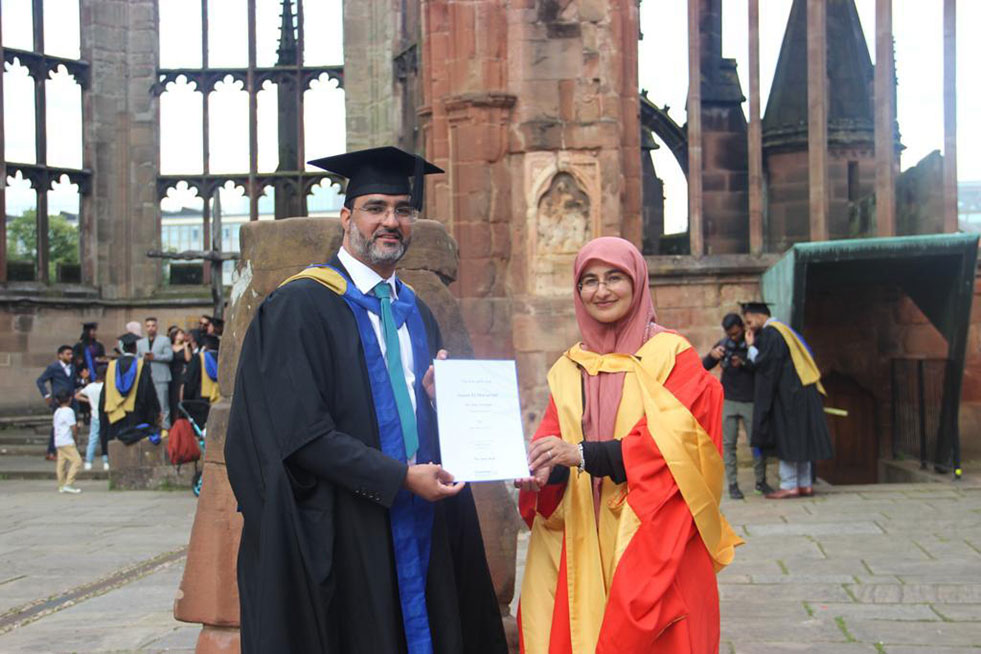
My dream come true by celebrating my achievement of completing my master degree in Islamic finance, Thank you Coventry University for arranging our graduation ceremony which was very smooth and well organised and a special thanks to our super hero Dr Aqsa Aziz for her unlimited support.
Maryam Abdullah, Islamic Finance MSc Progression Route graduate, quoted in 2023

Course dates
Semester 1: Monday 18 May – Saturday 22 August 2026
- 7065EFA - Corporate. Finance and Risk Management (30 credits)
Semester 2: Monday 14 September – Saturday 19 December 2026
- 7065EFA - Governance, Ethics and Sustainability (30 credits)
- 7064EFA - Data Analysis & Research Methods (30 credits)
Semester 3: Monday 18 January – Saturday 24 April 2027
- 7069EFA - Postgraduate Project (30 credits)
How to apply
Apply nowPlease note this course is only open to candidates holding the Advanced Diploma in Islamic Finance.
Throughout the program, I was impressed by the high calibre of the faculty and the curriculum, which provided a rigorous and comprehensive understanding of finance and its applications in the real world. The structure of the program, with its emphasis on self-directed learning and collaborative projects, allowed me to develop important skills that I look forward to applying in the years to come.
Yousif Ahmed Al Hamar, Islamic Finance MSc Progression Route graduate, quoted in 2023



-
Disclaimers
Coventry University together with Coventry University London, Coventry University Wrocław, CU Coventry, CU London, CU Scarborough, and Coventry University Online come together to form part of the Coventry University Group (the University) with all degrees awarded by Coventry University.
1Accreditations
The majority of our courses have been formally recognised by professional bodies, which means the courses have been reviewed and tested to ensure they reach a set standard. In some instances, studying on an accredited course can give you additional benefits such as exemptions from professional exams (subject to availability, fees may apply). Accreditations, partnerships, exemptions and memberships shall be renewed in accordance with the relevant bodies’ standard review process and subject to the university maintaining the same high standards of course delivery.
2UK and international opportunities
Please note that we are unable to guarantee any UK or international opportunities (whether required or optional) such as internships, work experience, field trips, conferences, placements or study abroad opportunities and that all such opportunities may be unpaid and/or subject to additional costs (which could include, but is not limited to, equipment, materials, bench fees, studio or facilities hire, travel, accommodation and visas), competitive application, availability and/or meeting any applicable travel, public authority guidance, decisions or orders and visa requirements. To ensure that you fully understand any visa requirements, please contact the International Office.
3Tuition fees
The University will charge the tuition fees that are stated in the above table for the first Academic Year of study. The University will review tuition fees each year. For UK (home) students, if Parliament permit an increase in tuition fees, the University may increase fees for each subsequent year of study in line with any such changes. Note that any increase is expected to be in line with inflation.
For international students, we may increase fees each year, but such increases will be no more than 5% above inflation. If you defer your course start date or have to extend your studies beyond the normal duration of the course (e.g. to repeat a year or resit examinations) the University reserves the right to charge you fees at a higher rate and/or in accordance with any legislative changes during the additional period of study.
4Facilities
Facilities are subject to availability. Access to some facilities (including some teaching and learning spaces) may vary from those advertised and/or may have reduced availability or restrictions where the university is following public authority guidance, decisions or orders.
Student Contract
By accepting your offer of a place and enrolling with us, a Student Contract will be formed between you and the university. The current 2025/2026 contract can be found on the website. The Contract details your rights and the obligations you will be bound by during your time as a student and contains the obligations that the university will owe to you. You should read the Contract before you accept an offer of a place and before you enrol at the university.