Search
Coventry University’s success continues with another win at the Excellence in Recycling and Waste Management Awards
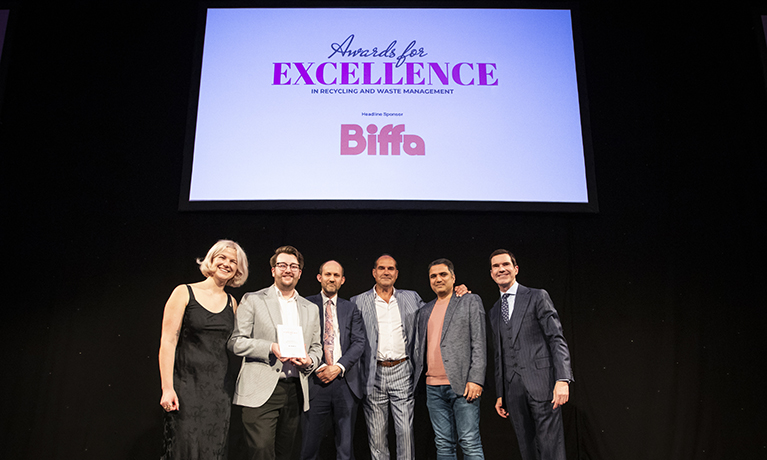
The Excellence in Recycling and Waste Management Awards were presented by comedian Jimmy Carr.
University news / Research news / Business news / Life Sciences
Monday 29 June 2026
Press contact
Coventry University has received another award recognising its pioneering work on the LithiumCycle™ process.
Working in collaboration with Cellcycle, one of the UK’s leading lithium battery recycling companies, the university won the Innovation of the Year category at the Awards for Excellence in Recycling and Waste Management.
The LithiumCycle™ process is an innovative bio-based recycling technology designed to recover critical minerals from end-of-life lithium-ion batteries in a more sustainable and efficient way.
The award follows previous success when it was named as winner of the National Recycling Award 2025 for Waste Management Energy Innovation.
The UK currently lacks the capability to fully refine and recycle end-of-life lithium batteries domestically, creating a significant challenge for the country’s net zero ambitions and future electrification plans.
LithiumCycle™ offers a more sustainable solution through an innovative bioleaching process that recovers valuable metals from used lithium batteries. This award is a fantastic recognition of the dedication of our research team and the strength of our collaboration with Cellcycle through our Innovate UK-supported Knowledge Transfer Partnership.
Sebastien Farnaud, from Coventry University’s Research Centre for Discoveries in Life Sciences
The LithiumCycle™ process aims to reduce the UK’s reliance on overseas refining while strengthening domestic supply chains for critical minerals.
The same project had also been shortlisted for another award that was taking place on the same day - The Energy Awards 2026 in the category Collaboration of the Year, which also illustrates how battery recycling can shift from highly polluting, high-heat processes to a natural, closed-loop model. It also demonstrates how our bioleaching processes not only process waste but provides metal for industry in true circular economy.
Find out more about research at Coventry University.