Search
Opinion: The UK's creative sector is booming - but its future depends on investing in arts education today
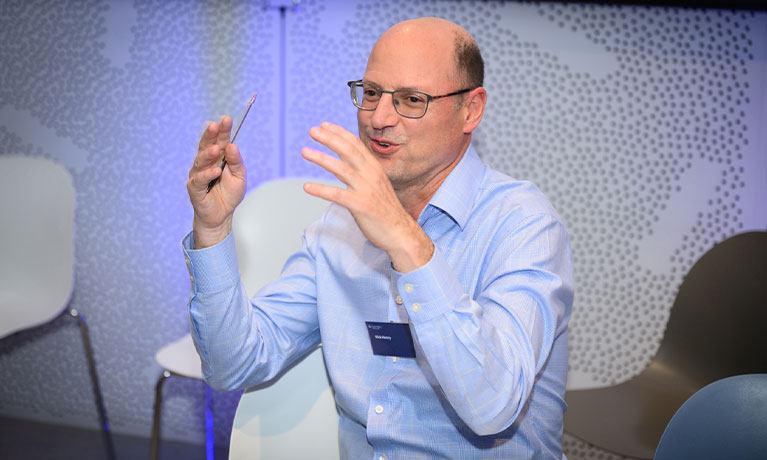
Professor Nick Henry, Associate Pro-Vice Chancellor and Creative and Cultural Industries Lead at Coventry University Group
University news / Research news / Business news / Opinion / Creative and Cultural Industries
Monday 18 May 2026
Press contact
With our Dot Dot Dot…Graduate Festival underway, Professor Nick Henry, Associate Pro-Vice Chancellor and Creative and Culture Industries Lead at Coventry University Group, explores the growth of the UK’s creative sector and why its future will be determined by how we value and invest in arts and humanities education today.
The evolution of the UK’s creative sector
Long before we had technologies to record our lives instantly, we relied on art, literature and architecture to tell us stories about how people lived, what mattered to them and how they saw the world. Much of what we know about the past exists because someone created something that outlived them. But as the digital age merges into an age of artificial intelligence, the creative sector is evolving profoundly, fuelled by its fusion with new technologies.
In 2024, the creative industries contributed £145.8 billion to the UK economy, growing by 4.6% compared with just 1% across the wider economy and they are now 20% larger than before the pandemic. The need for creative workers continues to grow across the economy, as they create the interactive and immersive experiences of technology, the stories and brands behind business and the human-centred design thinking across industries such as healthcare, transport and the experience economy.
Yet while the appetite for creative talent increases, the degrees that develop much of that talent are shrinking across the country. It raises the question as to whether we are investing enough in the education and skills this sector needs and what the consequences could be if we are not.
Arts and humanities education is essential for growth
As investment in the sector continues to surge, so too must investment in arts education that will help sustain its future because, at its core, the sector is not powered by technology alone but by creative people: the storytellers, the risk-takers and the curious thinkers who interpret and imagine what we see and what we know differently. STEM (science, technology, engineering and mathematics) must become STEAM (science, technology, arts, engineering and mathematics), encouraging the creativity of design, aesthetics and user experience alongside technical proficiency.
In many ways, undertaking an arts and humanities degree is one of the first real opportunities a creative person will have to put their talent and thinking into practice, which is reflected in our own students and graduates. Over the past year, we have seen a student on our Automotive and Transport Design course win an international competition for his open-plan yacht design, a Film Production graduate win a Royal Television Society award for his short film, students on our Graphic Design course produce artwork for Coventry City Football Club and Media and Communications graduates set up a marketing agency whose global clients include Disney and Netflix.
When we look more closely at what enabled this success, we see a huge array of behaviours and skills developed via their degrees, including spatial and 3D design thinking, narrative construction, branding and business creation. They are extraordinary examples of how creative graduates contribute to the economy and society as entrepreneurs, innovators and storytellers and how creativity has long been part of the lifeblood of Coventry University Group, from its textile heritage and the founding of the Coventry School of Design more than 180 years ago.
Where the creative industries are heading
Considering the continuous growth of the creative industries, we are beginning to see what they are really capable of, with the West Midlands alone being home to more than 15,000 creative enterprises.
Through CreaTech Frontiers, in which we are a partner, universities, industry and cultural organisations are collaborating to accelerate creative technologies in the region through business funding, research and development and educational programmes. More recently, we also delivered CreaTech Europe Connect to help creative businesses scale internationally, build partnerships and access new markets.
Focused on boosting creativity, economic growth and rewarding jobs, the UK Government’s Creative Industries Sector Plan is enhancing the infrastructure for continuous experimentation, commercialisation and the national and global scaling of creative technologies and businesses.
Demand is high and growth is undeniable, but a major challenge facing the sector is whether it can generate enough highly adaptable, digitally fluent and hybrid-skilled creative workers to sustain its expansion. As the Creative Industries Policy and Evidence Centre has identified, the UK’s education and skills system is not keeping up with the growth of the sector, with most hard-to-fill vacancies driven by skills shortages and a high proportion of advanced creative roles reporting skills deficiencies.
The future depends on how we invest in creative talent
Arts and humanities education must not only be encouraged but continually reviewed and evolved to ensure such education aligns with the skills the sector requires now and into the medium future. Through our creative education and its innovative project-based curriculum, impactful research and business-facing knowledge exchange initiatives, we are playing our part, but without addressing the wider misalignment between education, skills and creative professions at a national level we risk investment in innovation and infrastructure outpacing the talent needed to maximise the sector’s full potential.
Arts, culture and creativity help us understand humanity, the world around us and how to make the world work for us in all our diversity. That dynamic only grows, including the success story of UK creative industries, but we must invest far more seriously in the talent and creative thinking of the people who will define its future.
Find out more about our arts courses and Dot Dot Dot...Graduate Festival.