Search
Low‑carbon heat network cutting city centre emissions by more than 1,300 tonnes goes live at Coventry University
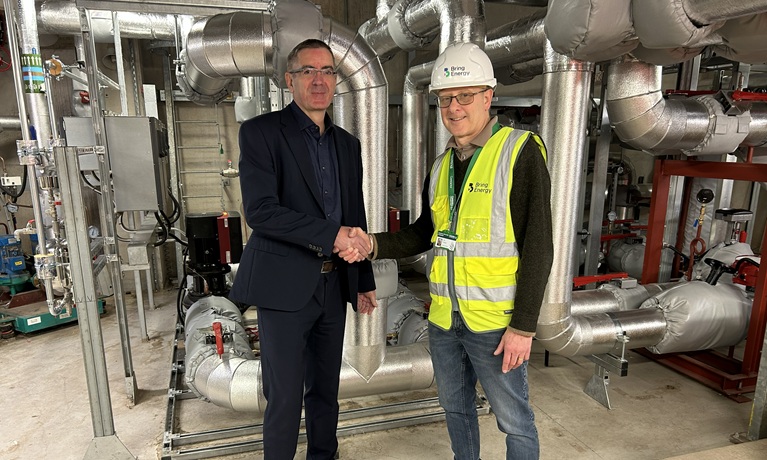
Dr Clive Winters, Pro‑Vice‑Chancellor (Strategy and Governance) at Coventry University, and Ian Parker, Project Director at Bring Energy
University news / Sustainability, Clean Growth and Manufacturing
Wednesday 15 April 2026
Press contact
Coventry University has completed work to connect its campus to the city’s district energy network - a major step that will dramatically cut emissions, boost energy efficiency and support a greener city centre for years to come.
The upgraded network is a major part of the university’s ambition to reach net zero by 2030 and also creates future opportunities for parts of the Hillfields community of the city to access low‑carbon heat, helping to reduce fuel poverty and improve local sustainability.
Supported by almost £13 million from the Government’s Public Sector Decarbonisation Scheme, the project - delivered with Bring Energy - is expected to cut carbon emissions by more than 1,300 tonnes a year, more than a fifth of the university’s annual emissions from fossil‑fuel heating.
This project has been a major undertaking and reaching this milestone simply wouldn’t have been possible without the patience and support of our staff, students and local community. The long‑term benefits - for our city centre, net zero ambitions and future generations - make this a truly transformative moment for Coventry.
Dr Clive Winters, Pro‑Vice‑Chancellor (Strategy and Governance) at Coventry University
The district energy network supplies heat from Coventry’s Energy from Waste (EfW) Facility on London Road through a 6.6km underground system. By switching from gas boilers to the low‑carbon network across seven plant rooms, 11 university buildings – including the Sir Frank Whittle building, the Student Centre, The Hub, Alma, Elm Bank, Cycle Works, Charles Ward, George Eliot and the three Priory Hall blocks – now receive a more resilient, efficient and sustainable heat supply that produces around one fifth of the carbon emissions of natural gas.
This completion marks the end of the first phase of the university’s connection to the district energy network, with the system designed to support further expansion if required.
As part of the upgrade, pipework has also been installed through Hillfields, creating future opportunities for community buildings and homes to join the network. This could help stabilise heating costs, cut emissions from local services and support efforts to reduce fuel poverty in one of Coventry’s most deprived areas.
Completing this connection to Coventry’s district energy network is a significant milestone in our journey to become net zero by 2030. By moving away from gas and onto low‑carbon district heat, we are immediately reducing our carbon emissions and strengthening the long‑term resilience of our campus. This investment benefits our staff and students, who repeatedly tell us sustainability matters to them, and opens the door to future community benefit in the Hillfields area of our city.
Dr Clive Winters
Earlier decarbonisation work funded through the same programme included installing around 800 solar panels across the campus and reglazing the Elm Bank building to improve energy performance.
We’re delighted to work with Coventry University to support its net zero ambition. With phase one of the expansion works now complete, this project demonstrates how extending the Heatline network can deliver scalable, low‑carbon infrastructure while maintaining day‑to‑day campus operations. It shows how district energy can transform a campus’ carbon profile in a practical, cost‑effective way.
Mark Anderson, Concession Director for Birmingham and Coventry at Bring Energy
The Public Sector Decarbonisation Scheme is run by the Department for Energy Security and Net Zero and delivered by Salix.
Connecting the Coventry University campus to Coventry’s district energy network marks a transformative step in this journey to net zero.
We’re pleased that through the Public Sector Decarbonisation Scheme we can support this initiative. It demonstrates what can be achieved when ambition, collaboration and investment come together to drive meaningful environmental change.
Ian Rodger, Director of public sector decarbonisation at Salix
Find out more about Coventry University’s sustainable development.