Search
Opinion: Why the budget is bad for social mobility
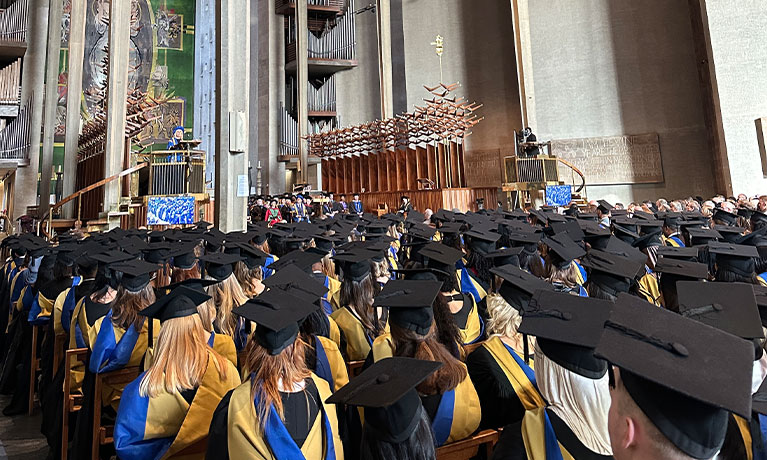
Coventry University graduates in Coventry Cathedral
University news / Opinion
Tuesday 09 December 2025
Press contact
Following the Chancellor’s autumn budget, Professor Ian Dunn, Provost of Coventry University Group, discusses why some of the policies announced risk weakening social mobility, inclusive growth and regional opportunity.
The budget arrived with the hopes of fairness and opportunity, but it is difficult to see this reflected in policies that will serve to reinforce class-based pecking orders.
On the surface, the budget offers a lifeline to both young people and universities through more support for students from disadvantaged backgrounds. Yet, these modest gains are quickly swallowed whole when set against a new levy on international students, rising tuition fees as well as living and employer costs and static loan repayment thresholds.
That isn’t to say that the reintroduction of maintenance grants isn’t great news for young people - for some, it will be the deciding factor in whether earning a degree is possible at all. The problems lie in frozen parental income and loan repayment thresholds and in more red tape and cost placed on a core part of the higher education sector that once kept it financially viable.
More strain on international income
For years, international student fees have helped universities subsidise research and teaching UK students, as domestic funding does not cover costs. The financial crisis in Higher Education was exacerbated by student visa restrictions and a new international student levy will add another layer of cost and complication.
As the Institute for Fiscal Studies has pointed out, a levy on international student fees amounts to a tax on one of the UK’s most valuable exports and ultimately risks eroding demand and income that has helped sustain universities during a period of prolonged underfunding. Fewer international students also mean significantly lower spending in the local economies of the universities affected.
We are firm believers in putting our own house in order and have made significant reforms to secure our long-term sustainability as we do not want students to carry the burden through higher tuition fees. But there is no denying the strain created by repeatedly squeezing an income stream that allows universities to maintain teaching quality and provide the broad education and skills that both students and industry need.
Why the levy hits some universities far harder than others
More concerning still is the way the levy is structured. A flat fee of £925 per student - rather than a percentage of income - cushions the universities that can charge the highest fees and shifts greater pressure onto those that cannot or choose not to. Universities outside a small subset of institutions, which educate far higher proportions of students from low-income backgrounds and are more dependent on international recruitment, are left to carry more of the risk. In effect, the institutions doing the greatest share of the work to increase access to education will be expected to absorb a greater share of financial shock. That would seem at odds with improving social mobility and opportunity.
The levy also rests on an unpleasant assumption that 'elite' status automatically translates to better teaching quality. Our twice awarded TEF Gold rating, alongside five QS star ratings in nine QS categories including teaching and employability, are much more illustrative of real focus on teaching excellence. As our Made in Coventry campaign demonstrates, our students and graduates succeed because of our sustained investment in high-quality education offered to students regardless of where they grew up or their home country.
Universities like Coventry continue to be one of the country’s most reliable drivers of social mobility and economic growth. The two go together, helping young people fulfil ambitions and enter professions that may have once felt out of reach, while building communities at the same time. We were levelling up before the phrase was even coined.
When access to education shrinks, so does economic growth
Widening access to education and creating a community where people from all over the world learn from each other is part of our DNA as a global education group. We work tirelessly to ensure that background does not dictate potential and that talent is nurtured and grown in every community, not just the most affluent ones.
The investment and care we put into support services reflect our understanding that not every student joins us with their life mapped out. Nor will they have all been given the same education and opportunities before reaching Higher Education. Support services and nurturing teaching are critical as they level the field, equipping students to succeed academically and step confidently into the world of work.
Our economic impact report showed that one in every 20 jobs in Coventry can be traced back to the education, research and innovation we deliver in our community. We are doing similar things in all the places that we operate – Scarborough, Barking and Dagenham and with the NHS in Lambeth and in Wiltshire. The government says it is prioritising growth, but growth must be inclusive to happen at all and to deliver the impact needed.
Some of the budget decisions do not come into effect for a few years, so we still have time to realise the implications for the communities they are supposed to help.