Why study a master's degree in health and care at Coventry University?
A postgraduate degree in health and care can help you take the next step in your career with confidence. You’ll learn from experienced academics and industry practitioners, and you’ll have access to facilities that mirror real-world clinical and community environments. This hands‑on experience is designed to build your confidence, strengthen your teamwork and support your decision-making skills.

5 QS Stars for Teaching and Facilities
QS Stars University Ratings

Ranked 1st for Engagement
Postgraduate Taught Experience Survey (PTES) 2026

Ranked 2nd for Support
Postgraduate Taught Experience Survey (PTES) 2026

Ranked 3rd for Skills Development
Postgraduate Taught Experience Survey (PTES) 2026
Choose from our courses with professional accreditation and regulatory approval
Many of our courses offer multiple start dates throughout the year, and some are accredited or approved by professional bodies or regulators.
Choosing an accredited or approved course can help you progress towards a career in a regulated profession. For some, it may help you meet the academic requirements to apply for professional registration. This matters for careers like physiotherapy, nursing and social work, where an approved course is usually required to apply for registration (with the regulatory body) to practise in the UK.
Accreditation or approval shows a course meets standards set by a professional body. This varies by course and may change, so always check the course page for the latest details and any specific terms and conditions.
Professional and regulatory bodies

British Dietetics Association (BDA)

Chartered Management Institute (CMI)

Chartered Society of Physiotherapy (CSP)
Royal College of Occupational Therapists (RCOT)
Royal College of Podiatry (RCOPD)
Health and Care Professions Council (HCPC)
Nursing and Midwifery Council (NMC)

Social Work England
Health and care spaces designed for applied learning and research
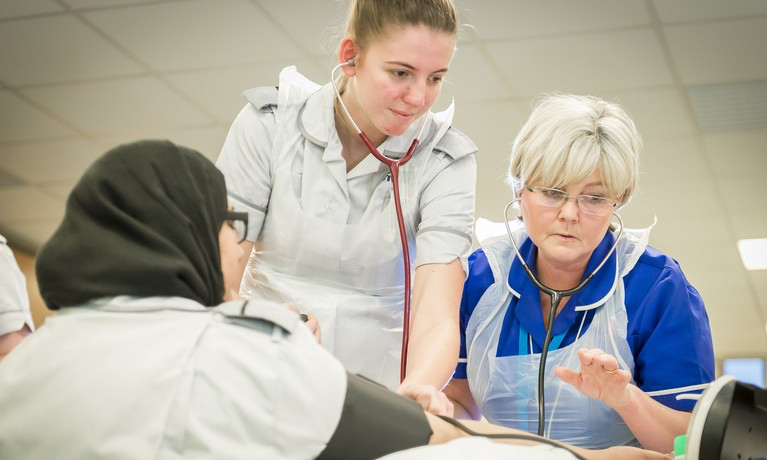
If you choose to study on campus, you’ll have access to dedicated facilities that support hands-on learning, clinical skills development and real-world practice.
- A full-size ambulance room equipped with industry-standard medical tools and advanced manikins, helping you prepare for emergency scenarios in confined, high-pressure environments
- Simulated hospital wards designed to reflect a range of healthcare settings, where you can practise clinical skills such as patient assessment, first aid, suturing, injections and ECGs
- Community houses that support activities such as home visits, patient care and environmental assessment, including spaces with assistive technology for applied and simulated learning
- Clinical skills areas where you can develop core techniques such as physical examinations, patient assessment and key procedures in a safe, supported setting
- A strength and conditioning suite with specialist equipment for analysing movement, performance and rehabilitation, including motion capture systems and force platforms
- An immersive VR CAVE that uses large-scale simulation screens and 3D headsets to support interactive, scenario-based learning and clinical decision-making
These spaces mirror real-world settings, helping you apply your learning and prepare for professional practice.
Visit our dedicated facilities page to find out more.
Take a virtual tour
Hear from our students
-

May Parsons - Made in Coventry
May Parsons, who delivered the world’s first COVID-19 vaccine, reflects on her journey, growth through Coventry University, and inspiring future nurses.
5 min read
-

How a Master’s in Global Healthcare Management...
Study a Master’s in Global Healthcare Management at Coventry University and gain the skills to lead healthcare change and build a rewarding global career.
3 min read
-

Why study a postgraduate degree
Discover why postgraduate study can elevate your career and expand your horizons.
4 min read
Adult Nursing Blended Learning MSc - Adele's story
Find out why Adele thinks our Adult Nursing Blended Learning MSc gives her the best of both worlds.
Fees and funding
Students enrolled in eligible health and care courses may be eligible for the NHS Learning Support Fund, including:
- £5,000 per year non-repayable training grant.
- Additional support is available for travel, dual accommodation, parents and financial hardship (Please check the NHS website for criteria and more information).
Where a health and care postgraduate degree can take you
Our postgraduate courses are designed to help you deepen your expertise, develop your clinical or professional practice, and support progression towards specialist, leadership or research roles across the health, wellbeing and social care sectors.
Depending on the course you choose, your prior qualifications and experience, and any additional professional requirements, you may be able to pursue roles (further training, relevant registration or work experience may be required) such as:
Advanced clinical and professional practice
- Advanced clinical practitioner roles across primary, secondary or community care (subject to relevant registration and experience).
- Specialist practice in assessment, diagnostics and clinical decision‑making.
- Leadership roles in service improvement, quality, or evidence-based practice.
- Clinical educator or practice development positions.
Nursing and allied health (pre-registration pathways)
- Eligibility to apply for registration with relevant regulators such as the Nursing and Midwifery Council or Health and Care Professions Council, where the course is approved, to work as an adult, mental health, learning disability or children’s nurse.
- Roles such as nurse, physiotherapist, occupational therapist, podiatrist, or dietitian (subject to successful completion of an approved course and meeting registration requirements).
- Clinical roles in hospitals, community teams, integrated care systems, or private practice.
- Opportunities to gain experience in acute, rehabilitation, mental health, or public health settings.
Mental health and psychological therapies
- Cognitive behavioural therapist roles within NHS Talking Therapies or specialist services (subject to further training and/or accreditation).
- Mental health practitioner, wellbeing specialist, or therapeutic support roles.
Public health, global health and health systems
- Public health practitioner or health improvement specialist.
- Epidemiology, health protection, or incident response roles.
- Global health project management or humanitarian health roles.
- Policy, strategy, or health systems development positions.
Leadership, management and service development
- Healthcare management or operational leadership roles.
- Service transformation, commissioning, or workforce development.
- Research, evaluation or academic pathways.
- Roles within charities, NGOs, or international health organisations.
Average gross salary* for a a registered nurse (nurse practitioner)
£48,576 per year
Source: salary.com
*Salaries vary depending on experience, sector and location.

Courses that fit around you
Study at our London campus, located in the heart of the financial district, where we offer postgraduate programmes to a diverse, global community.
Coventry University London

 Apply now
  Prospectus
  Contact us
  Call us