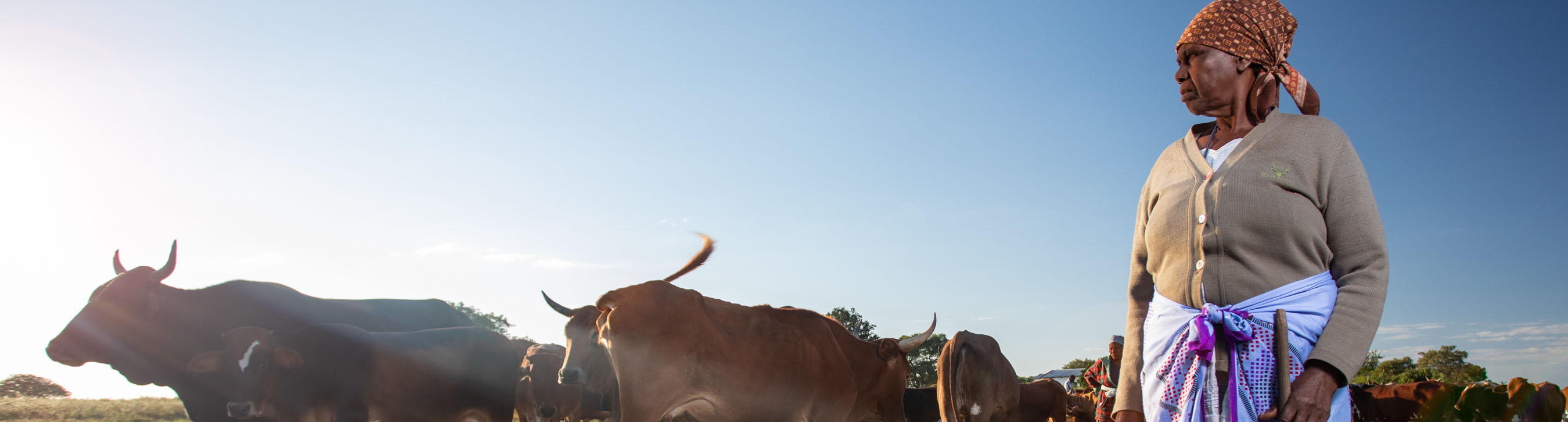
Enhancing biodiversity, climate resilience and livelihoods through more sustainable and equitable cattle value chains in communal rangelands of South Africa (BRACE)
Funder
Funded by the UK Government's Department for Environment, Food and Rural Affairs (DEFRA) through the Global Centre for Biodiversity for Climate (GCBC).


Project team
James Bennett - Coventry University (Principal Investigator)
Lovemore Gwiriri – Coventry University (Research Fellow)
Barbara Smith - Coventry University (Co-Investigator)
Gina Arena – Conservation South Africa (Co-Principal Investigator)
Heidi-Jayne Hawkins – Conservation South Africa (Co-Investigator)
Wayne Twine - University of the Witwatersrand (Co-Principal Investigator)
Marizvikuru Manjoro – University of Venda (Co-Principal Investigator)
Collaborators
Coventry University (Lead)
University of the Witwatersrand


Value to Coventry University
£262,317
Total value
£794,517
Duration
July 2026 to June 2029
Project overview
Through a focus on communal rangelands in the globally important Maputaland-Pondoland-Albany (MPA) biodiversity hotspot in South Africa, this project analyses how Nature-based Solutions (NbS) can be optimised socially and ecologically within a community setting to deliver improved outcomes for biodiversity, climate change and local livelihoods. Working through an existing Herding for Health (H4H) community engagement model and using a co-construction and ‘living labs’ approach, the project will explore ways to enhance NbS practice and outcomes in three key areas. Firstly, the development of more appropriate and inclusive institutional arrangements for delivering NbS and monitoring of biodiversity, focused on increased community participation and incorporation of indigenous knowledge (IK) and practice. Secondly, testing how existing and novel (e.g. thinning of invasive trees) NbS approaches can be optimised in time and space to deliver improvements in forage production, soil carbon and biodiversity in rangelands. Related scientific modelling of these outcomes at scale, under different climate projections, will enable evaluation of different rangeland management practices, and will be used as a basis for co-developing community climate adaptation scenarios. Thirdly, the project will evaluate how these potential improvements in ecosystem services can enhance livelihood outcomes by increasing currently limited opportunities for local people, particularly women, to participate in the beef value chain. Our research will identify key opportunities for adapting the current H4H model in communal rangelands, with potential to scale to 9 additional H4H sites in Sub-Saharan Africa. Further details can be found on the GCBC website: https://www.gcbc.org.uk/project/enhancing-biodiversity-climate-resilience-and-livelihoods-through-more-sustainable-and-equitable-cattle-value-chains-in-communal-rangelands-of-south-africa/
Project objectives
The project is driven by four research objectives:
a) To co-developing institutional arrangements for NbS rangeland management that increase community participation and compliance.
b) To integrate scientific and indigenous knowledge to enable communities to optimize biodiversity value and benefits within communal rangelands.
c) To evaluate combinations of current and potential rangeland NbS (resting, high density livestock corralling and invasive tree removal) to maximise biodiversity and carbon sequestration within rangelands.
d) To co-develop an equitable beef value chain to ensure greater community benefits and heightened participation by community members, particularly women.
Impact statement
The project aims to enhance rangeland biodiversity and associated livelihood resilience by optimizing NbS management and governance. The project impact pathway is based on a co-development approach aimed at integrating indigenous knowledge with science to develop locally-led monitoring and management approaches that improve participation and benefit distribution. Specifically, impact will be achieved through delivery and scaling of several different outcomes in relation to:
- Development and trialing of local biodiversity monitoring protocols blending western scientific and indigenous knowledge.
- Testing and refinement of novel NbS for rangeland management.
- Building of these monitoring and management outcomes into local toolkits for further adoption at H4H sites
- Development of a model for improved participation of women, from rural communities, in the Beef Value Chain (BVC) with potential for scaling.
- Using agent based and empirical modelling outcomes to inform co-created, adaptive community management plans for improving ecosystem service and livestock outcomes from local rangelands.
- Engaging with national and regional policymakers to mainstream project outcomes through policy briefs and how-to-guides and videos.
Outputs
- At least seven academic research articles on the following topics: i) inclusive institutional arrangements for NbS delivery, ii) co-developed biodiversity monitoring protocols, iii) modelled soil carbon outcomes from NbS field trials, iv) improved biodiversity outcomes from NbS trials, v) modelling of livestock management for improved ES outcomes, vi) modelling of tree-thinning for improved ES and vii) how to make beef value chains more socially inclusive in communal areas.
- Two policy briefs on: (i) Effective and inclusive Nbs arrangements in communal rangeland systems facing different institutional constraints, and (ii) Opportunities for more inclusive (particularly by women) engagement of communal cattle farmers with emerging beef markets and specifically aim to inform the emerging South African Livestock Development Strategy and the new Centre of Excellence on Goat and Beef commercialisation.
- At least three how-to guides and climate-smart adaptive management plans focused on i) biodiversity monitoring and compliance, ii) thinning of invasive wattle trees, using short duration livestock kraaling and brush packing, and iii) thinning of encroached native bush with brush packing.
- A Total Ecosystem Carbon (TEC) model for reliable carbon projections under different NbS scenarios.
- A Social-Ecological Model underpinning development of rangeland management scenarios.
- Six short-videos in English with Xhosa and Tsonga subtitles on: (i) take-home messages from policy workshops, and (ii) 'how-to' videos on community-led compliance and biodiversity monitoring; practical guidelines for thinning invasive trees and managing bush encroachment; and step-by-step guidance for BVC market readiness
Communication and Dissemination
(Updated in due course)