Search
Opinion: We’ve been embracing transnational education for years – and our second campus in Kazakhstan takes our global journey even further
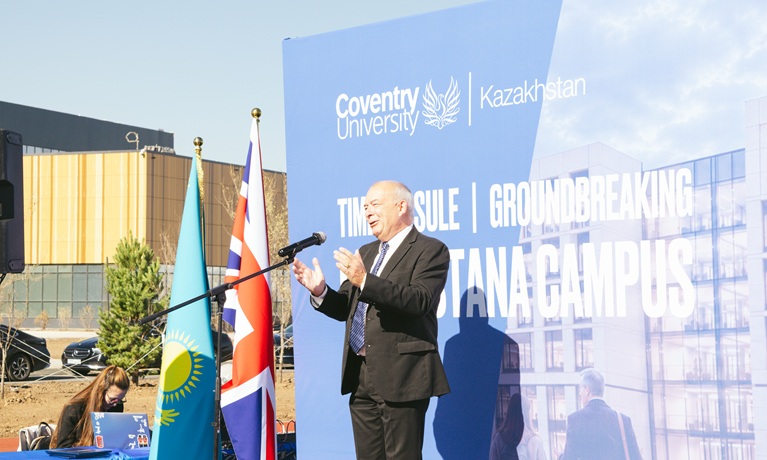
Professor John Latham CBE at the groundbreaking event in Astana
University news / Opinion
Thursday 24 September 2026
Press contact
Following the opening of Coventry University Kazakhstan’s second campus in Almaty, Vice-Chancellor and Group CEO, Professor John Latham CBE, reflects on the Coventry University Group’s global journey and what the latest expansion tells us about the importance of transnational education.
As a result of the financial challenges still sweeping through the higher education sector, many British universities are now viewing transnational education as a vital new source of revenue.
The UK Government, while limiting the opportunities for students to come here, is encouraging universities to establish campuses abroad to diversify income and widen access to our world-class education.
Yet while financial pressures may be a catalyst for the sector, this is not new territory for us.
Driven by the ethos that knowledge should be shared and enriched across borders and cultures, as well as a robust belief in the value of international collaboration, we have been building our global presence for years.
By establishing hubs, campuses and partnerships across continents, we have developed a multi-location approach that allows us to continue broadening and reimagining where and how we deliver education. And though we have not been immune to the challenges of the sector, they have certainly reinforced the immense value of what we have built overseas so far – and fuelled our determination to take our expansion further and faster.
Teaching students overseas
A key reason we chose to establish campuses outside of the UK was the recognition that talent and potential exist all around the world. Many students who want or would benefit from a UK education cannot relocate here because of the financial, practical and personal challenges involved.
Having campuses in international students' home countries allows us to bring our education directly to them, enabling them to gain a UK-accredited qualification closer to home while developing the knowledge and skills needed by their own economies.
Working with delivery partners we know and trust is an important part of how we operate internationally, giving us the local knowledge and established relationships we need to navigate new markets successfully and ensure our overseas campuses reflect the needs of the students, employers and economies in which they operate.
Our success in Kazakhstan’s capital
Almost two years ago, we became the first UK university to open a campus in Kazakhstan’s capital – Astana – and the success we have seen since then has led to a second campus in the same country for the very first time.
We have once again collaborated with our partner, Primus Education LLP, to deliver this new campus in the southern city of Almaty, replicating the proven model behind the success of our Astana campus and ensuring students can expect the same high standards of education and facilities.
As Kazakhstan’s capital and the base for the country’s government and many major businesses and institutions, including the Astana International Financial Centre (AIFC), our campus in Astana enables more students across Kazakhstan and neighbouring countries to study in a city where many of the decisions determining the country’s economy and future are made - and where international business and investment is expanding.
The growth of the AIFC, which was established to develop financial services and attract international investment and now has more than 4,900 companies from over 90 countries registered there, demonstrates the international business and investment now taking place in Astana, creating a need for more skilled people who understand global markets.
As we do in every country where we operate, we have aligned our education with Kazakhstan’s economic priorities, working closely with local partners to understand the skills their economies need and embedding vocational and technical elements throughout our curriculum. As business, finance and international relations are fundamental to the city’s growth, we offer courses in these areas so that our students develop the knowledge and skills that are both necessary and relevant to the economy they will be contributing to.
Creating more opportunities in Almaty
Demand from students across Central Asia continues to grow and we have responded by creating more opportunities: first through scholarships in Business and Computer Science and more recently by expanding our Astana campus and opening a new campus in Almaty.
Almaty, the country’s largest city, is experiencing a boom in technology and entrepreneurship, with growing numbers of start-ups, fintech businesses and research and development activity. Its advantageous location in Asia enables close economic ties with nearby countries such as China and Uzbekistan.
The students joining us will be developing their skills in a city where businesses work across regional and international markets, while preparing for careers in some of Almaty’s fastest-growing industries, including artificial intelligence, construction and engineering.
As these industries expand and evolve, the city will need more highly skilled and educated professionals who can adapt quickly and contribute to their future development. As we have done in Astana and at our other overseas campuses, we’ve tailored our undergraduate and postgraduate provision to reflect where Almaty’s economy is heading, offering courses in areas such as Electronic Engineering, Architectural Technology and Robotics and Intelligent Automation - developing the skills and knowledge graduates will need to take these industries forward.
The future ahead
What started as an ambition to educate 3,500 students in Kazakhstan has now grown to 5,000 - enabling us to reach thousands more learners across Kazakhstan and Central Asia and equip them with the knowledge and skills to make positive impacts in their economies, industries and communities.