Search
New ‘Smart Sock’ to detect and prevent diabetic foot syndrome being created by a Coventry University led research consortium
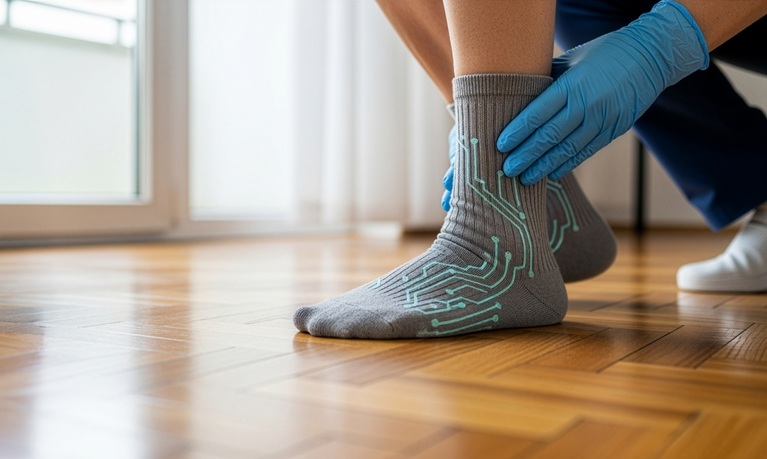
A 'smart sock' to help diabetes sufferers could be created by a Coventry University-led project (stock image)
University news / Research news / Sustainability, Clean Growth and Manufacturing
Tuesday 16 June 2026
Press contact
Coventry University is leading a project to create a ‘Smart Sock’ to help detect and potentially prevent diabetic foot complications.
Diabetic foot syndrome remains a major global health challenge, driven by the growing prevalence of diabetes and the associated loss of sensation in patients’ feet caused by nerve damage and poor circulation.
Researchers behind the STAND project – Sensing Textiles enabled with Advanced Novel materials for Diabetic foot care – want to design and develop a wearable system that continuously monitors key indicators such as pressure, temperature and humidity. By combining advanced materials, flexible electronics and data analysis, the Smart Sock will be able to detect early signs of risk supporting timely intervention and reducing the likelihood of ulcers and complications.
Machine learning and explainable data models will help turn continuous sensor readings into meaningful risk signals for both patients and clinicians.
Led by Coventry University’s Research Centre for Manufacturing and Materials and the Research Centre for Arts and Creative Cultures, the three-year project brings together partners from across Europe including UK-based Printed Electronics Ltd, Istanbul Technical University in Turkiye, Łukasiewicz-Łódzki Instytut Technologiczny in Poland and Sensing Tex, Instituto Tecnológico de Aragón (ITA) and Instituto de Investigación Sanitaria Aragón, all based in Spain, and is funded by the European Union.
STAND is a truly collaborative effort bringing together expertise from across Europe in materials science, textiles, electronics, human-centred design and clinical research.
By combining these strengths we aim to develop a practical, user-friendly solution that can support earlier detection of diabetic foot complications and ultimately improve patient outcomes.
Professor Andrew Cobley, the project’s Principal Investigator from the Research Centre for Manufacturing and Materials
STAND will use low-impact materials and design principles to ensure it has a reduced environmental footprint and improved recyclability, as well as looking to strengthen Europe’s leadership in smart textiles and wearable health technologies, opening new opportunities for industry and contributing to more efficient and proactive healthcare systems.
--
The project is funded by the European Union.