Search
Coventry University creative projects given international recognition
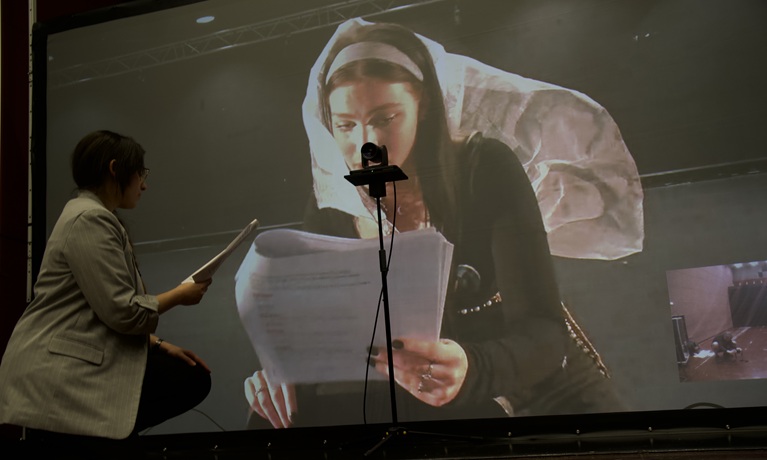
Students taking part in the Shakespeare Remote project
University news / Research news / Creative and Cultural Industries
Monday 19 October 2026
Press contact
Two Coventry University projects that stretch across a number of countries have been recognised for their global impact and presence.
Shakespeare Remote and Frugal Artist-in-Residence (FAiR) have both been shortlisted in the QS Reimagine Education Awards 2026, which received more than 2,200 submissions from around the world.
FAiR is shortlisted for the Sustainability Education Action award, while Shakespeare Remote is among the runners in the Learning Design Excellence category.
Shakespeare Remote
Shakespeare Remote – which has also been shortlisted for International Collaboration of the Year at the Times Higher Education Awards 2026 – was developed through Coventry University’s Acting for Stage and Screen course. The project uses immersive telepresence technology to create the illusion that actors separated by thousands of miles are sharing the same stage.
The design innovation lies not simply in the technology but in the learning experience built around it. Students rehearse remotely as a single international ensemble before coming together for a final week of in-person rehearsals and performances. This approach enables sustained international collaboration while challenging students to develop the communication, adaptability and ensemble skills needed to create theatre across geographical, linguistic and cultural boundaries.
Over the past decade Shakespeare Remote has involved 247 students from institutions across six countries; the UK, Finland, Sweden, Poland, the USA and Spain.
Since 2024, collaborations with L'Escola Superior d'Art Dramàtic de les Illes Balears (ESADIB) in Mallorca have introduced bilingual English-Catalan performances, with neither language taking precedence. Rather than simply learning about cultural differences, students must actively negotiate them through the shared process of rehearsal and performance, developing new ways to communicate and collaborate while engaging with Mallorca’s distinctive language and cultural identity.
The project with ESADIB was previously named as Study Abroad and Exchange Experience of the Year at the PIEoneer Awards.
Frugal Artist-in-Residence (FAiR)
FAiR originated within Coventry University’s Research Centre for Arts and Creative Cultures and has developed through interdisciplinary collaboration including the University’s College of the Arts and Society.
Developed with communities in Sarawak, Malaysia, and then extended through work with schools and communities in Coventry, FAiR uses playful and creative activities including mural-making and environmental storytelling, using recycled and natural materials to connect scientific research with local knowledge, creativity and environmental stewardship.
A willow sculpture of a frog created with Earlsdon Primary School as part of FAiR recently won a silver medal from the UNESCO Associated Schools Network. Pupils chose the theme of life cycles and were inspired by watching tadpoles turn into frogs at the school pond.
Caption: The frog sculpture created with pupils at Earlsdon Primary School
Although the two projects are very different, both demonstrate how creative practice can provide a testing ground for new approaches to education, collaboration and engagement.
While one has grown through interdisciplinary research and community co-creation and the other through international performer training, both reflect a wider culture of experimentation.
Rather than innovation being defined by a particular technology or methodology, the projects demonstrate different ways in which creative disciplines can explore new forms of learning and collaboration: connecting students across countries and languages, bringing researchers and communities together, combining artistic and scientific perspectives, and creating environments in which students of different age groups can experiment, negotiate and learn through doing.
Shaun Hides, Academic Dean of the College of the Arts and Society at Coventry University
Find out more about Coventry University's College of the Arts and Society.