Search
Adult Nursing BSc (Hons) with foundation year
Study level: UndergraduateProfessionally Accredited Programmes

This degree combines theoretical and practice-based learning to lead you to professional registration and a rewarding career as an adult nurse.
Course features
Course option
Year of entry
Location
CU Scarborough (Scarborough)
Study mode
Full-time
Duration
4 years full-time
UCAS codes
B7DF
Start date
September 2027
November 2027
January 2028
March 2028
Course overview
Adult nurses work to improve people’s lives by offering comprehensive physical, emotional, mental and social support to people of all ages. This course aims to equip you with the knowledge, skills and behaviours required to independently address the diverse health and care needs of individuals across the lifespan.
- Successful completion of this course makes you eligible to apply for professional registration as an Adult Nurse with the Nursing & Midwifery Council (NMC) (please see Accreditation section for more information).
- Gain the skills to deliver professional, impactful, evidence-informed care across a range of dynamic and diverse healthcare environments.
- Learn to collaborate and thrive as an adult nurse across and within multidisciplinary teams to coordinate safe, evidenced-based care delivery.
- Study one module at a time, with five weeks of learning followed by one week of assessment per module.
- All eligible students on this course can apply for a minimum payment from the government of £5,000 per year, with additional payments for students incurring childcare costs6. This funding is not available for the foundation year of this course.
- 50% of your learning will take place in diverse practice-based learning environments where you will apply your theoretical knowledge to the real world2,5.
Why you should study this course
If you are compassionate, enthusiastic and committed, we can support you in developing the skills to deliver professional, evidence-informed care that truly impacts people’s lives.
If you are compassionate, enthusiastic and committed, we can support you in developing the skills to deliver professional, evidence-informed care that truly impacts people’s lives.
- Our approach supports you to develop a strong sense of professional identity and accountability as an adult nurse from day one.
- Develop your confidence and skills in preparation to lead, influence and supervise others.
- Delivered by a team that includes highly skilled, knowledgeable, nursing and allied health professionals.
- Develop your digital fluency, curiosity, critical and reflective thinking.
- Study in our campus which includes a clinical skills space for realistic scenarios.
- Access to success coaches, placement supervisors and specialist support for mathematics and academic writing4.
Studying nursing at CU Scarborough
Gain the skills and experience to transform lives, communities and the future of healthcare delivery. We aim to empower you to become a stand-out healthcare professional, capable, competent and confident in your field and role within the wider healthcare team.
While continuously developing your sense of professional identity as an adult nurse from day one, you'll learn in an environment that puts inclusivity, diversity and dignity at its heart.
Joint 10th
for Nursing
The Times and Sunday Times Good University Guide 2027
Accreditation and professional recognition
Nursing and Midwifery Council
The Adult Nursing BSc (Hons) programme is approved by the Nursing & Midwifery Council (NMC) for the 2027-28 intake.1
CU Scarborough celebrates success of Nursing graduates
87 per cent of 2024 Nursing graduates secured employment locally before they even graduated.
Find out more about this achievement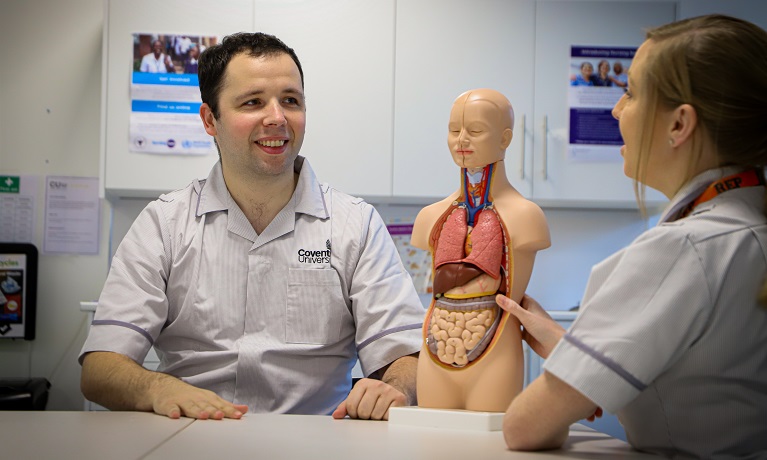
What you'll study
You will cover:
- practical skills relating to assessing and caring for people in your care
- evidence-based care
- your role and responsibility as an adult nurse
- knowledge and skills to maintain the health and wellbeing of others
- leadership and working within the multi-disciplinary team.
We regularly review our course content to keep it relevant and current for our students. Consequently, we may update modules to reflect the latest industry standards.
How you'll learn
Entry requirements
Typical entry requirements:
Got higher grades? Have you considered direct entry to the degree without foundation year?
Fees and funding
Foundation year
| Student | Full-time | Part-time |
|---|---|---|
| UK, Ireland*, Channel Islands or Isle of Man | £10,050 | Not available |
| International/EU | Not currently available*** | Not available |
Degree
| Student | Full-time | Part-time |
|---|---|---|
| UK, Ireland*, Channel Islands or Isle of Man | £10,050 per year | Not available |
A non-repayable grant of £5,000 and extra payments worth up to £3,000 may be available to eligible home students for each year of degree study6. Read more about this in th NHS Learning Support Fund information booklet. This funding is not available for the foundation year of this course.
For advice and guidance on tuition fees and student loans visit our Undergraduate Finance page and see The University’s Tuition Fee and Refund Terms and Conditions.
The University will charge the tuition fees that are stated in the table above for the first Academic Year of study. The University will review tuition fees each year. For UK (home) students, if Parliament permits an increase in tuition fees, the university may increase fees for each subsequent year of study in line with any such changes. Note that any increase is expected to be in line with the Retail Price Index (RPI), a UK measure of inflation that tracks changes in the cost of living.
For international students, we may increase fees each year, but such increases will be no more than 5% above inflation. If you defer your course start date or have to extend your studies beyond the normal duration of the course (e.g. to repeat a year or resit examinations) you may be charged the tuition fees in force at the time you take that additional period of study, and/or in line with any legislative changes that apply at that time.
Tuition fees cover the cost of your teaching, assessments, facilities and support services. There may be additional costs not covered by this fee such as accommodation and living costs, recommended reading books, stationery, printing and re-assessments should you need them. Find out what's included in your tuition costs.
Applies to degree only
The following are additional costs not included in the tuition fees:
- Any optional overseas field trips or visits: £400+ per trip.
- Any costs associated with securing, attending or completing a placement (whether in the UK or abroad) which may include costs of travel, accommodation, equipment or uniform required for the placement and any visa-related costs.
Foundation year funding
To secure funding for a degree with a foundation year, you must complete the full four-year programme. If you do not finish the entire course, including the integrated foundation year, you may have to pay the foundation year fees yourself. For further information, please refer to the 'Tuition Fee Loan' details in the 'Funding your undergraduate course' section of our 'Fees and finance' page.
*Irish student fees
The rights of Irish residents to study in the UK are preserved under the Common Travel Area arrangement. If you are an Irish student and meet the residency criteria, you can study in England, pay the same level of tuition fees as English students and utilise the Tuition Fee Loan.
**This degree with foundation year is not currently available to international students who require a student visa to study in the UK.
How do you know if you need to pay UK or international tuition fees?
Facilities
Our campus building is designed with your needs in mind4.
As nursing students, you'll have the opportunity to:
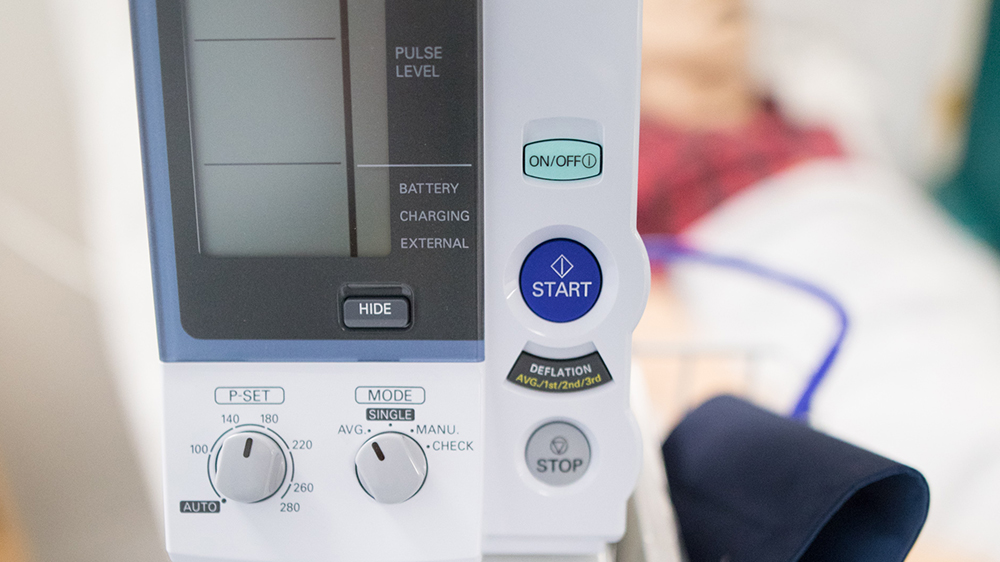
- make use of our simulation facilities - from basic life support manikins to high-tech simulation manikins, which emulate patient responses and test resuscitation skills
- use equipment found in the real world of practice, such as medical devices
- assist with all elements of care, including medication administration.
This is designed to help you to build your confidence before you go on placement.
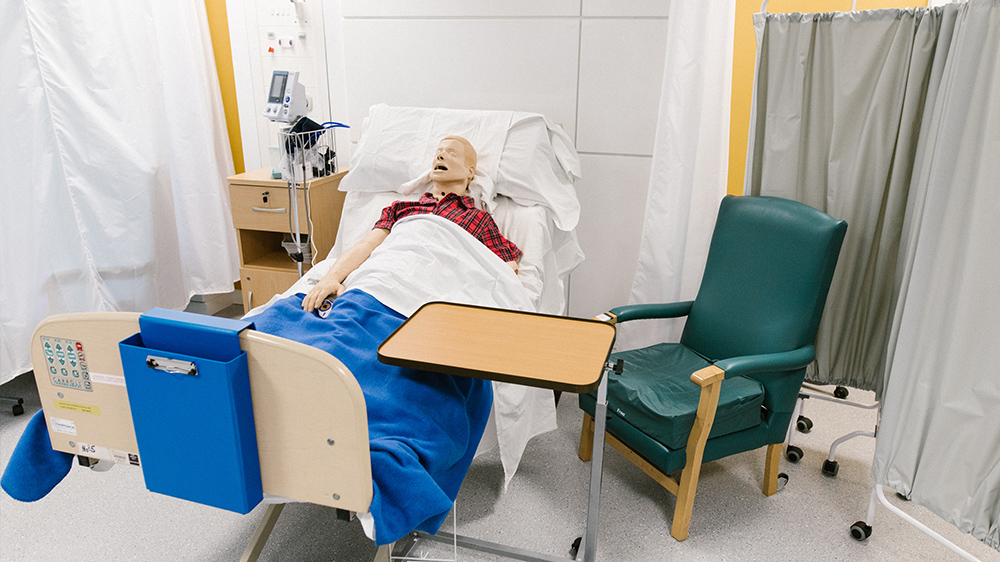
Mock hospital ward
Gaining experience using simulation across a range of care settings. The aim is to:
- build your confidence and knowledge
- prepare you for how to act in real-world situations
- enable you to practice and develop your clinical and interpersonal skills in a safe but realistic environment.
Realistic scenarios
We may use actors to enhance your experience. This gives you the opportunity to replicate real-life situations. For instance, breaking bad news, demonstrating emotional resilience, and dealing with conflict and aggression.
Facilities on campus
Our purpose built campus building is arranged around an open central atrium and also includes:
- indoor social spaces, including a café
- a library that includes loan laptops and a silent study area
- open-access computers
- a prayer room
- student support and careers advice teams
- free on-site student parking
- public bus stops close to the campus
- free WiFi.
The campus itself is located next to Scarborough’s Sports Village, a complex that includes an Olympic Legacy swimming pool, sports hall, fitness suite, all-weather pitches, and the Scarborough Athletic Club Football ground.
The campus is just a 10-minute walk from the stunning Yorkshire seafront. North Bay is Scarborough’s Blue Flag beach, meaning it is one of the best in Europe for cleanliness, both on the sand and in the water, for facilities, and safety.

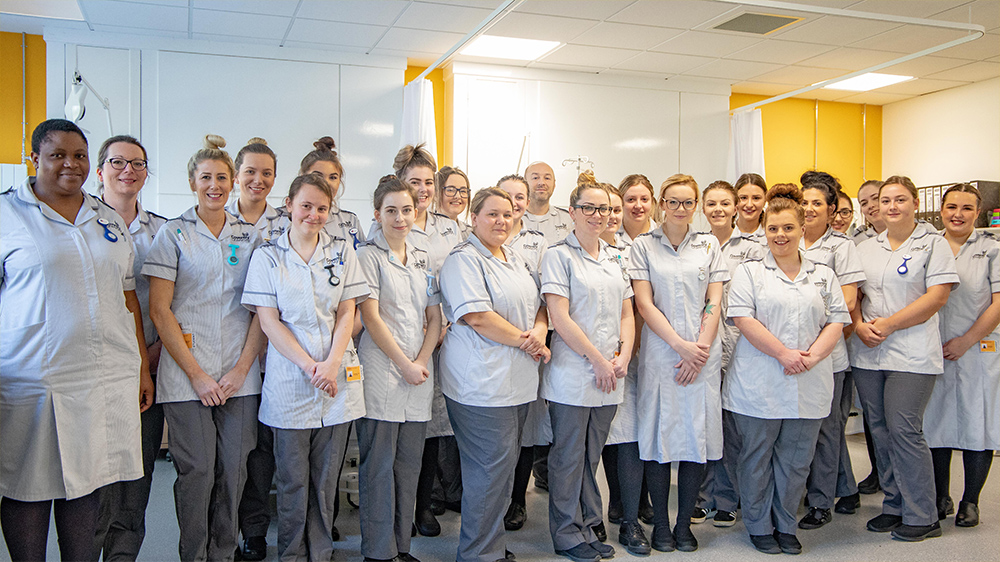
You’ll use facilities through timetabled teaching, practical activities and relevant independent study. Access may vary by module, activity, capacity, supervision or safety requirements. Access may change or be limited where the University needs to follow public authority guidance, decisions or orders.
Careers and opportunities
On graduating successfully from this course, and providing you also meet the NMC requirements, you can apply for registration with the Nursing & Midwifery Council (NMC), additional costs apply1. Successful registration enables you to practise immediately.
CU Scarborough is committed to preparing you for your future career and aims to give you a competitive edge in the graduate job market. We offer a range of support services to help you plan and prepare for your career.
There is a real shortage of qualified nurses across the North Yorkshire Coast and nationally, meaning that there is a demand for graduates in the sector.
Where our graduates work
Many of our graduates find employment as qualified nurses in the NHS with a growing emphasis on community settings, in acute hospitals, military nursing, in the private and independent healthcare sector, in private hospitals, nursing or care homes. As your career progresses a number of options may open up to you, such as a lecturer or specialist practitioner, advanced nurse practitioner, consultant nurse or manager.
How to apply
This course with foundation year is not available to international students.
UK students
Disclaimers
You may also like
CU Scarborough (Scarborough)